
27 September 2026, 08:37
Loading...
Germany’s battery storage boom: The largest projects

Jakub Malý
2 December 2025, 06:16
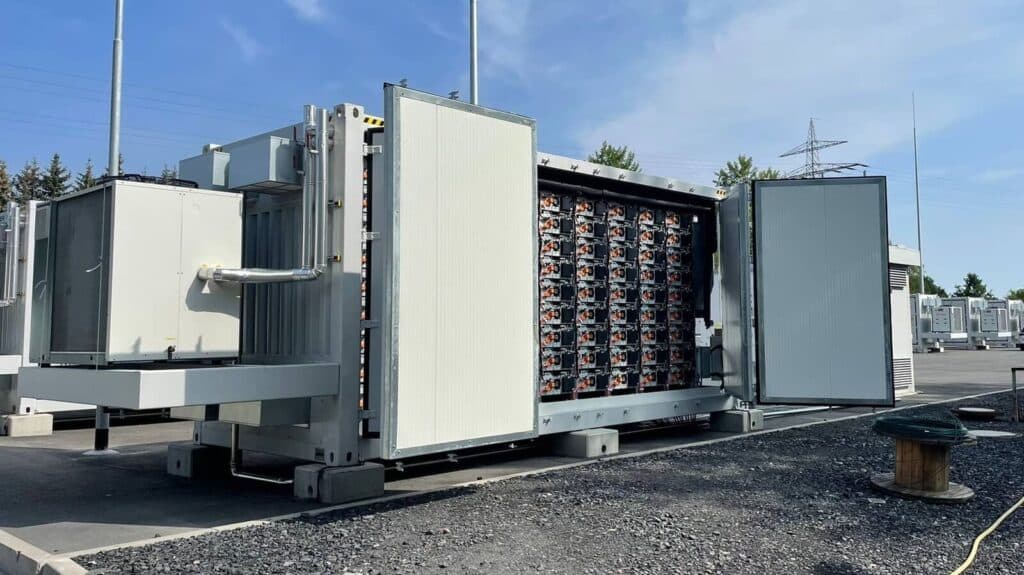
The German market for stationary battery energy storage systems (BESS) is entering a new phase of rapid expansion. This article presents the largest projects that have already reached a final investment decision (FiD).
A ranking of the five largest BESS projects in Germany by capacity can be compiled from publicly confirmed projects. These projects represent not only different approaches to technology, but also different types of investors.
The five largest German BESS projects (with FiD):
1) Gigabattery Jänschwalde 1000 – 1 000 MW / 4 000 MWh
Europe’s largest battery storage facility is being built by the LEAG Group in Jänschwalde as part of the broader transformation of the former coal-mining region of Lusatia. With an installed capacity of 1 000 MW and energy storage capacity of 4 000 MWh, the project pushes the boundaries of what is considered standard in the European context. Commissioning is expected in 2027/2028.
2) Förderstedt – 300 MW / 714 MWh
Developer ECO STOR GmbH is implementing a project in Förderstedt that is technologically notable for its in-house integration of batteries based on BYD solutions. Its 714 MWh capacity places it among Germany’s largest projects managed purely by a developer. It is scheduled to be commissioned in 2028.
3) Grundremmingen – 400 MW / 700 MWh
RWE is building one of the largest storage projects in its portfolio at the site of the former Grundremmingen nuclear power plant. The 400 MW / 700 MWh facility will serve as a key source of flexibility in southern Germany. Although the technology supplier has not been disclosed, an integration model similar to RWE’s other projects, using CATL cells, can be assumed. Commissioning is planned for 2028.
4) Röhrsdorf – 100 MW / 400 MWh
The Röhrsdorf project, implemented by LichtBlick, is one of the first storage facilities of this size in Saxony. The 100 MW / 400 MWh battery system is due to enter operation in 2027 and will help stabilise the grid in Saxony.
5) Alfeld – 137,5 MW / 282 MWh
Developer Kyon Energy is preparing a project in Alfeld which, unlike the preceding projects, relies on Saft (TotalEnergies) technology. At 282 MWh, it is the smallest of the five largest projects, but represents an important milestone for Kyon, which will join the major players in the German energy storage market through this project. Commissioning is planned for 2026.
Germany is clearly on track to become Europe’s most significant market for stationary energy storage. Projects with capacities of 300–1 000 MW, which only a few years ago appeared to be hypothetical visions, are now genuinely progressing through investment processes and will be commissioned before 2029.
For Central Europe, this is a clear signal that energy storage is becoming an integral part of energy systems and that the future will require addressing not only new capacity, but also the integration of large storage facilities into tariff, regulatory and investment frameworks. The Czech Republic is also preparing a number of battery storage facilities, with some already in operation.
Translation disclaimer
This article is a machine translation of the Czech original and has not yet been fully reviewed. In case of any doubt, please refer to the Czech version.
Sdílejte článek prostřednictvím:
You might also like
26 September 2026, 13:54
26 September 2026, 07:42
25 September 2026, 11:17
25 September 2026, 09:51