9 October 2026, 06:22
Loading...
Billions apportioned: eight major Czech coal-region projects already have grants, doubts over some
Ekonews.cz
20 May 2024, 15:22
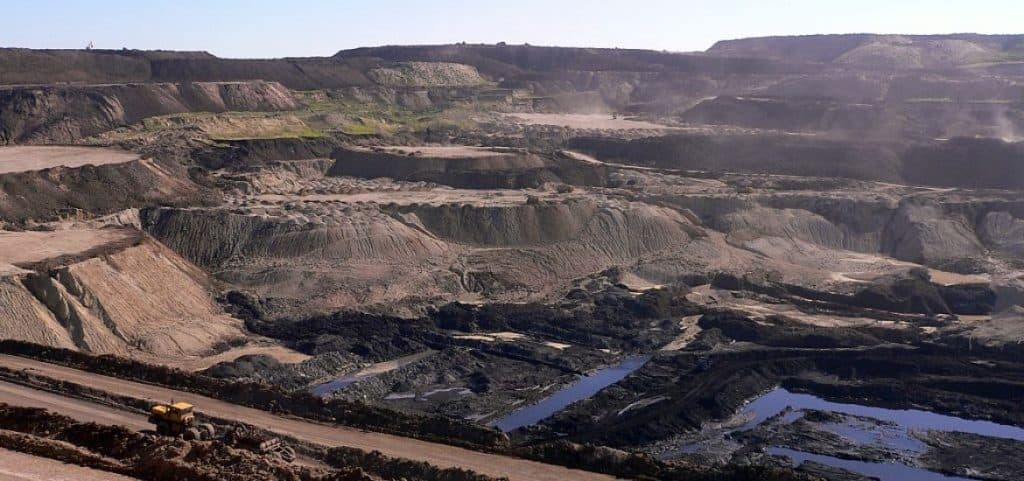
Eight projects and nearly nine billion koruna in grants. That is the current state of funding allocations to help coal regions. A further 23 projects, including some raising doubts, are awaiting approval. Officials will decide on the allocation of roughly eleven billion within less than two months.
In total, roughly forty billion koruna is at stake, to be directed from the Just Transition Operational Programme to the Moravian-Silesian, Ústí and Karlovy Vary regions. The money is intended to help the three regions transition from coal to a more sustainable development model.
Roughly half of that amount is earmarked for major strategic projects. The largest share, 18.9 billion koruna, is for the Moravian-Silesian Region, followed by 15.8 billion for the Ústí Region and 6.3 billion for the Karlovy Vary Region. An equal amount will then be distributed among smaller thematic calls or umbrella projects.
Northern Moravia has so far been the most successful in its applications. According to available information, seven projects out of thirteen submitted applications have already passed the approval process, amounting to eight billion koruna.
Funding has been awarded to the Black Cube, LERCO (Ostrava University Research Centre), the Centre for Business, Professional and International Studies (CEPIS), Poho Park Gabriela, Refresh (Centre for Research into Energy and Social Change), the Technology and Business Academy, and the Centre for Public Energy Experts.
Projects raising questions
The Black Cube in the Moravian-Silesian Region is a typical project that has been sitting in a drawer. Such projects had the best chance, as their authors had only one month in 2022 to submit projects to the regions for assessment. The Cube's first proposal dates back to 2007 and has changed significantly since then. According to people monitoring its development, what has remained is its name, the building's shape and its number of floors. It is no longer intended to be merely a scientific library, but a centre for digitalisation, science and innovation with a budget of 2.6 billion, of which grants account for 1.65 billion koruna.
Other projects still on the waiting list also raise doubts. One example is Eden, large-capacity greenhouses which, according to their authors, should not be called greenhouses because they are an “educational and scientific research complex where educational and research activities will be carried out”. The project is backed by the Silesian University, which drew inspiration from a similar project in England.
However, it is already clear – as regional representatives have confirmed – that the project will operate at a loss and will therefore need support from the regional or another budget. Approval has so far stalled over this, as it would constitute state aid requiring EU approval. “In the case of Eden, it has not yet been possible to find an existing state-aid framework,” Petr Valdman, director of the State Environmental Fund, said at an April press conference.
Expensive plasma
Another project with an uncertain return is Podolupark in northern Moravia. Under the project, PDI, led by entrepreneur Grisch Kahlen, is seeking a grant for waste plasma gasification technology. Kahlen has been working on and seeking to promote the technology in Czechia for more than twenty years under the umbrella of various companies. The technology is meant to consume waste on one side and produce hydrogen on the other. This time, the project is in Karviná, with ties to some local politicians.
However, the technology has yet to work on an industrial scale and commercial basis, either in Czechia or anywhere else in the world. Projects have generally ended after the pilot phase. Examples include those of Solena Group, with which Kahlen also previously worked, in the United Kingdom and California. Plasma gasification, which is essentially incineration at very high temperatures, is highly energy-intensive and therefore expensive.
Approvals are moving more slowly on the Czech side
In the Ústí Region, nine applications have been submitted, but so far only the Ústí Region Transformation Centre, worth just under one billion koruna, has been successfully approved. The Karlovy Vary Region has submitted nine applications, with no result so far.
The applicants also include the polluters themselves, raising the question of whether they should receive grants to restore land after coal mining. One example is the Green Mine project to revitalise and reintegrate the ČSA mine, which belongs to Pavel Tykač's Sev.en Group. Similarly, in the Karlovy Vary Region, there is a project by Sokolovská uhelná.
The Do No Significant Harm and Polluter Pays principles should apply. “If we are talking about energy recovery from waste, or about a mining company receiving funding for an area after mining, then we need to ask whether this goes against that principle and how we interpret it. We need to think in context: I polluted, I made money from this activity, should I ask taxpayers for more money so that I can build something again on my own land? And what should it be, and how will people benefit from it?” said Zuzana Vondrová, who has worked on the transformation of coal regions for six years at the non-profit Centre for Transport and Energy.
“Support is not for miners”
This should be assessed by evaluators based on feasibility studies prepared by grant applicants. Jan Kříž, director general of the environmental economics section at the Ministry of the Environment, rejected claims at an April press conference that the support would go to large companies.
“It is not for miners, that is not true,” he said, presenting pie charts showing that the largest share of funding for strategic projects – almost ten billion koruna – will go to universities. The private sector is to receive 6.6 billion koruna.
A decision on all applications submitted so far is due by mid-year. However, the ministry is already declaring that financial support for the transformation of coal regions must continue after 2027. At a recent EU Council meeting, Environment Minister Hladík called on other member states to join the Karlovy Vary Declaration, which was created last year with this aim.
“It received a positive response. I believe the programme will continue after 2027; the transition of coal regions onto the path of decarbonisation is time-consuming and financially demanding, and it cannot be fully implemented within a single programming period,” the minister adds.
Republished from the online portal EkoNews.cz, a website covering business and sustainability.
Translation disclaimer
This article is a machine translation of the Czech original and has not yet been fully reviewed. In case of any doubt, please refer to the Czech version.
Sdílejte článek prostřednictvím:
You might also like

8 October 2026, 10:05