9 October 2026, 06:22
Loading...
Czech coal-region transformation expert: We lack information on whether money will go where it should
Ekonews.cz
21 August 2023, 13:52
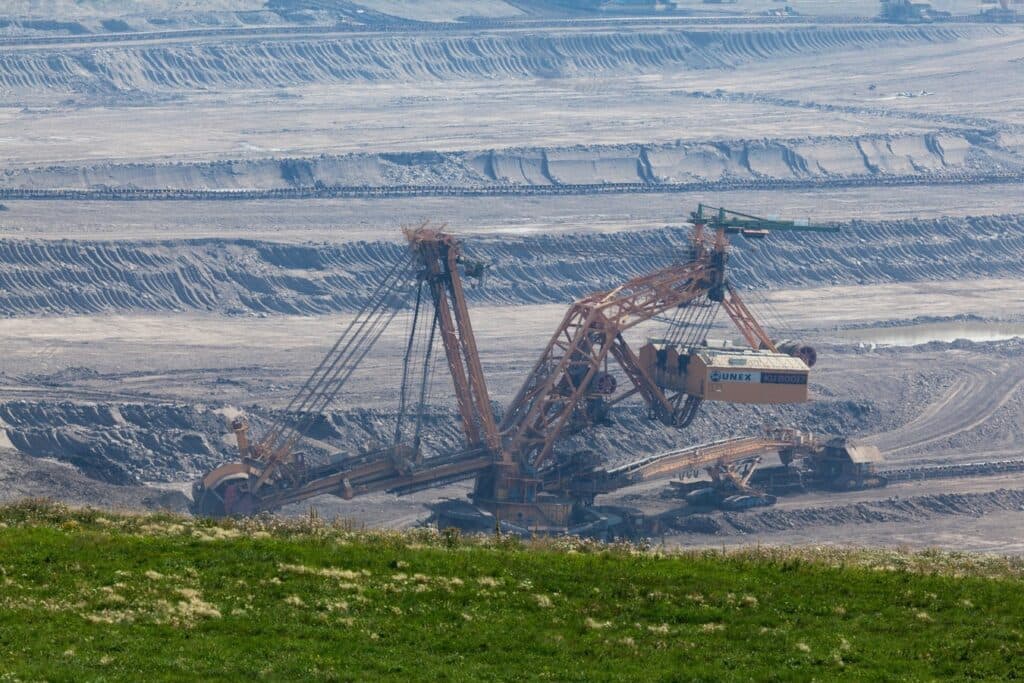
More than CZK 40 billion is set to go towards transforming coal regions, with half earmarked for huge projects worth billions. A website containing information about them now exists, but according to Zuzana Vondrová of the Centre for Transport and Energy, there is still too little information. We do not even know who will decide on them or on what basis.
“I would consider it transparent if it were stated somewhere how it will be ensured that evaluators are impartial, or according to what criteria they are selected and how many there should be,” says Zuzana Vondrová, who has worked on the transformation of coal regions for five years at the non-governmental non-profit organisation Centre for Transport and Energy.
She is a member of the committee monitoring the allocation of the funds, yet she has no access to the feasibility studies, which are meant to contain the most important information on each project’s benefits for the region. “When I sought access to the feasibility studies, or to make them available to mayors working in those regions, I was told that as a member of the monitoring committee, it was not my role to assess or obtain the feasibility studies. So I can comment on the process and technicalities, but not on the content,” she says.
Could you summarise your main criticisms of how the process of allocating money under the Just Transition Fund has proceeded so far?
We very much welcomed the Just Transition Fund. Not only because long-neglected coal regions need to be compensated and their mining debt repaid, but also because meaningful investment needs to be kick-started. The European Commission also asked us to reflect on the whole issue. A condition for the fund was the creation of a Just Territorial Transition Plan, which was supposed to describe how we want to approach decarbonisation. It is all a very good idea, but implementation has encountered a number of issues we disagree with.
Such as?
First, we are not taking a strategic approach to the transformation. Ideally, it should involve gathering input from people living in these places and working with it when considering how to reshape the region. More specific strategies would then be developed, followed by individual projects. Czechia did exactly the opposite with the Just Territorial Transition Plan, and moreover involved local people only minimally. We came up with strategic projects relatively early in the planning of the Just Transition Fund, while political decisions, such as when we want to end coal mining, were made only at the end.
What were the other problems?
A lack of transparency. At the outset, the problem was that we were not receiving information we considered important. It was only when colleagues from Transparency International used the freedom of information law that they compiled a range of documents. A website now exists with plenty of documents and information, but it still lacks a great deal of material specifically on strategic projects. Then there is the problem of insufficient public engagement, or of not allowing the public to act as an active watchdog and raise comments.
Is there then a document that sets out precisely what the goal is, what direction the regions should take and what we want to achieve?
There is RE:START – the government-approved Programme for the Restructuring of Structurally Affected Regions. It was created in 2015 and defines what needs to be addressed. Again, a good idea with an unsatisfactory outcome.
In what respect?
We objected to the fact that the only way the public could have a say in the programme was by submitting an online form with suggestions and comments and entering their name. That was insufficient, and we hoped that the Just Territorial Transition Plan, which is an annex to the programme document, would provide an opportunity during the two years it was being developed to gather input from the public. But that did not happen.
I have been reading the Just Transition website. It always gives the basics of a project, but it is not clear what stage it is at. All one learns is that feasibility studies are under way, which I find unclear.
Yes, I agree. Very important decisions, especially concerning strategic projects, were made at the beginning, around two years ago. At that time, decisions were taken on whether strategic projects would exist, the methodology for selecting them, and so on. Those important decisions are continuing to shape events to this day, and the process is very complicated. For example, the assessment of feasibility studies for strategic projects is a lengthy process with around nine steps. The problem is that only the evaluating bodies have access to the feasibility studies: the State Environmental Fund, the Regional Standing Conferences and others. Yet these studies contain crucial information, such as the benefit for the region undergoing transformation, the environmental impact of the technologies used, or the socioeconomic impact. But there is one further issue I consider important with strategic projects.
What is that?
If we look at the Just Transition Fund through the eyes of someone assessing whether the funds are being drawn down and will be fully used, large projects may seem efficient. A smaller number of projects are created for huge amounts of money. By contrast, creating a large number of smaller calls for a large number of applicants would require more work and time, which we do not have. That is the crux of the problem.
For strategic projects, there was roughly a month for applicants to come forward, which is not much. In other words, only huge, ready-made projects pulled from a drawer could apply…
Exactly. Those who were prepared had a major advantage. Mayors, associations of mayors or smaller entities, for example, do not have the capacity to respond immediately. Larger companies and universities, on the other hand, do – and I have nothing against universities drawing from the fund. It is then reflected in their degree of preparedness, and projects sitting in drawers have a chance to be pulled out.
From the perspective of using up the funds, that will probably be “good”, because strategic projects usually involve billions…
Yes, strategic projects are by nature large. Another factor that to some extent limited smaller entities was the minimum cost threshold. For strategic projects, it is CZK 200 million for investment projects and CZK 50 million for non-investment projects.
Has nothing moved forward regarding the feasibility studies? Is it not known precisely who will assess them…
It is clear which institutions are to be involved – the State Environmental Fund, with the Regional Standing Conferences playing a significant role, and the Jaspers advisory group, which comprises experts mandated by the European Union. There is also an interministerial expert group, which is to include ministry representatives, and other evaluators about whom we know little. I see no progress here. I would consider it transparent if it were stated somewhere how it will be ensured that evaluators are impartial, or according to what criteria they are selected and how many there should be.
Is there a deadline for the feasibility studies?
Strategic projects can apply for funding until the end of the year. However, specific projects were already pre-selected by regional authorities and Regional Standing Conferences on the basis of preliminary feasibility studies and recommended as projects that could succeed. They thus made it onto the list before the formal call was launched. The call is now under way, and applicants on the project list can apply. If an applicant withdraws or fails in the assessment process, it remains to be seen what will happen next with the money and its allocation. I assume the percentage allocation of CZK 41 billion among the regions should remain valid.
At this stage, can anything still be corrected or improved in your view? Strategic projects are meant to use roughly half of the planned amount, so is there still scope in the other half…
That is the assumption currently being worked with. I do not have access to the feasibility studies, even though I am a member of the monitoring committee, where the non-governmental and non-profit sector has two representatives among roughly fifty members. When I sought access to the feasibility studies, or to make them available to mayors working in those regions, I was told that as a member of the monitoring committee, it was not my role to assess or obtain the feasibility studies. So I can comment on the process and technicalities, but not on the content.
As for European Commission oversight, it is invited to and forms part of the monitoring committees. Major reversals are therefore unlikely.
What powers does the monitoring committee actually have?
The committee is to monitor matters and check whether the operational programme is being implemented properly. For example, whether it contributes to achieving a goal – in this case, a coal phase-out that is beneficial for the regions.
Were the European Union’s requirements clearly defined?
They are defined in the regulation establishing the fund, which is a binding document. The European Commission also gave member states feedback on what it thought of draft versions of the plans. It strongly emphasised the involvement of a broad range of affected stakeholders, saying this should occur at all levels – not only in allocating money, but also in the preparation and implementation of the fund and subsequent monitoring. It was also important to the Commission that we be specific about decarbonisation: what we want to do with coal and how we want to phase down coal-fired assets. One priority is diversifying the economy in individual regions, mainly by supporting small and medium-sized enterprises. The European Commission is therefore to ensure that large companies are only an exceptional case and that smaller businesses are supported instead.
So how should it ideally proceed?
The improvements we propose are based on experience abroad. Decarbonisation has proved successful where it has ambitious targets and smooth organisation without ad hoc decisions. There are also many examples where involving people has worked and benefited the process. Preparation is important, but so is the political courage to state what the end of coal should look like. Participation is an important matter. To obtain input, we need to involve people. That is the democratic element of the entire process. If we do not map all the important stakeholders and involve the public, a lack of trust emerges and many people lose interest.
How can the public be involved – directly or through mayors?
Naturally, the public cannot be involved everywhere, for example in meetings of the monitoring committee. But there are many ways to gather input, work with it and discuss matters with local people so that ideas can be realised. Regional authorities played a prominent role in the monitoring committee and the Transformation Platform. However, the lower level – mayors and municipalities – was poorly represented. Yet they are indispensable to the planning process, because they know the problems of a given locality, its history and context, and the owners of land that could be important for the transformation. Without them, it is questionable whether actual needs will translate into specific calls and financial instruments, and whether those needs will be met.
Returning to the total amount of money, should the other half of the CZK 41 billion be allocated through calls for smaller projects?
Yes, the other half of the fund is divided into smaller calls. There is a structure of thematic working groups under the Ministry of the Environment, including a working group on the circular economy. There are ten thematic groups. Unfortunately, none deals primarily with social issues.
In what specific way?
For example, the only social-policy expert on the monitoring committee is a representative of the Ministry of Labour and Social Affairs; there is no expert on socially excluded areas, inclusion or education. Social instability is a major issue for coal regions. We are now also dealing with an energy crisis, with major problems of energy poverty and digital poverty, and tens of thousands of people living in socially excluded areas who face serious difficulties. If we do not address the problems of the most vulnerable, it is difficult to move the transformation forward. That is why it is important to involve relevant experts.
Certainly. All three regions have very similar problems in terms of the highest level of education attained, with a great many people having only primary education. They have socially excluded areas and face problems with debt traps and energy poverty. There is certainly scope for this in the Just Transition Fund, and I see great potential in education, for example.
Are there countries showing that a region can be successfully transformed?
There are, but one has to look carefully. In Germany’s Ruhr region, for example, I saw a completely different approach to education and to finding pathways for a given region. This coal region has several universities, and they work with research centres and companies on various projects. Such broader cooperation can create interesting jobs and kick-start a region that becomes attractive even to students from abroad.
Since you mention universities and education, the Moravian-Silesian Region has several strategic projects for research centres and universities. But sometimes it seems merely declaratory, and it also seems easy to obtain a grant for something like that, because then research can be conducted for an awfully long time while its practical application remains a big question.
You are certainly right. A lot of money can be spent very poorly. In the Ruhr region, they want a business entity interested in the particular innovation, and participating with a commercial interest, to be involved from the very inception of specific research projects. Research is then not created simply for research’s sake, but is already linked to the creation of new jobs and so on.
Among the known strategic projects, are there any that you believe should not be there?
The European Union has defined the “polluter pays” principle and the Do No Significant Harm principle. These are two established principles, but they are often interpreted rather vaguely. When you extract minerals somewhere in Czechia, you pay the state for extraction and must subsequently restore the land to a condition acceptable to the authorities. But it is a major question whether it runs counter to the principle if, after extraction, I restore the land at my own expense to an acceptable condition and then apply for money to do something extra there. In my view it does, but this needs to be set out somewhere, and that is a very complicated matter.
This article is part of the series Where will the billions intended for the end of coal go?, supported by the Independent Journalism Foundation Fund.Republished from the online portal EkoNews.cz, a website covering business and sustainability.
Translation disclaimer
This article is a machine translation of the Czech original and has not yet been fully reviewed. In case of any doubt, please refer to the Czech version.
Sdílejte článek prostřednictvím:
You might also like
8 October 2026, 10:05