3 October 2026, 13:01
Loading...
High operating costs, not government deadlines, driving European coal exit

Martin Voříšek
31 August 2023, 08:10
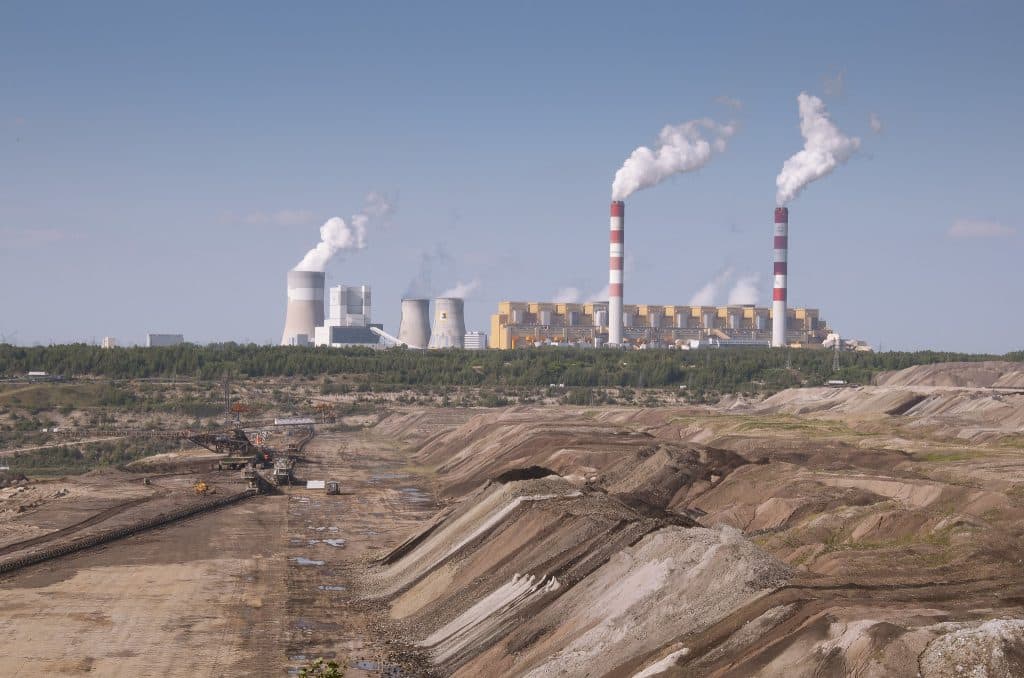
Coal-fired power generation in some European Union countries is likely to end for economic reasons rather than because of government commitments pledging a coal phase-out by a certain date. For example, Polish utility PGE recently announced that it would exit coal ten years earlier than the deadline set by the government. A similar situation could also arise in the Czech Republic.
The European Union has long planned to phase out coal, and although it has no specific date for ending coal combustion, the EU's climate commitments will likely require this no later than the end of 2050. By that date, the European Union is to achieve climate neutrality.
As a result of climate commitments, coal-fired power producers are burdened far more by the costs associated with burning coal than by government-set deadlines for ending its use.
A similar situation is currently occurring in Poland. The Polish government has set 2049 as the date for its coal phase-out. Although this is the latest coal phase-out date among all European Union member states, the late deadline has its justification. Poland relies on coal for more than 60% of its electricity generation.
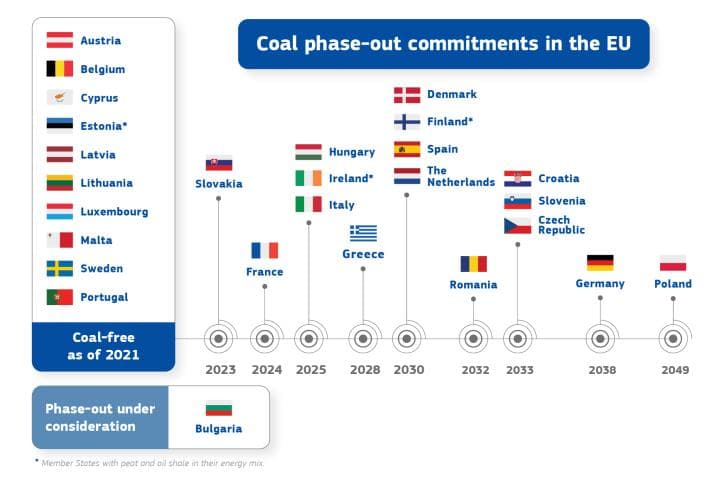
Coal phase-out dates of individual European Union member states. Source: European Commission
However, Poland's largest energy company, PGE, sees the coal phase-out differently. High operating costs of coal-fired assets have forced the company to update its corporate strategy. PGE will pay as much as PLN 26 bn (roughly CZK 140 bn) in carbon emission costs this year alone. Under the new strategy, the company is to become carbon-neutral as early as 2040.
Instead, PGE wants to focus on renewables, energy efficiency and the provision of modern energy services. The company's targets are fairly ambitious. By 2030, PGE wants to have 2.5 GW of offshore wind power and, by 2040, also 2.8 GW of installed capacity at nuclear power plants.
However, the Polish government quickly spoke out against an accelerated coal phase-out. It criticised PGE for planning to exit coal earlier than the government-set deadline of 2049.
"The Ministry of State Assets expects the government's energy policy to be implemented in practice by all energy companies with state ownership, which will also be reflected in their strategies and investment activities," Reuters quoted the ministry as saying.
The 2049 deadline for ending coal was agreed in Poland with trade unions. A substantial share of jobs in Poland is linked to the coal sector, and the government therefore cannot afford to accelerate the coal phase-out.
The Czech Republic plans to end coal use in 2033, but it could be earlier
The Czech government plans to end the use of coal in the energy sector in 2033. This deadline is to be included in the currently prepared update of the State Energy Policy, which should be approved by the government by the end of the year.
The Ministry of Industry and Trade has so far published only the basis for the State Energy Policy. The section entitled "Strategic objectives and indicators in the area of sustainability" states, among other things:
"Reduce the share of fossil fuels (used without carbon capture technology) in primary energy consumption to 50% by 2030 and 0% by 2050, and completely phase out the use of coal for electricity and heat generation by 2033."
However, there is still no political consensus on 2033. As the iRozhlas.cz website pointed out, a number of politicians from the five-party coalition disagree with this date and would prefer a later deadline.
Czech energy companies, however, view the matter differently. For example, Sev.En (through its owner) told the SeznamZpravy.cz website that coal generation "will probably cease to pay off as early as 2025. 2026 will clearly be loss-making, while 2027 already looks like an absolute catastrophe for our coal business". Semi-state-owned ČEZ also did not rule out closing its power plants if they become loss-making.
Translation disclaimer
This article is a machine translation of the Czech original and has not yet been fully reviewed. In case of any doubt, please refer to the Czech version.
Sdílejte článek prostřednictvím:
You might also like
3 October 2026, 07:43

2 October 2026, 21:55

2 October 2026, 15:14