9 October 2026, 06:22
Loading...
First Czech solar car parks emerge. They are more expensive than photovoltaic plants, but there is interest in them
Ekonews.cz
15 April 2024, 13:09
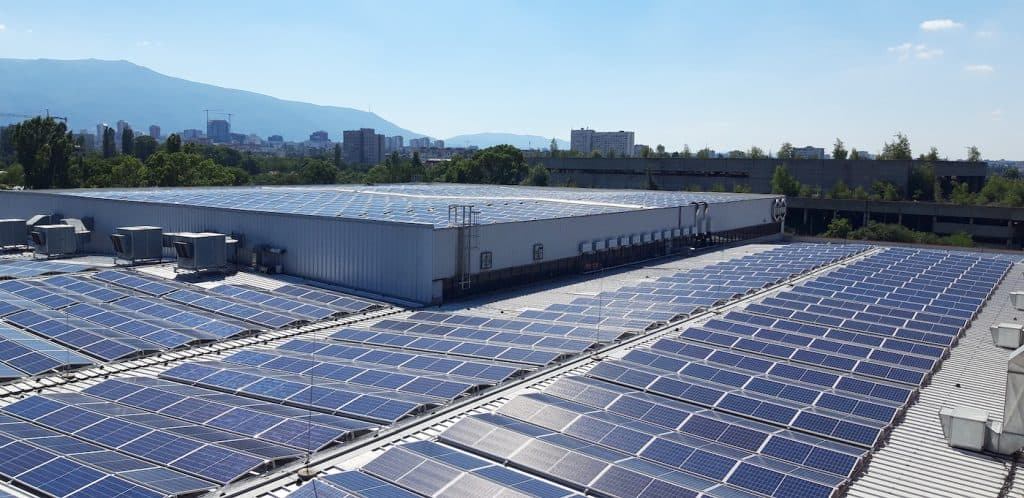
In France and Germany, the law requires that part of a car park be fitted with photovoltaic panels. In Czechia, solar car parks, or carports, are being planned at airports, hotels and warehouses. “We have several initial installations under discussion in Czechia,” says Aleš Damm, director of Czech company Greenbuddies Charging, which specialises in photovoltaic power plants combined with car parks.
Photovoltaic panels are installed on canopies beneath which cars are parked. They not only generate electricity, but also protect cars from the weather. The largest Czech photovoltaic installation covering a car park is operated by ČEZ directly at the Dukovany Nuclear Power Plant. In its first year of operation, it exceeded the originally expected amount of energy generated. The second-largest solar car park is being built at Česká zbrojovka.
Other solar trends, according to him, include large photovoltaic installations on landfill sites or slim-profile panels, which are lightweight and can also be installed on older roofs that would not support a conventional photovoltaic power plant..
You have the first solar carport projects under discussion in Czechia. Who is interested in them?
Czechs are looking into who offers what in this field. This segment is still new compared with conventional photovoltaics, whether rooftop or ground-mounted. As these projects in Czechia are at the negotiation stage, I cannot disclose specific company names. However, I can say that we have no demand from state or municipal institutions; these are exclusively corporate customers.
They are mostly manufacturers and, in one case, the operator of a commercial car park near Prague. They also include logistics sites with large parking areas that do not want them to serve just one purpose, namely parking cars. In Austria – and I think this will soon become a trend in Czechia too – spas and hotels with adjacent car parks that can be used for this purpose are interested, for example. Any locations where people park for at least several hours or several days are suitable for solar carports supplemented with electric vehicle chargers. Football stadiums, airports and similar locations are ideal, for example. At all such places, it is possible to build a canopy, install photovoltaics on it and add chargers.
Can you say more about the companies you are negotiating with?
They are manufacturers in the automotive sector or their suppliers. One company we are in talks with focuses on components for future electric mobility. Here in Czechia, we are also negotiating with the operator of a public car park near an airport, which is even considering adding battery storage so it can offer electric vehicle charging to its customers.
Quite often, they are subsidiaries of larger foreign companies. They have certain obligations under European Union legislation and ESG reporting. For them, a carport is an important tool for reducing emissions directly on their own premises. In Germany, for example, one of the world’s major e-commerce companies is among our potential customers. However, so far we have completed carports only abroad; for example, we built Austria’s largest carport at the thermal spa in the town of Lutzmannsburg, with around 450 parking spaces.
Does electricity from these carports go into the grid, or is it used to charge parked electric vehicles?
Both are possible. The canopies are not built primarily to charge electric vehicles from them, although chargers are very often part of the installation. The primary purpose is photovoltaics as such – they are mainly built so that the car park area can be used to generate electricity. It is essentially conventional photovoltaics, but instead of being on a roof, it is on an elevated structure above a car park. In addition, the canopies protect cars and their occupants from adverse weather conditions.
Must the structure meet specific requirements?
There are several types of carports. We are currently building an aluminium variant in Austria, which is among the less costly options. It can be mounted on ground screws because the structure is lightweight. There is no need for complex concrete foundations. Installing a large carport is essentially a construction project and is subject to a range of fire safety, building, structural and other rules in the given country.
Is it more costly to put solar panels on a roof or on a carport?
In terms of costs, it is simpler and cheaper to put them on a roof. However, the roof must meet certain requirements in terms of structural strength and it must be taken into account that it will bear the load. But the choice is not either-or; it can easily be both, ideally both a rooftop photovoltaic power plant and a solar carport.
How much more expensive are carports than conventional photovoltaic panels on roofs, and is that an obstacle for companies considering them?
Carports are approximately 40 percent more expensive because the supporting structure beneath them includes a certain amount of material. In addition, all the engineering work involved is more demanding than for roofs. However, this is truly only an approximate figure. It is like asking how much a car costs. It depends on many characteristics and circumstances surrounding the installation. Costs and economics are the issue companies consider most when it comes to carport installations. However, some do not pay much attention to that.
What, then, is a company’s motivation for acquiring a solar carport when it is more expensive than rooftop panels?
It is often another usable space alongside the roof, and a carport also protects the cars, people or goods beneath it. We have a customer that stores cable drums and wants to keep them covered. So it makes sense for them. Last but not least, for some customers it is still a matter of prestige. If you have a large spa with a hotel, such as the complex in Burgenland, Austria, such a solar carport catches the eye from a distance and looks modern and attractive.
Are subsidies available for acquiring carports?
Yes, solar carports and potentially batteries are eligible for exactly the same subsidies as conventional photovoltaic panels, and companies can draw them, for example, from the Modernisation Fund’s RES+ calls No. 1 or 2, depending on the size of the installation.
What are the other trends in solar development?
Interest in agrivoltaics is steadily increasing. It makes it possible not to take up agricultural land while still using the areas to generate electricity. Floating power plants on water bodies are also a trend, with experienced players heavily involved in this field, including Greenbuddies and ČEZ. Another interesting new form of solar installation is construction on landfill sites. These are areas that could not otherwise be used, or whose remediation would cost too much money. In such cases, it pays to build photovoltaics on them. However, this has its specifics, mainly in anchoring and sizing the supporting structure, and a detailed survey of the subsoil must also be carried out. We have implemented such projects in the Netherlands, Belgium and Austria.
As for brownfields, most recently we built at former quarries in France and the Netherlands, for example near Bovenfeld Forest, or at a former freight railway station in Germany. One of our floating installations is located in a flooded quarry.
Another trend is the significant expansion in the range of roof types on which panels can be installed. Previously, we were limited by the material; supporting structures had to be drilled in, and care had to be taken to ensure roofs did not leak water, and so on. Today, ballast systems are used on a range of more delicate surfaces on flat roofs, which simply put means adding weight, for example with a prefabricated concrete block. In addition, roofs that could previously not be used because of their structural strength can now be used because we can place lighter, slim-profile panels on them, which is also new. Interest in photovoltaics is not declining, so it can be assumed that these evolutionary steps will continue in the future.
Are there already panels that can be installed on a historic house and approved by heritage authorities?
Yes, solar tiles now exist, although this solution is not yet very widespread in Czechia. Everything has its pros and cons. While a tile looks historic, it has a much smaller surface area than panels, so many more connections are needed and greater energy losses arise. The efficiency of such photovoltaics is therefore lower. This is also why solar tiles are still mainly being tested by solar enthusiasts.
Republished from EkoNews.cz, a website covering business and sustainability.
Translation disclaimer
This article is a machine translation of the Czech original and has not yet been fully reviewed. In case of any doubt, please refer to the Czech version.
Sdílejte článek prostřednictvím:
You might also like

8 October 2026, 10:05