9 October 2026, 06:22
Loading...
Solar power plants on more than 150,000 Czech homes; new installations usually include batteries
Ekonews.cz
23 January 2024, 14:03
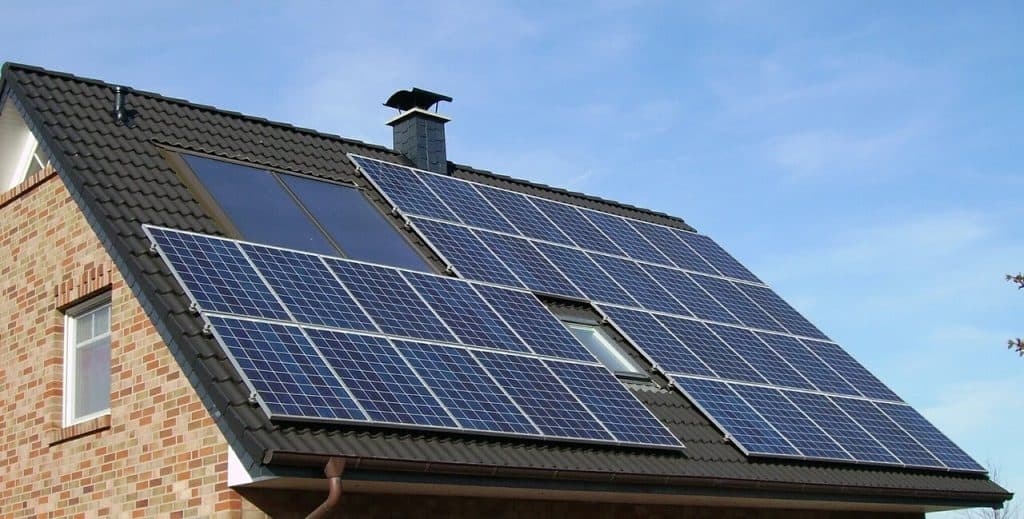
According to distributor data, more than 82,000 new solar power plants with capacity exceeding 970 megawatts were connected to the grid in Czechia last year. Most were acquired by owners of family homes, but a growing number of companies are also building their own solar installations.
Growth was driven mainly by households, which added 820 megawatts. More than 80,000 households installed solar power last year, usually complemented by batteries. Up to 92 percent of solar plant owners in Czechia have batteries, placing the country among global leaders, as Jan Fousek, chairman of the board of the Solar Association, which presented the data, pointed out.
Although several companies, including Malina, FG Energy and Alpha Solar, went bankrupt, the market has stabilised. Waiting times for grid connection have also shortened, and distributors are providing better support to customers. Since last year, for example, their websites have allowed users to view available grid capacity at a given location and whether a plant can be connected. However, high-capacity installations still face grid access problems, according to the Solar Association.
Companies await electricity prices
Interest in their own energy sources also grew among companies last year. In total, they installed more than 2,500 plants with combined capacity of around 140 megawatts.
New plants were built on production halls, shopping centres and office buildings. Examples include a commercial complex in Hodkovice nad Mohelkou near Liberec and the agricultural company Agro Sedlice in the Strakonice region, which have installed their own solar panels.
This year, companies, together with municipalities and their contributory organisations, can apply for funding from the Modernisation Fund. Four programmes will be launched for them, the last two of which are aimed at municipalities and larger entities such as regions.
By contrast, solar parks are being built slowly in Czechia. Last year, only 25 larger installations with capacity exceeding one megawatt were built, with combined capacity reaching 67 megawatts. At present, only 1.4 percent of them have their own batteries.
“If we want to tap the potential of solar energy in Czechia and, above all, prepare for the very real scenario that coal-fired power plants will be shut down earlier than expected, we must speed up the construction of solar parks,” warns Jan Krčmář, executive director of the Solar Association.
According to the Solar Association, the current pace is the result of lengthy approval and grid connection processes. Several large projects have even been put on hold pending developments in electricity prices. Conversely, the construction of new plants could be supported this year by subsidies from the Modernisation Fund and, above all, by the adoption of the legislation needed to launch agrivoltaics, combining crop cultivation with energy production.
“We could find ourselves in a situation where coal-fired power plants are no longer profitable for their operators, while new nuclear units have not yet been built. Without sufficient renewable sources, electricity in Czechia will be significantly more expensive than in neighbouring countries,” Krčmář argues, explaining why the development of large projects is important according to the Solar Association.
A third from renewable sources
The total capacity of all solar power plants in Czechia now reaches 3,500 megawatts. Nearly 170,000 plants feed electricity into the grid, more than four-fifths of which are on the roofs of family homes—around 150,000 in total. Despite the growth, however, Czechia trails some of its neighbours. Austria, of a similar size, installed solar capacity totalling 2,200 megawatts last year alone. Poland built plants with capacity of 4,600 megawatts last year.
The Solar Association outlined three different possible development scenarios. The realistic scenario assumes that Czechia could achieve annual additions of 1,750 megawatts by 2030. However, this depends mainly on how quickly barriers related to project approval and subsequent grid connection are removed.
The current government’s plans envisage the continued addition of new solar power plants. By the end of the decade, their total capacity in Czechia should increase by at least 10,000 megawatts. This follows from a plan for the gradual reduction of emissions prepared last year by the Ministry of the Environment together with the Ministry of Industry and Trade.
Hundreds of turbines to be added
The National Energy and Climate Plan envisages ending coal burning in 2033, while other fossil fuels are to be phased out in 2050. They are to be replaced mainly by nuclear power and energy from the sun and wind. By 2030, the share of renewable sources should therefore rise from around 18 percent today to 30 percent.
According to government calculations, meeting the target will require increasing solar capacity by the aforementioned 10,000 megawatts and installing at least another 1,500 megawatts of wind power capacity. Hundreds of new turbines will thus appear in the Czech landscape.
“Trends show that we are capable of meeting the 2030 target. However, a key condition is the sensible use of the funds Czechia receives from the sale of emissions allowances,” says Environment Minister Petr Hladík (KDU-ČSL). Funding for new sources should come from the Modernisation Fund, from which Czechia could draw up to CZK 500 billion.
The European Commission considers Czech plans for the use of “green” sources insufficient. In its view, Czechia should achieve at least a 33 percent share of renewables in total consumption over the next six years for the Union as a whole to meet its 42.5 percent target. The government must submit the final version of the National Energy and Climate Plan by June this year.
Republished from the online portal EkoNews.cz, a website covering business and sustainability.
Translation disclaimer
This article is a machine translation of the Czech original and has not yet been fully reviewed. In case of any doubt, please refer to the Czech version.
Sdílejte článek prostřednictvím:
You might also like
8 October 2026, 10:05