9 October 2026, 06:22
Loading...
First vineyards and raspberry bushes to be paired with solar panels as agrivoltaics comes to Czechia
Ekonews.cz
18 June 2024, 14:20
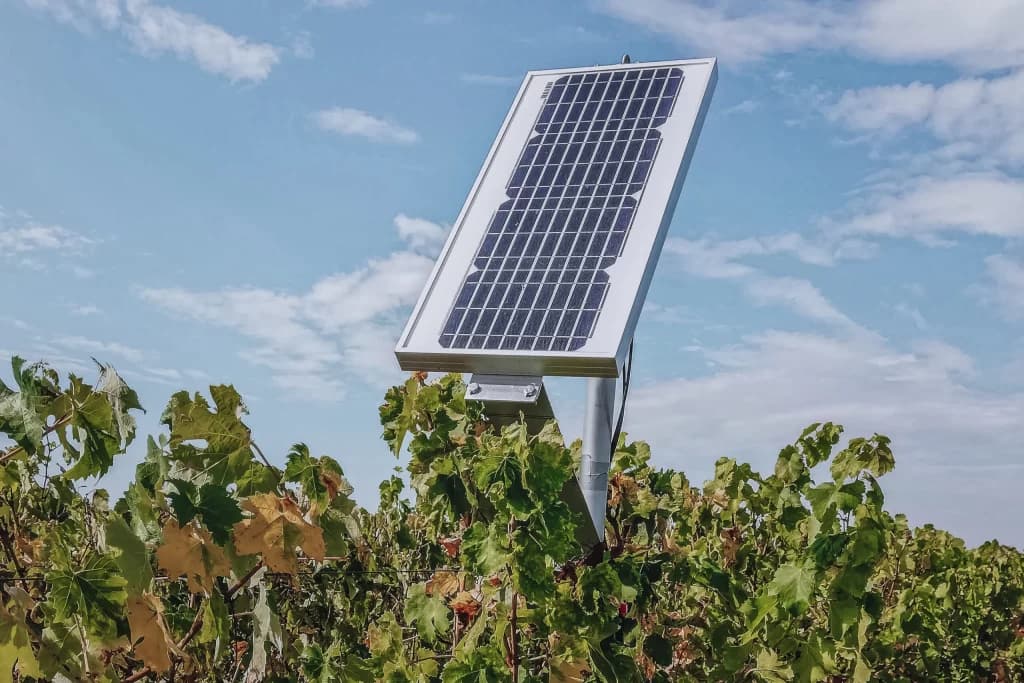
Solar panels may soon appear above vineyards, hop gardens and orchards. Agrivoltaics could help reduce costs or protect certain crops from direct sunlight.
At the end of May, senators approved an amendment to the Agricultural Land Fund Protection Act, which will allow electricity generation and crop cultivation to be combined, known as agrivoltaics. It could therefore get under way as early as July, if the ministries prepare the relevant implementing decrees. Electricity is already generated in this way in the US, China and other European Union countries.
Thanks to the amendment, most of the paperwork previously required for panels on agricultural land will no longer be needed. Orchards or hop gardens will no longer have to be removed from the agricultural land fund, meaning applicants will not have to pay levies. However, approval from the agricultural land fund protection authority will be required. Depending on the size of the plot, permits will have to be issued by a municipality with extended powers. Another positive development for farmers or other investors is that there will be no need to amend the local development plan or demonstrate compatibility with the character of the area.
“In a month, we should have one of the highest-quality legislative frameworks for agrivoltaics in the EU in the Czech Republic. If we want to preserve the competitiveness of the Czech agricultural, energy and industrial sectors, we need to take this tool into account and make use of it,” Jiří Bím, head of the agrivoltaics section and guarantor at the Solar Association, said at the recent Solar energy and storage conference in the Czech Republic, describing the amendment.
In Czechia, the new combination is being tested in Prague-Suchdol, for example. At the Czech University of Life Sciences Prague, raspberries are being grown while electricity is generated at the same time. In the municipality of Zavidov near Rakovník in Central Bohemia, biodiversity strips are being supplemented with vertical agrivoltaics intended to support local biodiversity.
Another project is a vineyard in Starý Poddvorov in South Moravia. Winegrowers are cultivating Rhine Riesling and Donauriesling varieties at the site of energy company MND. The company had to plant the vineyard on a brownfield site precisely because otherwise it would have had to remove the vineyard from the agricultural land fund.
Orchards are declining
Agrivoltaics could give Czech fruit growing a new boost. Over the past two years, around 2,500 hectares of orchards have disappeared in Czechia, Vlastimil Zedek of the Ministry of Agriculture said at the conference mentioned above. “The possibility of using agrivoltaics will provide a certain incentive for fruit growers or investors who want to engage in fruit cultivation, so that these crops can expand again to higher levels,” he added. Dual income from crops and the energy produced could increase stability for farmers.
His words were also confirmed by Martin Ludvík, chairman of the Czech Fruit Growers’ Union. “The Czech Republic is dependent on fruit imports, and the area of orchards has declined significantly and dramatically over the past ten years. This is mainly due to the poor profitability of fruit growing, strong competition from neighbouring Poland, the oligopolistic behaviour of retail chains and labour shortages, as well as climate change,” he explained.
According to Czech Fruit Growers’ Union figures, there are currently around 11,000 hectares of fruit orchards in Czechia. These are operated by 600 to 800 farms. “Many fruit growers have switched to arable farming, which is far more characteristic of the Czech Republic, namely growing cereals and oilseeds,” Ludvík added.
Fruit growing is generally very energy-intensive. Energy accounts for a substantial part of costs. Fruit growers usually have to process the fruit themselves, handling sorting, packaging and the subsequent production of juices, dried fruit or purées.
A great deal of energy is also consumed in storage itself, so that people can buy apples, for example, throughout the year. “You harvest fruit when its temperature is 20 to 25 degrees, and you have to cool it down quickly. In the case of apples, for example, to as low as one degree. You then keep the produce in air-conditioned storage for six to nine months of the year,” the chairman of the Czech Fruit Growers’ Union explains.
Protection against frost
According to Vlastimil Zedek of the Ministry of Agriculture, farmers could be deterred by the complicated maintenance of agrivoltaics or high upfront costs, which he said run into tens of millions of crowns. Another disadvantage may be the potential negative impact on the growth of cultivated crops. “Some crops may not thrive in the shade of solar panels; it is a matter of selection,” Zedek specifies.
Ludvík, chairman of the Czech Fruit Growers’ Union, mentioned, for example, smaller fruit size or poorer colouring. “Today, when you need to produce the highest quality, even the slightest damage relegates fruit to produce intended for processing,” he described the drawbacks. However, agrivoltaics could in turn help suitably selected crops grow. It can protect them from direct sunlight, hail and frost. Unexpectedly low spring temperatures severely damaged fruit growers’ harvests this year.
According to Ludvík, questions remain for fruit growers about how the combination will work in practice. For example, it is important how panels will cope with various plant treatment products and fertilisers. Frequent machinery passes or air temperatures around the panels could also be a problem. It is also important whether pollinators, as well as other beneficial organisms and pests, will have sufficient access to the plants.
Vineyards, orchards and nurseries
The benefits of agrivoltaics were also welcomed by Agriculture Minister Marek Výborný. “I am pleased to see farmers successfully combining innovative and traditional areas of farming so that together they benefit farmers, the national economy and our environment,” he said on the last day of May at an event in Litomyšl called For modern Czechia: new energy for Czech farms begins.
The amendment will be supplemented by a necessary implementing decree, which the Ministry of Agriculture is preparing jointly with the Ministry of the Environment. It will precisely determine the agricultural crops suitable for this type of cultivation. In addition, it will define the necessary technical equipment and other parameters of agrivoltaics. The decree will also regulate rules for both horizontally and vertically installed panels.
Vlastimil Zedek, director of the environmental and organic farming department, outlined the planned decree at the Solar Conference. For the time being, agrivoltaics will be allowed above vineyards, hop gardens, fruit orchards, nurseries or container areas, meaning beneath greenhouses or other covers under which crops are grown. The decree will also propose electricity storage as an additional component.
Permanent crops such as vineyards, hop gardens, orchards and nurseries account for less than three percent of the agricultural land fund, according to Solar Association data, with the remainder consisting of permanent grassland and arable land. For the time being, agrivoltaics will therefore be possible only on a small share of agricultural land.
Republished from the online portal EkoNews.cz, a website covering business and sustainability.
Translation disclaimer
This article is a machine translation of the Czech original and has not yet been fully reviewed. In case of any doubt, please refer to the Czech version.
Sdílejte článek prostřednictvím:
You might also like


8 October 2026, 10:05