
17 October 2026, 13:09
Loading...
Bidding zones under scrutiny: Is Germany's division on the horizon?

David Vobořil
2 May 2025, 11:34
European transmission system operators assessed alternative bidding zone configurations in Europe. While no changes were proposed in the Nordic region, the study identifies specific configurations with economic benefits in Central Europe, including proposals to split Germany's bidding zone. However, according to the study, implementing a change to the current configuration requires more in-depth political and economic assessment. A significant weakness of the study is its use of outdated data.
The European Network of Transmission System Operators for Electricity (ENTSO-E) has published a Bidding Zone Review (BZR) for the 2025 target year.
Bidding zones define areas in which market participants can trade electricity with one another without restrictions imposed by transmission capacity. Under the Regulation on the internal market for electricity, their review is intended to ensure that these zones continue to support an efficient market, the security of the electricity system and the integration of renewable energy sources.
Bidding zone (also known as an offer zone)
is a fundamental element of the European electricity market. The electricity price within a bidding zone is uniform for each trading interval. Trades between bidding zones are limited by available transmission capacity calculated by transmission system operators, while trades within bidding zones are carried out without restrictions. Defining the boundaries of bidding zones is therefore highly significant for the market and requires thorough analysis.
The BZR methodology, established by a decision of the European regulator ACER, assesses alternative bidding zone configurations both on the basis of monetised economic indicators and on the basis of other non-monetised indicators, such as their impact on operational security and market liquidity.
Splitting Germany's bidding zone
In Central Europe, as the region is referred to for the purposes of the study, alternative configurations were analysed for Germany, the Netherlands, France and Italy. In terms of net socioeconomic benefit, calculated as the sum of changes in market welfare and the costs of ensuring operational security, splitting Germany into five zones (DE5) ranked highest, with an estimated benefit of EUR 339 million in 2025.
Redispatch
is a measure taken by a transmission system operator to ensure the secure operation of the system. Instead of the generators originally scheduled to supply electricity to the grid, generators in a different location are dispatched to prevent congestion on elements of the electricity system. These measures are costly, as the original generators must be compensated for being unable to supply electricity to the grid, while the electricity produced by the replacement generators must also be paid for.
Other configurations that split Germany into 2 to 5 bidding zones, and in some cases also divide the Netherlands into 2 zones, showed similar results. By contrast, configurations splitting France and Italy were excluded from further assessment because of their negative economic benefits.
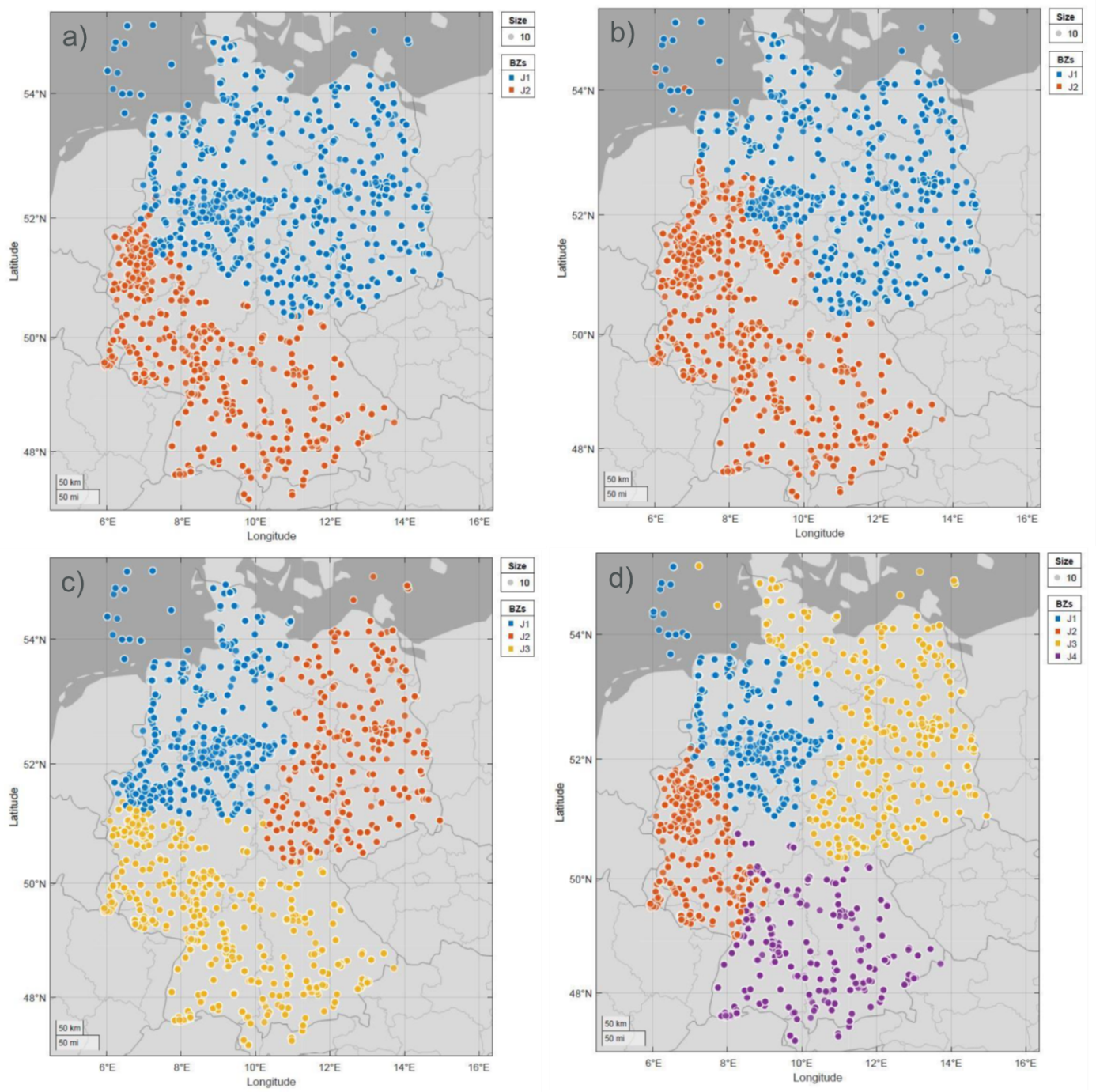
Proposed alternative bidding zone configurations in Germany. Source: ACER
The analysis shows that splitting Germany would have a positive impact by reducing operational security costs, particularly those associated with redispatch, and cutting unscheduled electricity flows between zones, known as loop flows. At the same time, this configuration would reduce market liquidity by fragmenting it across individual zones and increase transaction costs. The costs of implementing the change are estimated at EUR 1.2-2.4 billion, implying a payback period of 4–9 years if it were implemented around 2030.
Lower liquidity is a particular concern for trading in long-term electricity markets, where Germany's bidding zone, thanks to its high liquidity, is used as a trading hub to help electricity market participants hedge against price fluctuations. As a solution, ACER promotes the creation of a so-called virtual hub, intended to concentrate liquidity. However, market participants say its introduction is problematic for many reasons and its results are unclear.
Four configurations involving alternative ways of splitting Sweden were analysed in the Nordic region. The results showed that none of the options would improve economic efficiency compared with the current situation, which already features smaller bidding zones than elsewhere in Europe. Changes in market welfare and redispatch costs were minimal or negative. The study therefore recommends retaining the current configuration.
The results are not sufficient grounds for changing the configuration
Although modelling in Central Europe identified several configurations with economic benefits, the report says the simulation results alone are not a sufficient basis for a decision. Transmission system operators point to the need to consider broader factors, including the outdated input data, expected grid changes by 2030, the impact on markets supporting renewable energy, the distribution of costs among consumers and investment signals.
The data's age appears to be a major shortcoming, particularly given the time required to conduct the study, its overall complexity and its demands on human resources, significantly undermining the value of its findings.
The report serves primarily as an expert basis for decision-making, with the final decision resting with individual member states. According to ENTSO-E, they should consider the study's findings in light of political, regulatory and market impacts.
Member states that decide to change the configuration of bidding zones will have to reach a unanimous decision within six months. If they fail to reach a unanimous decision, the European Commission will make the decision within a further six months, after consulting ACER.
Translation disclaimer
This article is a machine translation of the Czech original and has not yet been fully reviewed. In case of any doubt, please refer to the Czech version.
Sdílejte článek prostřednictvím:
You might also like




16 October 2026, 10:16