25 September 2026, 09:51
Loading...
Billion-koruna investments: Overview of the largest planned battery storage facilities in the Czech Republic

Jakub Malý
11 January 2026, 07:56
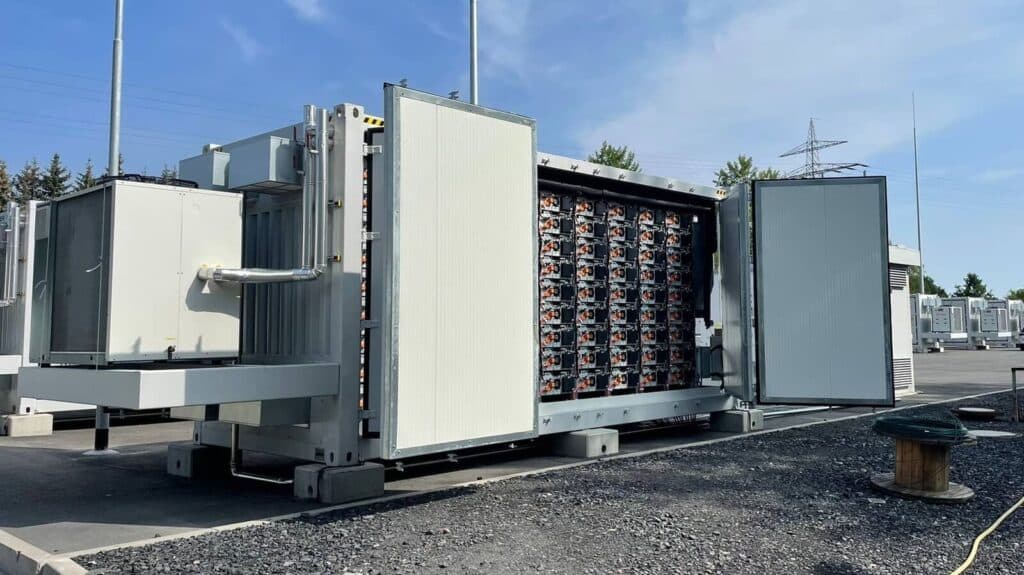
Battery energy storage systems (BESS) are becoming an important pillar of modern power systems in the Czech Republic as well. While installations of up to 10 MWh dominated the market just a few years ago, current investment plans are reaching multiples of those levels and reflect developments in Western Europe.
The drivers of this transformation are not only major energy players, but also independent developers, which see storage as a key element of the new decentralised infrastructure. Battery storage is no longer seen as an add-on to renewable energy sources, but as a standalone asset for ensuring grid flexibility, providing ancillary services and commercial optimisation.
1) ČEZ in the Chomutov region – 270 MW / 970 MWh
The largest project in the history of Czech energy storage is being prepared by the ČEZ Group at a site between Kadaň and Chomutov. The project comprises three separate battery storage facilities linked to a large solar park with a capacity of almost 300 MWp. Total planned storage capacity is up to 970 MWh, with an output of 270 MW. The technology will be based on modular lithium-ion cells. Once completed, it will not only be the largest battery system in the Czech Republic, but also one of the largest in Europe. The project is at the EIA stage and is expected to be commissioned before 2030.
2) Chvaletice power plant (Sev.en) – 115 MW / 230 MWh
The Sev.en Group is planning to build a large standalone battery system at its coal-fired power plant site, with an output of 115 MW and capacity of 230 MWh. The storage facility will provide balancing services and enable commercial arbitrage on the day-ahead and intraday markets. Investment in the Chvaletice “megabattery” will exceed one billion koruna. The project is in the permitting process, with commissioning planned around 2026.
3) Havlíčkův Brod (C-Energy & Jipocar) – up to 120 MW / approx. 240 MWh
A joint venture between C-Energy and Jipocar is preparing to build a storage facility in Mírovka near Havlíčkův Brod. Planned output is 80–120 MW, with approximately twice that capacity. The project builds on C-Energy’s previous experience of operating smaller battery systems and will focus on providing ancillary services. C-Energy is among the pioneers of large-scale storage in the Czech Republic – it already operates batteries in Planá nad Lužnicí and Tábor with a combined capacity of 34 MWh. Commissioning is expected by 2027.
4) Kladno (Sev.en) – 45 MW / 90 MWh
The second major storage facility from the Sev.en Group is being built at the Kladno heating plant site. With a capacity of 90 MWh and an output of 45 MW, the facility will be used both for grid regulation and to optimise electricity purchases and sales. Thanks to the existing infrastructure at the heating plant site, the project is under construction, with commissioning no later than 2026.
5) Modlany (Katemo) – 35 MW / up to 130 MWh
A significant project is being developed by Katemo in an industrial zone near Modlany, close to Teplice. In the first phase (2025), a battery with an output of 35 MW and capacity of 42 MWh will be commissioned, while the second phase (2026) will expand the system to up to 130 MWh. The storage facility will be connected to a 41,8 MWp solar power plant and will use LFP cells from CATL.
Investment interest in large batteries is enormous, both among traditional players and new market entrants. A key impetus was the LEX OZE III legislative package, which removed legal barriers preventing the connection of standalone storage facilities. The practical impact of LEX OZE 3 became apparent almost immediately in 2025, particularly for standalone battery storage, which began appearing en masse in connection applications after storage was established in legislation.
In a short period, distribution system operators began handling thousands of applications, and the published aggregate figures showed an unprecedented scale of “paper” demand for grid capacity: in the ČEZ Distribuce distribution area, applications emerged for reserved capacity of around 150 GW and storage capacity of 311 GWh, while other distribution system operators also recorded dozens of additional GWh.
Translation disclaimer
This article is a machine translation of the Czech original and has not yet been fully reviewed. In case of any doubt, please refer to the Czech version.
Sdílejte článek prostřednictvím:
You might also like

24 September 2026, 11:23
24 September 2026, 10:30
24 September 2026, 06:56