9 October 2026, 06:22
Loading...
Fourteen months with a Czech solar power plant: energy self-sufficient from May to September
Ekonews.cz
18 March 2024, 10:41
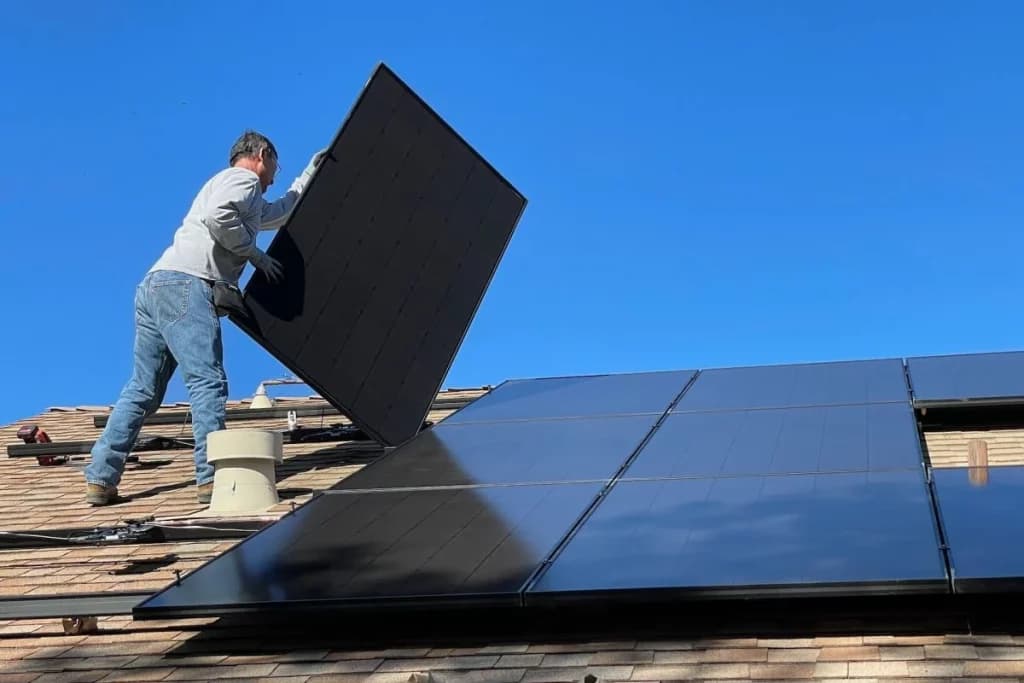
Last year, solar power plants were newly installed on the roofs of 80 thousand family homes, compared with 33 thousand a year earlier. One of them was the home of Otakar Schön, whose system has now been operating for 14 months. How satisfied is he with solar PV, and how much of the family’s annual consumption does the plant cover?
“It's hard to find someone who gets a solar power plant and complains about it. I haven’t met one yet,” says Schön. The only thing he would change is that he would have started building it a year or two earlier. Schön described everything involved in acquiring the system in the book The story of a novice solar owner, published in the Hospodářské noviny series – from choosing a supplier and the need to cover the roof with new roofing to a change in regulations during the process, which ultimately meant fewer panels could fit on the roof.
It was not a short process. Otakar Schön began arranging the solar power plant at the start of 2022, but it was not until just before Christmas that year that the panels on the roof of their home began generating electricity. The installation of the panels and electrical wiring itself took only a day and a half.
The key is to map everything out
Schön began arranging the power plant at the worst possible time due to a combination of circumstances. Energy prices were rising and everyone wanted their own rooftop solar PV system. Demand far exceeding supply created room for a number of unreliable suppliers, who were not easy to identify.
“Supplier lead times were mostly six months to a year, and in the end we changed suppliers as well,” he says. When choosing a supplier, he says it is important to be guided mainly by references, of which fortunately there are far more today than there were two years ago. The size of the company or how long it has been operating on the market can also reveal a great deal.
“At first it was complete chaos. Then the Refsite portal emerged, where there are relatively trustworthy reviews. Although it is not entirely foolproof either, because many companies incentivise customers to write positive reviews,” he reveals. However, it is at least some form of guidance.
Even before choosing a supplier, anyone interested in solar energy should first and foremost map out their electricity consumption, how it changes during the day and year, how energy-intensive their house is, and how often the sun shines on the roof – in other words, how much electricity can be generated there at all, according to Schön. This can usually be established using simple freely available software or apps.
Based on the data obtained in this way, the future solar owner must then decide on the capacity of the rooftop PV panels and whether to invest in a battery as well, and if so, what capacity it should have. Otakar Schön recommends calculating the optimal size of the power plant and battery using available calculators and comparing the result with the funds available. In his experience, the simulations correspond to reality.
A power plant for half a million
Schön decided to purchase a battery to limit the impact of electricity price fluctuations on the market on the family budget. He also has a virtual battery, because he likes certainty. A virtual battery means that surplus electricity generated is “stored” by being sent to the distribution grid. Schön is not paid for it, but can “withdraw” it at any time. He only pays distribution charges and mandatory fees, which account for roughly half of the total electricity price. Typically, the family stores surpluses in summer and uses them in winter.
“Without a battery altogether, we would get only around 32% direct electricity supply from our power plant,” he writes in his book. He originally planned to build a power plant with a capacity of 10 kWp (at the time, this was the maximum threshold below which a licence involving more paperwork was not required, author’s note) and add a battery with a capacity of 10kWh. In the end, however, he had to settle for panels with a capacity of 7 kWp.
The final price for the entire system reached CZK 550 thousand and includes the less common 15-year warranty for the entire power plant. Of this, around CZK 205 thousand was covered by a subsidy.
Thanks to the battery, the family is self-sufficient from May to September in the sense that the electricity generated by the power plant during the day is enough to run the house at night as well. By contrast, the worst months are December and January. In December, the power plant generated enough energy to cover 9% of consumption, while in January it was 25%.
Specifically, over the past year the PV system generated more than seven megawatt-hours, while the consumption of the two-storey family home is roughly five megawatt-hours. At first glance, this may appear to mean the family is fully self-sufficient, but that is not how it can be calculated. “We consume electricity even when the sun is not shining. For most of the year, the battery covers nighttime consumption as well, but it does not cover winter. That is why we have a virtual battery,” he adds.
Virtual battery helps stabilise prices
“I like predictability, which is why we considered a virtual battery from the very beginning. I know exactly how much I will pay in charges,” he explains. Schön did not want to sell surpluses and buy electricity at spot prices because of the risk that prices could rise again, as they did at the start of Russia’s invasion of Ukraine.
Like most families that install solar PV on a family home, Otakar Schön’s family found that it pays to adapt their behaviour to sunshine where possible. “I work from home, so we do the laundry when the sun is shining, dry it when the sun is shining, and turn on the dishwasher when the sun is shining. But it’s not as if we prohibit the children from watching television in the evening or when it is raining,” he says.
The advantage of the appliances mentioned is that their operating times can be scheduled, and they also consume relatively large amounts of energy. Although the situation today differs from 2022, when prices were at their peak, the annual energy savings from the solar power plant are noticeable. Schön’s family saves roughly CZK 30 thousand per year, assuming an electricity price of CZK 4 per kilowatt-hour.
“It is probably even more, because we also save on heating by using air conditioning for supplementary heating. It is difficult to express everything fully in monetary terms; the emotional return and comfort are additional values,” he adds. However, he does not really focus on the investment payback period.
“We went into it knowing that it would pay off in the long term because we would generate our own electricity. We did not consider whether it would pay back in five years or ten. What matters is that it pays back over the lifetime of the power plant, for which we have a 15-year warranty. We just have to hope that our supplier remains on the market for those 15 years,” he says.
At the end of last year, there were 152 thousand household power plants in Czechia, according to data from the Solar Association. Another significant increase is expected this year.
Republished from EkoNews.cz, a website covering business and sustainability. The article was published in Reportér magazine.Translation disclaimer
This article is a machine translation of the Czech original and has not yet been fully reviewed. In case of any doubt, please refer to the Czech version.
Sdílejte článek prostřednictvím:
You might also like


8 October 2026, 10:05