9 October 2026, 06:22
Loading...
Ostrava steelworks and steel were meant to go green. Even five years after the plan was announced, they are no closer to the goal
Ekonews.cz
26 March 2024, 15:48
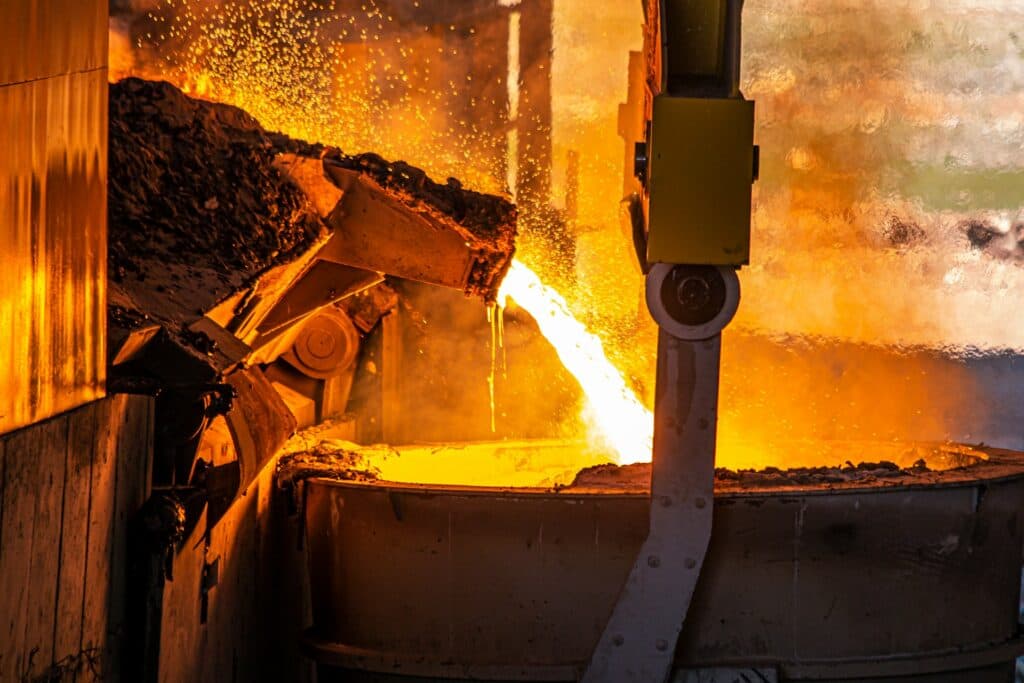
Green steel was meant to be the future of the Ostrava steelworks when businessman Sanjeev Gupta came to the region in 2019. But it is becoming increasingly clear that this “green steel game” was more of a rhetorical exercise and that, even after five years, the steelworks is not at all ready for zero-emission production.
Ondřej Stratilík’s article was originally published on the independent regional website Okraj.cz.“Caution, high voltage! Thanks to connection to a new 400 kV high-voltage grid, which is necessary for the full flexibility of primary production, we will be able to produce steel from up to 100 percent scrap, thereby significantly reducing CO2 emissions! We call this the second advantage! And below, the addendum: ‘Everything should be completed by 2025.’
Liberty Ostrava’s marketing department was posting these statements, accompanied by a simple pictogram, on social media as early as October 2020. It was preparing the Ostrava region for a new era for the ageing steelmaking giant, when the company would no longer depend on the smelly, dusty process beginning in coke oven batteries, but would make do with electricity supplies instead of fires and combustion.
This was not a surprising message. Back in 2018, when reports first emerged that Sanjeev Gupta might take over the Ostrava steelworks from the Mittal family, the British entrepreneur of Indian origin began publicly promoting the plant’s green future. Indeed, in an effort to improve his image, Gupta used the vision of so-called green steel not only in connection with Ostrava, but also with his other steelworks around the world.
In the past, regional media in the Ostrava area also occasionally carried fragmentary reports that work was under way on the linear construction of massive extra-high-voltage pylons, and that Liberty Ostrava’s zero-emission future was therefore drawing closer. The reality, however, is different.
We do not have it, we cannot estimate it…
Although the Tameh power plant stands directly at the steelworks, its technology – if it ever operates again – is not powerful enough to supply a pair of hybrid arc furnaces in which pig iron is to be melted from scrap. Energy therefore needs to be brought into Liberty from elsewhere. A power line from the Nošovice substation was originally selected as the best solution.
However, even five years after Sanjeev Gupta came to Ostrava with his plan, Nošovice Mayor Jiří Myšinský (SNK) has seen no concrete steps in his municipality, known mainly for its cabbage, brewery and car plant. “We do not have it in the land-use plan. The distributor first has to make up its mind and then begin concrete steps with us,” Myšinský told Okraj.cz.
The distributor in this case is ČEZ Distribuce. According to its Moravian-Silesian spokesperson Vladislav Sobol, the company is merely preparing the conditions for a new extra-high-voltage line to be built one day. “Liberty Ostrava has asked us to modify the distribution system in a way that will enable it to build an extra-high-voltage line from the Nošovice substation to Ostrava. Put simply, this will involve raising the support points (pylons) so that the new line can pass under the existing line in accordance with applicable standards,” Sobol explained.
Asked why construction itself had not yet begun and whether it was possible to estimate a realistic date for the start of building work, Sobol offered only a general response: “We are proceeding in accordance with the contract agreed with Liberty. At this time, we cannot estimate the start of construction; it depends primarily on how successfully the project can be prepared in legislative and property terms.”
Okraj.cz therefore also contacted the state-owned joint-stock company ČEPS (the Czech Electricity Transmission System), established by the Ministry of Industry. It is the sole transmission system operator in the Czech Republic and should therefore also be responsible for the line from the Nošovice substation to Liberty Ostrava. However, the ČEPS spokesperson did not wish to answer the questions sent. “Please direct your questions to Liberty Ostrava. This is its project and ČEPS is not involved in it,” Lukáš Hrabal said.
The management of the Ostrava steelworks, which has been in crisis for several months and whose owner Sanjeev Gupta has still been unable to come up with a solution to its critical situation (the company is protected from creditors until 20 March and must submit a restructuring plan), now admits that the project to bring sufficient green energy to the site is not a priority and work is not under way on it. “We are currently focusing on our optimisation plan and will subsequently return to our long-term decarbonisation projects,” promises Kateřina Zajíčková, Liberty Ostrava’s spokesperson. She says that the process of obtaining the necessary approvals from landowners and other stakeholders is nevertheless continuing.
Furnaces from Italy
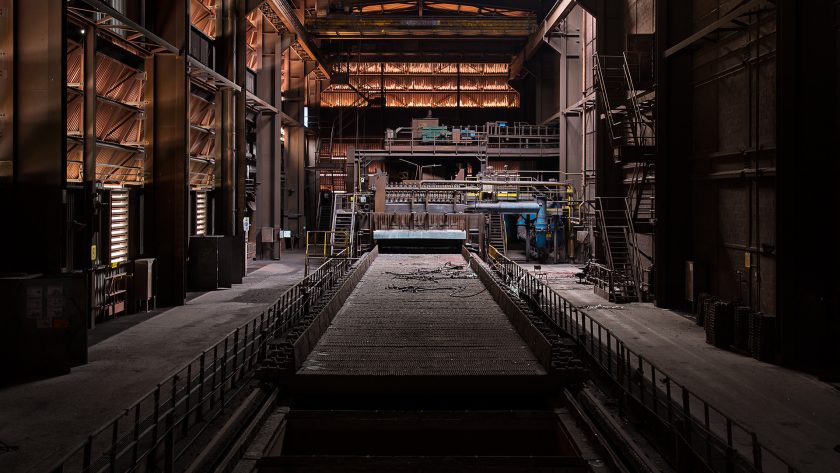
The current owners of the Ostrava steelworks envisioned that they would eventually shut down the existing blast furnaces and that pig iron production would gradually be taken over by hybrid arc furnaces powered solely by electricity. While the first step has therefore taken place (albeit probably differently than anyone expected) and the steelworks now does not have a single working furnace, none of Gupta’s people has yet made a move on the second step: installing the new technology.
Yet a key step was taken as early as 8 July 2022. A contract was signed directly in Ostrava between the steelworks and Italian furnace manufacturer Danieli. It is to supply Liberty with two new hybrid furnaces. “The largest investment in the Ostrava steelworks in several decades, totalling CZK 8.6 billion, will make it possible to reduce carbon dioxide emissions by more than 80 percent by 2027,” the steelworks said in a press release.
Further information released at the time stated: “The new furnaces should be commissioned in 2025. Once the 400 kV extra-high-voltage line to the steelworks, which should be completed in 2027, is finished, they will be able to use 100 percent metal scrap in the charge.”
Sanjeev Gupta himself, who at the time had not yet begun travelling to Ostrava in secret but was happy to appear before journalists, added: “Our investment demonstrates our long-term commitment to the workers here in Ostrava, the local community and future generations who will come to work at a modern, clean steelworks. I would like to thank the Liberty Ostrava team for all the work we have done together so far in preparing this extensive project.”
The plan is, or at least was in 2022, for the Italian arc furnaces to start operating next year at least at partial capacity, for which energy supplies from Tameh should initially suffice. Okraj.cz therefore asked Liberty Ostrava whether its target of commissioning two Danieli arc furnaces in 2025 still stood, given growing reports of delays.
The response from the steelworks’ spokesperson Kateřina Zajíčková was again very brief and evasive: “We remain committed to delivering our green steel transformation plan, but we are currently focused on our optimisation plan.”
And what does Italian company Danieli, the manufacturer of the arc furnaces for the Ostrava steelworks, say? It is completely silent. It did not respond, even after a follow-up request, to questions about the progress of the contract with Liberty Ostrava signed on 8 July 2022 and whether all the agreed deadlines still apply.
Work began, but we are not continuing
Another indication that the transition to the green world of green steel is not proceeding smoothly is the response from semi-state giant ČEZ. On the same day that Gupta signed the furnace contract, he “confirmed a partnership between Liberty Ostrava and ČEZ Esco in the steelworks’ transition to renewable energy sources needed for green steel production,” according to a press release dated 8 July 2022.
According to official information, the approved memorandum involves launching cooperation on seeking and developing technologies in renewable energy and hydrogen. These are “essential for the transformation of the Ostrava steelworks towards green steel production.” Kamil Čermák, CEO of ČEZ Esco, commented at the time: “The steel industry in Europe is at an important crossroads. (…) Together, we want to secure the future of steelworks and contribute to a substantial improvement in the environment in the Ostrava region.”
But here too, it appears that the strategic cooperation has frozen. “Work on it began, there were projects, but at this point it is not continuing,” says Roman Gazdík, a ČEZ spokesperson.
In the current situation, with the steelworks having been idle for several months and having no work for its employees, it is logical that development plans have been put on ice and the company is primarily addressing its basic survival. But it is becoming increasingly clear that the transition to green steel production in recent years was far from proceeding as some portrayed it publicly, and that little thought was given to the future.
This is being revealed very clearly now, during the steelworks’ deepest crisis. Had the original plans been followed, Liberty Ostrava might no longer have depended on energy from the Tameh power plant within a few months; its shutdown is now severely limiting any potential restart of steel production in Ostrava. The almost fairy-tale story of “green steel” has thus so far had a very bitter ending for the region.
Republished from EkoNews.cz, a website covering business and sustainability.
Translation disclaimer
This article is a machine translation of the Czech original and has not yet been fully reviewed. In case of any doubt, please refer to the Czech version.
Sdílejte článek prostřednictvím:
You might also like
8 October 2026, 10:05