25 September 2026, 09:51
Loading...
More Czech residents felt unable to afford heating costs last year, yet their share remains among the EU’s lowest

Martin Voříšek
13 September 2023, 08:44
Last year, just under three percent of households in the Czech Republic said they were unable to bear the costs of ensuring adequate heating. Compared with 2021, this represents a slight increase caused by the energy crisis. However, compared with other European Union countries, the Czech Republic still ranks among the leaders – it is fifth among the EU’s 27 member states in this statistic.
Energy poverty is an issue that has once again come to the forefront in connection with the energy crisis. This is hardly surprising, as energy prices have risen substantially for many consumers, in some cases several-fold.
One of the indicators the European Union uses to measure energy poverty is the indicator showing the share of households whose owners state that they are unable to keep their homes adequately warm (in English: Inability to keep home adequately warm).
The “Inability to keep home adequately warm” indicator represents the share of people who state whether or not they can afford to maintain a suitable temperature in their homes. This situation is generally considered one of the main consequences of energy poverty.
Although it is one of the main indicators that may point to energy poverty, it can be interpreted differently in each country. This is because it is a subjective indicator – everyone has different thresholds regarding home heating and accordingly states whether or not they are able to heat their household sufficiently.
"This indicator is subjective, meaning that the social and cultural characteristics of households strongly influence statements as to whether a household is unable to adequately heat its home. What constitutes an adequate temperature may differ between countries, and even between individuals. For example, a person in Germany who is used to district heating may consider a certain temperature too low. By contrast, a person in Portugal may find it pleasant and acceptable because they are used to lower room temperatures. Similarly, an older person feels the cold more and will appreciate a higher temperature in their home," the European Commission states on its website.
The fact that the indicator is subjective is also reflected in the results published on Eurostat’s website. While the highest share of inadequately heated households is mainly found in southern Europe (for example Bulgaria, Cyprus, Greece and Portugal), Finland and Sweden are at the opposite end of the scale.
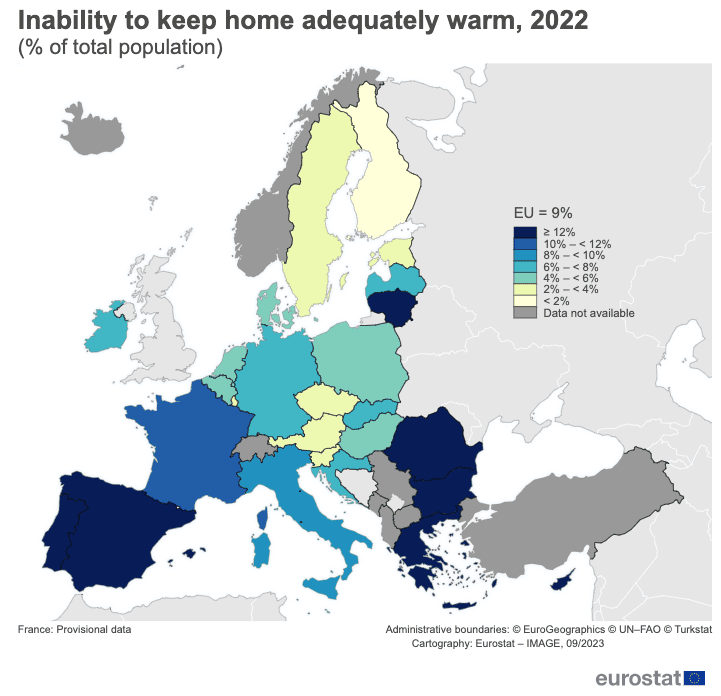
Energy poverty indicator. Source: Eurostat
Energy crisis broke the long-term downward trend in the Czech Republic
Despite the year-on-year increase in the energy poverty indicator, this was the first more significant rise since at least 2013 (older data are not available on Eurostat’s website). The increase between 2021 and 2022 was 0.7 percentage points.
By contrast, a historical comparison reveals a long-term trend indicating that energy poverty is declining. As the following chart shows, ten years ago the share of inadequately heated households was twice as high (6.2 %).
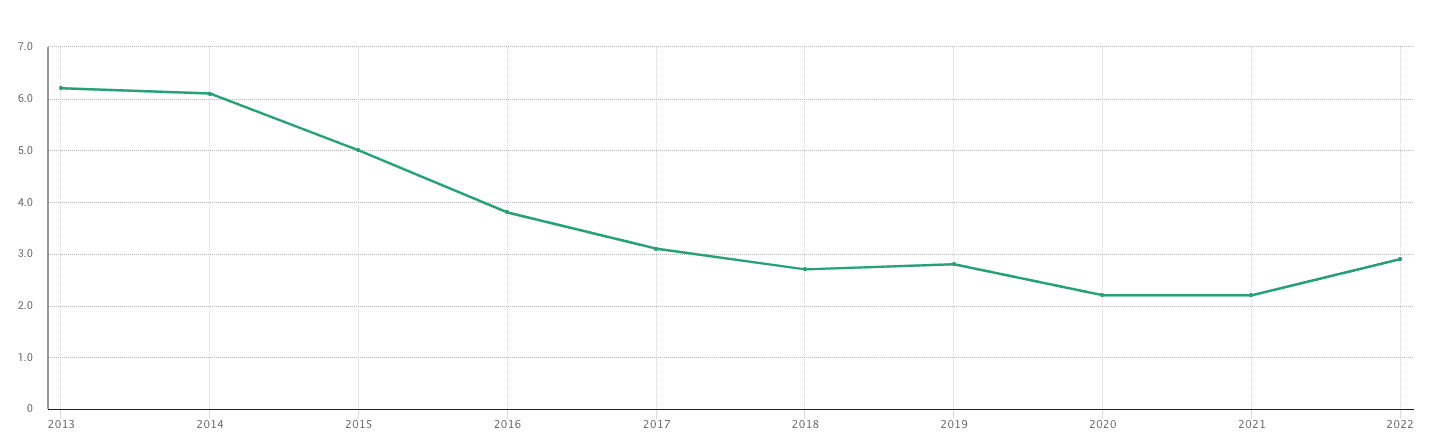
Share of households that are not adequately heated. Source: Eurostat
Indicator points to an increase in energy poverty in the European Union
The situation in the European Union as a whole is considerably worse in this respect. A total of 9.3 % of EU households said they were unable to keep their homes adequately warm. There was also a substantial increase – 2.4 p.p. compared with 2021.
Czech residents are therefore doing very well in this respect even compared with the European Union as a whole. Compared with the Czech Republic, the share of households affected by energy poverty according to the indicator is more than three times higher.
Translation disclaimer
This article is a machine translation of the Czech original and has not yet been fully reviewed. In case of any doubt, please refer to the Czech version.
Sdílejte článek prostřednictvím:
You might also like
24 September 2026, 11:23

24 September 2026, 10:30
24 September 2026, 06:56