17 October 2026, 13:09
Loading...
Let us not be afraid to buy hydrogen from countries where it is cheaper and become electricity importers, says German scientist
Ekonews.cz
13 June 2023, 16:16
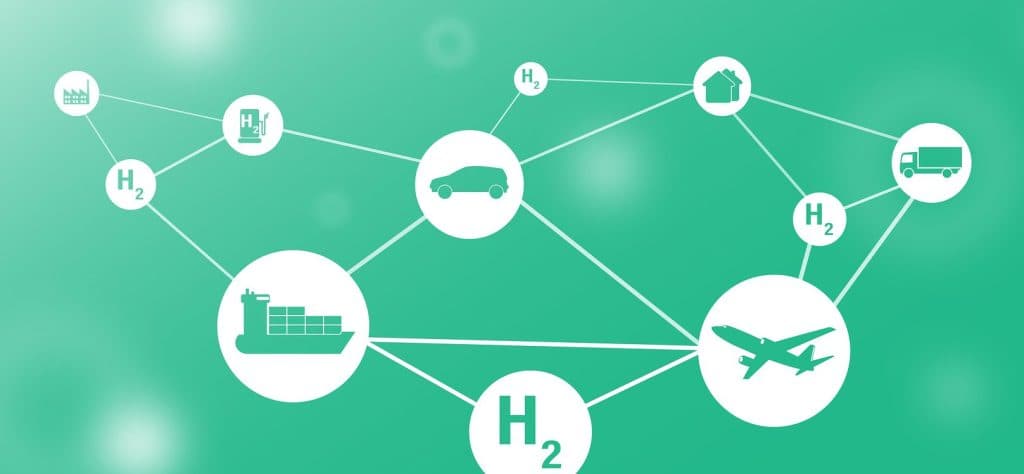
Germany recently disconnected its last nuclear power plant and is one of Europe’s advocates of the hydrogen economy. This is to be built on producing green hydrogen through water electrolysis using electricity from renewable sources, and is intended to help reduce carbon dioxide emissions.
Hydrogen can be used as a fuel, including for the aviation industry, steelmaking or the chemical industry. It can also serve as an energy store for periods when renewable sources are not running at full capacity. Producing such electricity is, however, relatively inefficient.
According to Mario Ragwitz, director of the Fraunhofer Research Institution for Energy Infrastructures and Geothermal Systems, it is necessary to count on solidarity within Europe and not be afraid to shift from being an electricity exporter to an importer, as has happened in Germany. Czechia is counting on hydrogen in the future, but it must reflect its hydrogen strategy in at least three documents. These are the State Energy Policy, the National Energy and Climate Plan and the Hydrogen Strategy. Together, these documents can create the conditions and incentives for investors in the hydrogen economy.
I saw you discussing hydrogen in Prague at the end of March. Has anything significant happened since then for the transition to a hydrogen economy?
Changes are happening all the time, but there have been no technological breakthroughs in the meantime. It is good that we have a plan for subsidy auctions for renewable hydrogen (the first is to be held in December, editor’s note), which will give interested market participants the opportunity to secure financial support for their renewable hydrogen projects. This creates a certain momentum for buyers and exporting countries in hydrogen markets. Moreover, there is a clear strong will in Europe to build a hydrogen backbone infrastructure. I might also mention the progress brought by the delegated acts on renewable hydrogen, specifically in setting the definition of “green hydrogen”.
This is quite a sensitive issue for Czechia, because we would like to produce green hydrogen with electricity from nuclear power, which will most likely not be possible. Germany is also in a transitional phase between a nuclear and hydrogen economy. Do you understand Czech concerns?
I think the transitional period has ended for us. We no longer have any nuclear power plants in operation; the last one was shut down on 15 April, so we have not used any since then. And therefore we also have no interest in nuclear power contributing to the production of “green hydrogen”. Other countries, such as France, do have an interest in this.
Germany will now use more coal for a certain period of time. I understand that investments in nuclear power send a signal to the market and support something you do not want in the long term, but what solution would you recommend to Czechia?
I think the strongest tool for Europe is to strengthen the entire market, have strong links between individual countries and maximise the benefits this brings. Across the whole system, we have a certain degree of flexibility and potential for renewable development. In my view, Czechia also has solid potential for solar energy and, in certain regions, wind energy. So every country should maximise its domestic resources and import some green hydrogen as well. Europe has a number of potential exporters, such as Portugal and Denmark. These countries are fortunate in that they will probably be able to produce it very cheaply and in large volumes. After all, Germany too will have to import green hydrogen alongside using its own renewable sources. We will become an electricity importer from an exporter, because Denmark, Norway, Sweden and southern Europe simply have greater potential.
How much hydrogen will you import?
According to ministry estimates, the latest scenario for total electricity demand is between 1800 and 2000 terawatt-hours. Hydrogen should account for between 500 and 700 TWh, so let us say a quarter to a third of energy demand. According to most studies, hydrogen imports will account for roughly two-thirds of total hydrogen demand.
An emphasis on imports will probably also be the case for Czechia. Even if we were to use the potential of our renewable sources, the production cost of “our” hydrogen would exceed the cost of imported hydrogen. So we will not be able to produce competitive green hydrogen, if I understand correctly…
Exactly. That is how competitive markets work, and we will all benefit from it. We will get hydrogen more cheaply because it can be produced more cheaply elsewhere, and its exporters will benefit similarly.
We will have to trust in the solidarity of all Europe, that hydrogen will ultimately get where it is needed. Do you think there is political will in all countries?
For example, in Germany we are increasingly realising that we will need hydrogen as a main energy carrier to decarbonise industry and transport and partly use it for heat generation. I see similar willingness in France as well. The Netherlands is another example, where there is a truly strong motivation both to import hydrogen and to produce it through offshore wind farms. I also see new ambitions in the REPowerEU plan, which sets a new target of 20 million tonnes of renewable hydrogen by 2030, half of it from domestic production. This is a major sign of willingness to develop the hydrogen economy rapidly.
Is it also one of the priorities to support countries outside the EU that have optimal conditions and enormous potential to work with, for example, solar energy, but lack solar or wind power capacity? How much is the EU focusing on this?
It is certainly one of the main strategies and priorities supported by the European Union. We are currently working on a hydrogen strategy for the United Arab Emirates, for example. We are working with Saudi Arabia on its export plans, involving several gigawatts of electrolysers. We see that North African countries, especially Morocco, have a strong will to export green hydrogen. They are increasing renewable capacity very rapidly. Saudi Arabia is currently installing six gigawatts of renewable capacity. (This includes, for example, the Neom project, a complex with planned capacity of 2,2 GW that, according to the Hytep website, will use up to four GW of solar and wind energy and produce 600 tonnes of hydrogen a day for ammonia production, editor’s note.) For Saudi Arabia and the United Arab Emirates, it will be a combination of renewable and blue hydrogen (grey or brown hydrogen produced using fossil fuels that has undergone a decarbonisation process, primarily through carbon capture and utilisation methods, editor’s note).
Looking back at Europe, which of the steps require the largest investments?
Electrolysers probably represent the largest investment. At the same time, using hydrogen in industrial facilities, such as steelmaking, depends on a complete transformation of steelworks. The network will also require significant investment, around 50 billion euros in Europe over the next decade.
What incentives are being considered?
This is currently being discussed. A very important incentive will be CfDs, or “carbon contracts for difference” (a contract intended to bridge the gap between supply and demand, editor’s note), and in the long term the European Emissions Trading System should also support the use of hydrogen in industry.
Transporting hydrogen is far more complex than natural gas. Is it really possible to use existing gas pipelines alongside a new network? Hydrogen can damage them, so will investment be needed to “reinforce” them?
This is so-called embrittlement, where hydrogen gets into the steel and somehow makes it less stable. A number of research projects are looking into this, and the initial results so far show that most of these steel pipelines should hold up. But detailed assessments of different types of steel and long-term stability are still under way. So far, it looks good.
Is there a pilot project you could mention?
In Europe, we are seeing the first medium-sized electrolyser projects. But there is no single major “flagship” that we could point to as proof that the whole thing will work. There is the promising GET H2 Nukleus project, which brings together various companies and should be operational within the next four or five years. Steelmaker ThyssenKrupp is installing its first hydrogen steel plant, where half of production should be based on green hydrogen.
Republished from the online portal EkoNews.cz, a website covering business and sustainability.
Translation disclaimer
This article is a machine translation of the Czech original and has not yet been fully reviewed. In case of any doubt, please refer to the Czech version.
Sdílejte článek prostřednictvím:
You might also like
16 October 2026, 10:16