25 September 2026, 09:51
Loading...
Where will hydrogen flow to Czechia from? NET4GAS involved in developing four international corridors

Eduard Majling
13 November 2025, 06:19
Czechia, like other EU Member States, is preparing to develop a hydrogen economy. However, according to the recently published development plan for the Czech gas transmission system, prepared by its operator NET4GAS, domestic hydrogen production in the EU will not be sufficient to cover expected consumption, and a large share of this commodity will therefore be imported into the EU. The planned hydrogen transmission corridors and associated hydrogen infrastructure, which should be ready by 2040, are expected to play a key role.
The European Union, along with a number of Member States, has high hopes for the hydrogen economy, which is intended to help decarbonise local energy systems. In addition to seasonal storage for renewable energy sources, hydrogen should also offer a route to decarbonising industrial processes that use hydrogen conventionally produced from natural gas.
According to the latest version of the hydrogen demand outlook prepared under the European Ten-Year Network Development Plan, hydrogen demand in the EU should reach 484 TWh in 2030, with 127 TWh in Germany and around 5 TWh in Czechia. Hydrogen production in this period should amount to 307 TWh at EU level, 61 TWh in Germany and 0 TWh in Czechia. For comparison, natural gas consumption in the EU amounted to around 3,560 TWh in 2024.
At the same time, it should be noted that planned renewable hydrogen production in the EU in 2030 may be substantially lower in light of recent developments in EU hydrogen auctions. Nearly half of the successful projects from the second EU hydrogen auction, in which electrolysers with a total capacity of 2.3 GW secured support, were withdrawn. The projects withdrawn from the auction had a total capacity of 1.9 GW, representing around 80 % of the capacity of all successful projects. The largest successful project, Zeevonk, with a capacity of 560 MW, was also withdrawn.
It is clear from the above that relatively large volumes of renewable hydrogen will need to be imported in the future from locations with more favourable conditions for its production. The planned European Hydrogen Backbone (EHB), which is expected to reach a total length of 58 thousand kilometres when completed in 2040, is intended to ensure the transport of renewable hydrogen from these locations to regions with expected future demand.
The EHB initiative, established by European gas infrastructure operators, has identified suitable areas for producing renewable hydrogen for EU needs. These include North Africa, the Baltic states, Greece, Turkey, the Middle East and Ukraine. These areas have been grouped into a total of five hydrogen corridors, most of which pass through Czechia.
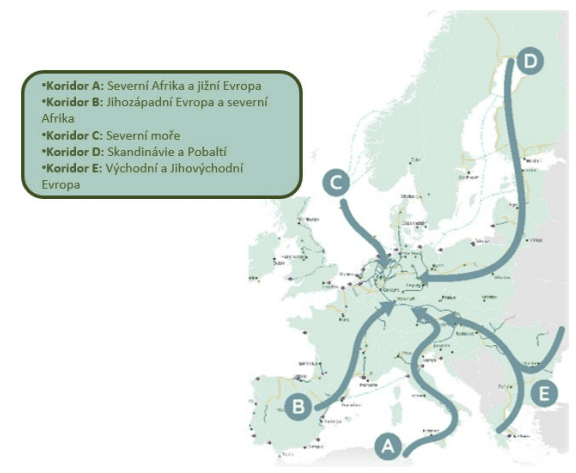
Identified hydrogen corridors for transporting renewable hydrogen to the EU. Source: NET4GAS
Czechia involved in 4 specific projects
As NET4GAS states in its published final draft of the Ten-Year Network Development Plan 2026-2035, its aim is to offer the future hydrogen market in Czechia maximum connectivity with major production locations. Consequently, in line with the EHB initiative and in cooperation with other partner transmission system operators, it has started developing four specific hydrogen corridors that will pass through Czechia.
The first is the Czech-German Hydrogen Interconnector (CGHI), which will enable hydrogen transport from northern Germany, the North Sea and Baltic Sea region, and the Baltic states to Czechia and onwards to southern Germany. The initiative was established in 2022, and the first phase of the project is expected to be commissioned in 2030.
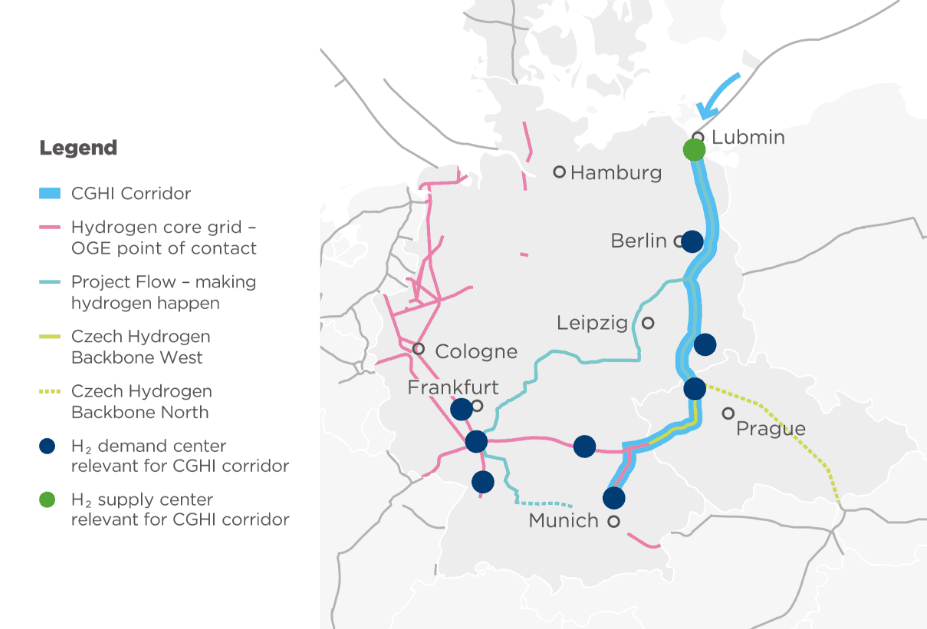
Czech-German Hydrogen Interconnector. Source: CGHI
The second project is the Central European Hydrogen Corridor (CEHC), which aims to enable the transport of renewable hydrogen produced in Ukraine to consumption centres in Slovakia, Czechia and Germany. Once completed in 2032, it is expected to have a total length of 1351 km.
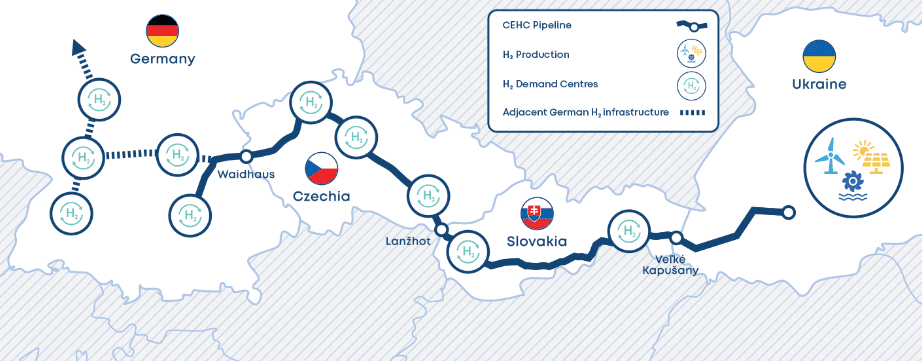
Central European Hydrogen Corridor. Source: CEHC
Another project involving NET4GAS is the SunsHyne Corridor, which will enable hydrogen to be transported from North Africa to Italy, Austria, Slovakia, Czechia and Germany. The corridor's total length upon completion in 2032 is expected to be 3400 km.
The final corridor set to pass through Czechia is the South-East European Hydrogen Corridor (SEEHyC). This corridor will open a route for hydrogen from the Middle East and south-east Europe to Greece, Bulgaria, Romania, Hungary, Slovakia, Czechia and Germany. It is also scheduled to be commissioned in 2032.
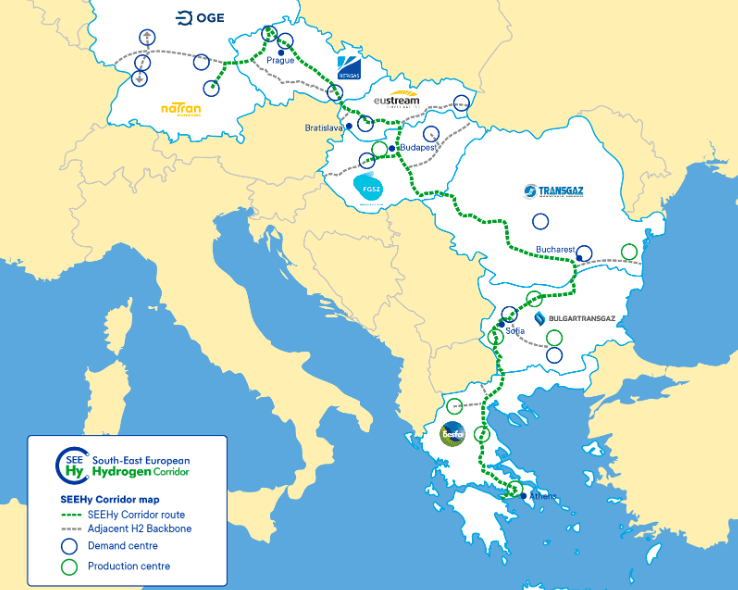
South-East European Hydrogen Corridor. Source: SEEHyC
The above shows that, thanks to its geographical location and existing natural gas transmission infrastructure, Czechia has significant potential to become an important hydrogen transit country. NET4GAS is therefore preparing three hydrogen infrastructure projects that will connect the largest cross-border interconnection points with neighbouring countries. Specifically, these are the Czech Hydrogen Backbone Infrastructure WEST (HYD-N-1034), Czech Hydrogen Backbone Infrastructure NORTH (HYD-N-1251) and Czech Hydrogen Backbone Infrastructure SOUTH (HYD-N-990) projects.
The first project, WEST, is expected to be commissioned in 2030. This is to be followed by NORTH, entering operation in 2032, while SOUTH is last, with expected completion in 2035.
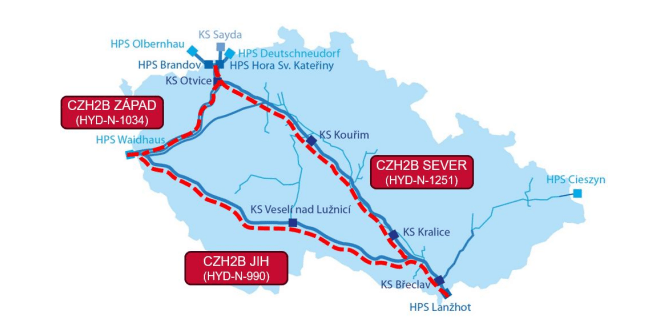
Czech hydrogen backbone infrastructure projects. Source: NET4GAS
Delays could complicate compliance with the EU Taxonomy
The timely completion of the European hydrogen backbone network and all associated projects is crucial for the planned replacement of natural gas or hydrogen produced from fossil fuels in industry and energy sectors across individual EU Member States with renewable hydrogen.
In the energy sector, a frequently discussed concept in this area is the so-called EU Taxonomy, which aims to provide clear rules for determining whether an economic activity is environmentally sustainable. The Complementary Climate Delegated Act, which focuses on activities in nuclear energy and gas, sets relatively strict requirements for natural gas-fired facilities. Among other things, it requires natural gas-fired facilities that obtain construction permits before 2030 to switch completely to burning renewable gases by the end of 2035. This should also apply to a number of gas-fired power plants and heating plants being built in selected EU Member States, including Czechia.
The end of 2035 is not fully aligned with the target of completing the European hydrogen backbone network in 2040. Although a number of projects are expected to be commissioned after 2030, there is a risk that these projects will be delayed. This risk was recently raised, for example, by Arturo Gonzalo, CEO of Spanish transmission system operator Enagás, who said he expects delays of two to three years for projects across Europe.
Specific cases of delays in hydrogen infrastructure development projects can be seen in Denmark and the Netherlands. In the case of the Danish hydrogen network, a three-year delay was announced last October, with key interconnections within Denmark now expected to be commissioned by the end of 2033. A three-year delay was also announced at the end of last year for the Dutch hydrogen network, which had originally been scheduled for commissioning in 2030 and is now expected in 2033.
Translation disclaimer
This article is a machine translation of the Czech original and has not yet been fully reviewed. In case of any doubt, please refer to the Czech version.
Sdílejte článek prostřednictvím:
You might also like

24 September 2026, 11:23

24 September 2026, 10:30
24 September 2026, 06:56