Leancat exports unique hydrogen equipment. We do not compete on price, says CEO
Leancat has become the first Czech exporter to focus on equipment for producing hydrogen and then generating electricity from it. As Leancat co-owner and CEO Professor Vladimír Matolín explains in an interview for MED, his company now exports test stations for hydrogen fuel cells and has also received overseas orders for electrolysers used to produce hydrogen from water. The next step will be exporting fuel cells.
Demand for Leancat's technologies is growing as hydrogen becomes part of individual countries' decarbonisation strategies and efforts to gradually replace natural gas. “Anyone wanting to manufacture hydrogen fuel cells needs a test station. And anyone wanting to produce green hydrogen needs an electrolyser,” stressed Vladimír Matolín, who has long been engaged in research at Charles University's Faculty of Mathematics and Physics. The Czech hydrogen startup, which is already making money from selling test stations, offers not only products but also related services. Leancat is a member of the Czech Hydrogen Technology Platform (HYTEP).
Leancat is targeting the market with various products. You started with a patent for an innovative fuel-cell catalyst at the Faculty of Mathematics and Physics. Now you make fuel-cell test stations, as well as electrolysers. What is your main direction?I sometimes ask myself exactly where we are heading. It is determined by our company's history. Six years ago, at Charles University's Faculty of Mathematics and Physics, we patented a new method of manufacturing catalysts for fuel cells with a lower content of expensive platinum, later adding a patent for catalysts for electrolysers. We joined forces with entrepreneur Dalibor Dědek and set up a technology-transfer company. At the time, we already had a preliminary agreement with Charles University on the potential manufacture of catalysts under its licence. It later emerged that as long as fuel cells are produced in small batches, no one is particularly interested in how much platinum their catalysts contain.
Yet research worldwide is focused precisely on reducing the content of precious metals. Do you therefore think the time for your catalysts is still to come?I am convinced it is. We are already slowly returning to our original plans. All existing projections by, for example, the US Department of Energy show that platinum will become a critical factor in the future when it comes to the cost of fuel cells and electrolysers. One option is to replace platinum with other metals, but that does not yet seem realistic. The other is to significantly reduce its content. We are certainly not giving up on this path. In the meantime, however, we embarked on developing fuel-cell test stations. We had a huge advantage in that we were involved in testing ourselves and had a clear idea of what customers would want. Like other companies, we went through a phase of making equipment that now seems amusing to us and that we are almost ashamed of. But we have improved our technology considerably, and we also have our own software. Today, we compete with two major global manufacturers of test stations from Canada and Germany.
How did you achieve that?Through the unique design of our test stations. For example, in a tender launched by Chemnitz University of Technology in Germany, we succeeded thanks to our technical solution. We did not offer the lowest price, as many would expect from a Czech company. Our solution is also quite unique in terms of testing resistance to catalyst poisons, which is an important part of fuel-cell testing.
Test stations became your first export product. How high is the export share?Virtually everything goes for export; our equipment is now in France, Germany, China, India, Poland and the UK. These are relatively large systems on which our exports are currently based. However, our original intention was to focus on electrochemical innovations, which is also what I enjoy most. We therefore gradually began, using grant-funded projects, to develop our own fuel cells and eventually our own electrolyser. For now, we buy the catalyst systems for them.
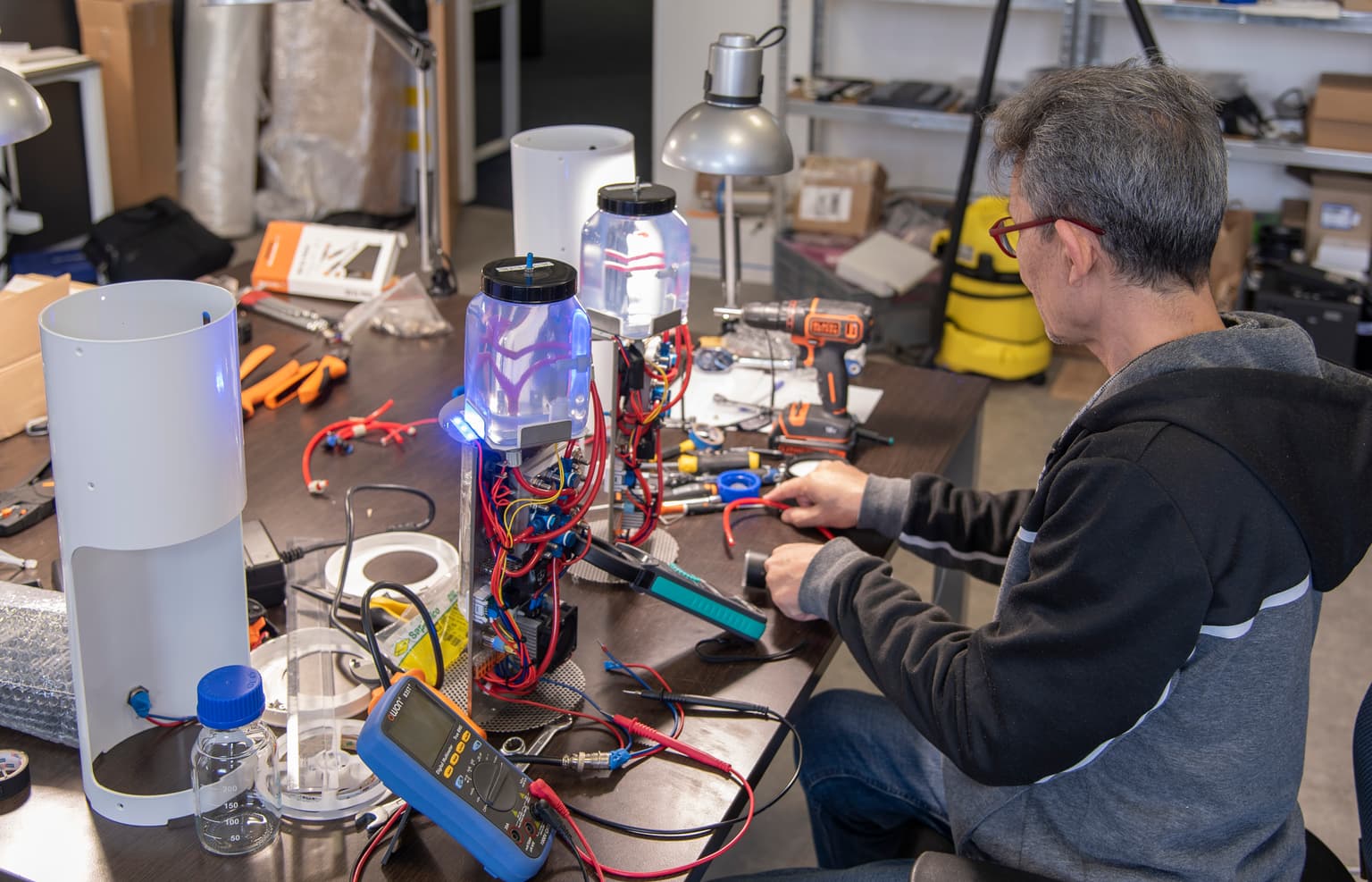
THE AIM IS INDEPENDENCE
Do you want to use your own catalysts in the future?That is indeed one of the reasons why we embarked on developing our own fuel cells and electrolysers. We realised that we would have the best chance if we started selling our products as a complete package. That way, we will not depend on whether other fuel-cell or electrolyser manufacturers buy our catalysts. There is also significant synergy with our test stations. Fuel-cell stacks and electrolyser cell stacks do not operate on their own. They are part of a generator, which also includes various pumps, sensors, safety features, electronics and software. And we have mastered all of this through manufacturing test stations. So we are also starting to manufacture complete generators – equipment that connects to the grid or a solar park and produces hydrogen. We will offer both standalone electrolysers and generators.
When will you start selling fuel cells and electrolysers with your own catalysts as well?First, we need to succeed in selling electrolysers and fuel cells with purchased catalysts. Then the time will come when it makes sense for us to acquire a licence for the innovative, patented catalyst technology. We could even borrow to acquire it, but we must be absolutely certain that we will be able to pay for such an investment through sales of complete products. Naturally, the evolution of the price of standard catalyst assemblies will also play a role.
After test stations, are electrolysers now next for export?The first product we developed was a bench-top electrolyser intended for healthcare use. We began selling these electrolysers first in the Czech Republic. We also have orders for electrolysers used as teaching aids. In the next phase, we began offering larger electrolysers for energy applications and large-scale hydrogen production. Interested parties have already started contacting us, mainly from Canada and Taiwan.
So, besides energy and healthcare, your electrolysers are also aimed at universities...It is becoming clear that a major problem in the Czech Republic is the shortage of specialists working on hydrogen technologies. Domestic experts are often graduates of the University of Chemistry and Technology in Prague; universities in Ústí nad Labem, Ostrava and Plzeň, as well as a new research institute in Brno, will also work on developing hydrogen technologies. The fact that our startup emerged from activities at the Faculty of Mathematics and Physics is actually unusual. The faculty is not a technical university; we focused on basic research. We expect Czech universities to devote much more attention to development and education in this field in the future. We therefore see a major opportunity in education as well. We will take a somewhat different direction from companies offering simplified models to universities. We want to supply real electrolysers and fuel cells to educational institutions, even if in smaller numbers.
Are you also planning to sell electrolysers for educational purposes abroad?We already have an order from the African country of Benin, where Leancat was recommended by our French colleagues. Benin has ordered two electrolyser assignments and two fuel-cell assignments on a trial basis. If the customer is satisfied, they will be supplied to each of the country's four universities.
Dalibor Dědek said in an interview with Export.cz last year that you are also exploring ways to secure hydrogen supplies. How have you progressed with these plans?
A hydrogen storage facility has been created in Jablonec, which will be supplied by Air Products. This is connected with the fact that we are also building our own 100-kilowatt fuel-cell test station there. That is already a truly large facility, consuming one thousand litres of hydrogen per minute. First, we are expanding our own know-how in this area. And second, we are beginning to successfully develop another line of business – offering testing of fuel cells and their components as a service. We already have one contract with a customer from Poland and another with a customer from California.
So they will test their products directly in Jablonec...We have mapped out that the capacity of testing facilities in Europe is completely sold out. There is particular interest in testing large fuel cells for cars. Moreover, we ourselves must be able to test our products.
Leancat is a member of the Czech Hydrogen Technology Platform HYTEP. What do you see as its role?HYTEP is a professional organisation engaged in awareness-raising and promoting hydrogen, and it supports various conferences. In other words, exactly what we need.
Could this platform also help exporters of hydrogen technologies? What is your view as a pioneer among these exporters?Our experience clearly shows that in foreign markets, you have to build direct contacts and offer a unique product. An organisation such as HYTEP could help facilitate contacts. However, companies that know what they want primarily seek out business partners themselves and communicate with them directly.

NOT JUST GREEN HYDROGEN
Do you expect your electrolysers to be used to produce green hydrogen using electricity from renewable sources?Yes. That is determined by the current market situation and subsidy programmes. Given this, both electrolysers and test stations look promising to us. Anyone wanting to manufacture hydrogen fuel cells needs a test station. And anyone wanting to produce green hydrogen needs an electrolyser.
On the other hand, there are also views that renewable sources alone will not be sufficient for hydrogen production. What do you think?Green hydrogen is receiving a great deal of media attention today, as is its use in automotive transport. There are several ways to achieve decarbonisation. We are now working on high-temperature electrolysis, which makes it possible to produce syngas – synthetic gas – from carbon dioxide and hydrogen. That is, gas that cars can run on. This means you capture carbon dioxide, consume it and produce synthetic gas, which you use in an internal combustion engine. The carbon dioxide is then released again. But because it was previously captured from some industrial process, you are operating in a carbon-neutral cycle. So it is clear that internal combustion engines have not died out yet. Synthetic fuels will have a significant share in the energy mix.
Do you agree that using hydrogen produced as a waste by-product also makes sense from an environmental perspective?If waste hydrogen is used that would otherwise be released into the air, it makes a great deal of sense.
Nanotechnology played a significant role in developing your innovative catalyst. Is this a practical example of what nanotechnology is good for?
Absolutely. I have been working on nanotechnology for a long time. It is talked about a lot, but, to exaggerate slightly, I find it quite amusing that few people know what to imagine under the term or what it is actually used for.
FROM NOVELTY TO REALITY
Dalibor Dědek says that when Leancat was founded, everyone turned their noses up at hydrogen. Do you agree?I would put it a little differently. Many saw hydrogen technologies as something of a novelty – they considered them insanely expensive and thought they would not even be needed. If we were not dealing with the problem of climate change, we probably would not be looking at hydrogen today. But carbon-free hydrogen is, of course, a clean energy source. Unfortunately, pointless debates are often held today over whether we need hydrogen or batteries in transport. In reality, hydrogen will be better in some places and batteries elsewhere. The market and demand for specific applications will show that. If someone wants to drive to work around the city, an electric car with a battery will probably be enough. People travelling long distances may assess it differently. For some, the decisive factor will be that hydrogen can be refuelled much like petrol, even though it is expensive. And heavy batteries are unlikely to be an ideal solution for trucks or trains.
Where could hydrogen find applications besides transport?Hydrogen uptake will be gradual; for now, it is too expensive. Over time, we will find out where its deployment begins to make sense. A fuel cell that generates electricity from hydrogen can be a good solution for off-grid systems that are not connected to the distribution network. It is not worth running wires to some remote hill, although today you would most likely transport a diesel generator there, which would cost you ten times less than a hydrogen generator. But I am convinced that the range of applications for fuel cells to generate electricity will expand. Aviation is another example. Propeller-driven electric aircraft will not fly on batteries because they cannot carry them.
What about using hydrogen for energy storage?Definitely for energy storage, especially seasonal storage. If we are talking about storing it overnight, it is better to have a battery. Energy surplus in summer will partly be stored as hydrogen and kept for winter. It is essentially the same principle as cutting wood for the winter. A fuel cell can be used in cogeneration – it produces not only electricity but also heat. However, all forecasts of what the energy sector will look like in twenty or thirty years can be tricky. Scientists have been researching nuclear fusion for decades – the potential production of almost free energy. Now imagine that this research is successfully completed in, say, ten years. Then we will suddenly be in a completely different situation.
That moment will probably come one day; the question is when...
The sooner, the better. That is certain.
Has your view of business changed since Leancat was founded?
I spent my entire professional life in basic research, was abroad for a long time and taught at a university in France for ten years. But I was always inclined to see some specific application behind research. Even in my lectures, I tried to tell students what those theoretical findings were actually good for. Academics do not address that very often. It always bothered me when I attended lectures, studied and did not know what practical purpose it had. In recent years, as I became more involved in hydrogen technologies, I moved more from basic research to applied research at the Faculty of Mathematics and Physics. And that is why my colleagues and I said: let us start a company. I have to say I have completely shifted. I greatly enjoy turning scientific findings into a final product while also using a researcher's experience to integrate various clever features into product development. At the same time, I still try to keep up with the literature. I think linking scientific experience with industrial development is a huge advantage. You have something to draw on.
How did it actually begin when Leancat was being formed? Did you ask Dalibor Dědek for support, or did he notice you first?
It was slightly different still. We were noticed by a completely different company, which also approached Dalibor Dědek. We later parted ways with it. Incidentally, many people think that the word cat in the name Leancat means a cat. But in this case, cat is not a cat; it is a catalyst. So, a lean catalyst – it is a play on words. And we put two plates in the logo, representing how stacks – bundles of fuel cells – are assembled.
The article was originally published on export.cz.Translation disclaimer
This article is a machine translation of the Czech original and has not yet been fully reviewed. In case of any doubt, please refer to the Czech version.