Martin Ruščák: Small modular reactors are a major opportunity for Czechia
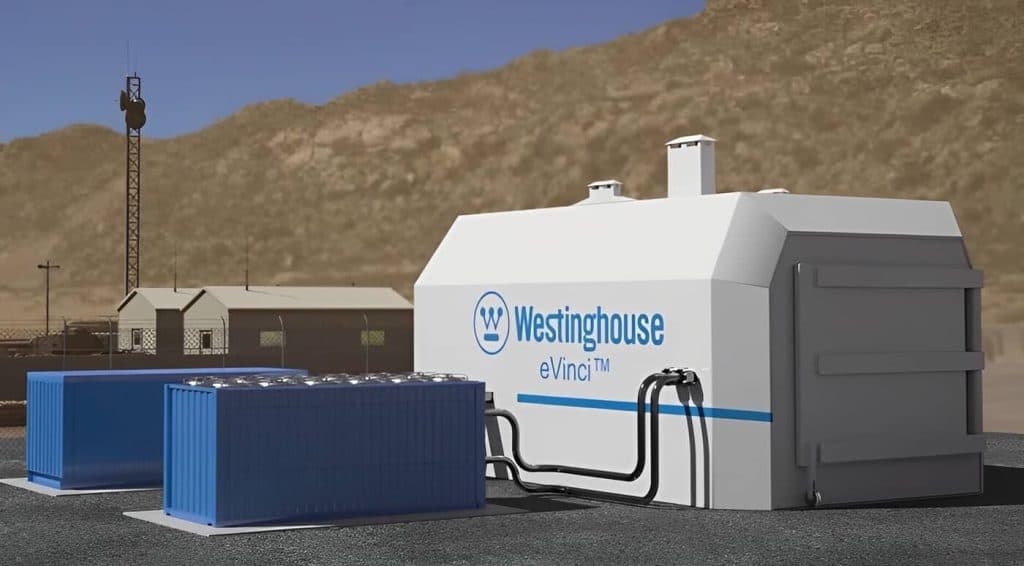
The production of small modular reactors could represent a major opportunity to preserve the expertise of the Czech nuclear industry. Czechs could play a significant role in their manufacture – and not only because these reactors could be used domestically. “Small reactors can to a considerable extent be a Czech product that finds application elsewhere,” Martin Ruščák, director of the Research Centre Řež, says in an interview with oEnergetice.
As for their use in Czechia, Martin Ruščák notes that their potential deployment in district heating is being discussed in particular. We now bring you the first part of the interview.
Nuclear power plant construction projects in Europe are becoming significantly more expensive and delayed. This year, France saw a large part of its existing reactors shut down because of suspected defective components. All this prompts the question of whether Europe’s future lies rather in small modular reactors. What is your view?
The future will probably lie in a combination of large and small reactors. I think that is the realistic answer. Both types of reactor have their purpose and role. Large reactors will continue to provide baseload – that is, the basic load on the grid – in countries where they can be built and where there is also the will to build such reactors. That currently applies, for example, to the United Kingdom and Finland. The transmission grid will still need this baseload. With all due respect to the development of renewable energy, these sources will not provide baseload. Small nuclear reactors, meanwhile, address other issues, including flexibility, which is not entirely ideal with large units. A combination of several small reactors provides a degree of flexibility.
So that means, for example, that one small reactor can be shut down… How quickly will it be possible to shut such a reactor down and bring it back into operation? It is probably not fully comparable to gas-fired power plants?
It is not comparable. However, if we know in advance what the transmission grid will require, the costs of ramping up small modular reactors will certainly be lower than the costs of ramping up large reactors.
And will it be faster?
It will be faster, yes. Small reactors have other advantages as well. Many new small-reactor technologies are intended to operate at significantly higher temperatures, thereby achieving higher efficiency, and can also serve as important heat sources. This gives them further applications. Poles are now saying that they would like to use small gas-cooled, helium-cooled reactors as heat sources for the chemical industry. Poland currently heats with coal, and that will have to be phased down gradually.
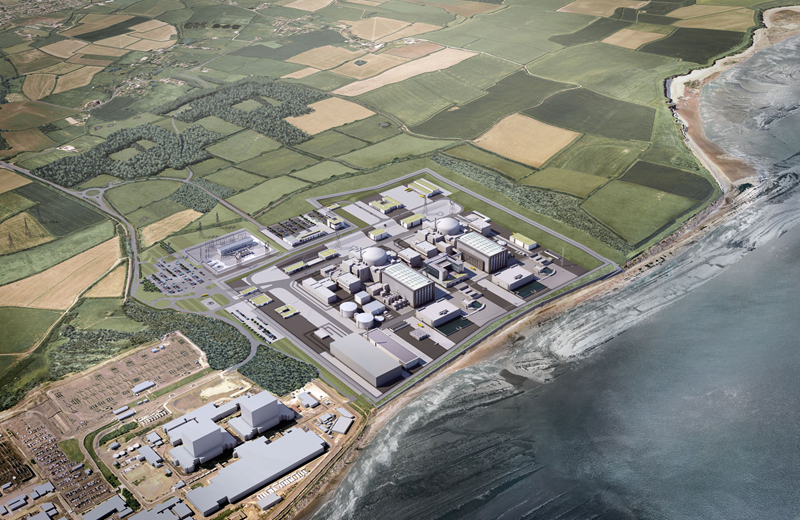
It is probably no coincidence that the United Kingdom is actively pursuing the development of small modular reactors. The British currently face a controversial debate over the Hinkley Point large-unit project, which will be very expensive…
Britain is an excellent example to me of strategic thinking in energy. The British are developing a very broad portfolio; it is like Europe in miniature. It is also an island – a large island with many inhabitants, but still an island. The British must therefore be largely self-sufficient. And since the first decade of the twenty-first century, the United Kingdom has approached this in a very planned and strategic way. It is developing various technologies – wind, gas, oil, large and small nuclear power plants; the British even talk about tidal power plants. They are trying to spread their options in order to reduce risks.
Do you therefore expect that, despite the problems with the Hinkley Point project, the British will develop both large nuclear power plants and small modular reactors?
I am convinced of it. There is another important factor in the development of Britain’s nuclear capabilities – support for the British defence industry. The navy, submarines… This industry needs to retain its prospects and efficiency. And also its expertise. Expertise is preserved when there are projects through which it can be put to use.
We need a strong long-term project
In this respect, we are similar to the British, leaving aside the defence industry. Czechia also needs to preserve expertise in nuclear energy.
Exactly, in this respect we are quite similar to the United Kingdom. Historically, we have very strong expertise in nuclear technologies, with a sixty-year tradition in this field. Czechia has developed significant knowledge infrastructure in operations, construction, companies, universities and research institutes. Nuclear regulation is a very important part of this knowledge infrastructure. All this places the Czech Republic among countries that are highly competent in nuclear energy. Some of this expertise is gradually disappearing… To retain this expertise, we need a significant long-term project or projects. Otherwise, our educated people will leave. And nuclear energy is also very important for us – just as it is for the United Kingdom – in ensuring baseload.
Does the path for Czechia also lie in both large and small reactors?
There are discussions in the Czech Republic that small reactors could in future primarily serve as heat sources.
Directly in the Czech Republic?
Directly in the Czech Republic. The company ÚJV and its EGP division have calculated models concerning the siting – that is, placement – of small reactors in the country. It appears that this is technically feasible and manageable. It depends on political will. Czechia has a relatively well-developed district heating sector, and industry would probably accept small reactors as heat sources. On the other hand, the Czech Republic is not a very large country. And for building small reactors to make sense, you need a lot of them – for their production to pay off. Czechia certainly will not be the driver of demand, but it can benefit from it very successfully.
As for the reactors that could be used in district heating, these will probably include very small ones as well? In general, small reactors can have installed capacity of up to 300 megawatts.
That is already almost the upper limit. I would speak of small reactors with a capacity of no more than 150-200 megawatts. But it could also be 50 or even 20 megawatts. We are talking about modular reactors, which means that the individual modules are manufactured and assembled in a factory. At the reactor site, they are essentially only interconnected. Modularity makes reactor production more efficient and reduces costs. It eliminates a fairly significant disadvantage of large reactors: prolonged construction.
Faster cost reductions
There is a major debate about whether modularity and serial production can truly achieve lower overall costs. Many people question it…
At the beginning of November, some results from the latest studies were published in London. A fairly large difference is emerging in the reduction of costs for the second and subsequent reactor once the first reactor of a new type has entered operation. For large reactors, cost reductions for the second and subsequent reactor are in the order of a few percentage points. For small modular reactors, reductions of up to fifteen percent are expected. Significant operating savings are also expected for small reactors, thanks to several small reactors being located at one site. They will thus share operations and maintenance. Siting could also be substantially easier. In any case, it can be assumed that once a certain number of small reactors is reached, their production will be more efficient.
Put simply, it is easier to find a suitable site for building a small reactor than a large one…
Yes, but from the Czech perspective, there is another important point in this regard. For the Czech Republic, small reactors matter not only as a technology to be used directly in the country. Small reactors can to a considerable extent be a Czech product that finds application elsewhere. Czech companies can make a significant contribution to manufacturing such reactors; they can join the supply chain somewhere – for example, in the United Kingdom mentioned above. Or Czech companies could even manufacture a small reactor largely on their own. I am not saying that we are able to manufacture everything ourselves down to the last screw, certainly not the fuel. But we have sufficient capabilities to pursue the idea of a small reactor with a capacity of, say, several dozen megawatts that could be a Czech industrial product for export – perhaps in cooperation with someone else. Then the question of siting such a reactor will be quite important, because we could also export it to regions that do not necessarily lie in the middle of civilised Europe.
You are actually talking about two different concepts. In this case, it concerns the deployment of reactors in remote locations. Earlier, however, you indicated that it makes sense to build several small reactors in a given location instead of one large reactor…
Another advantage of small reactors is that at a site where large nuclear reactors stand today, for example, the issue of siting has effectively already been resolved. Once a large reactor reaches the end of its operating life, it is possible to consider replacing it with several small ones. That is one option.
So would you even consider that, instead of a new large unit at Dukovany, several small reactors could ultimately be built?
I think not only I would. Quite a few people think this way. But I repeat: it is one option.
Czechoslovak roots
Let us return to the Czech product itself. If we do not count the very beginnings of nuclear energy in former Czechoslovakia, this could be the first time we could truly speak of a Czech product. Is that correct?
But people tend to forget the first A1 reactor at Jaslovské Bohunice, which was a highly unique Czechoslovak technological project. It did end at a certain point…
It did not end particularly well…
It did not, but the project significantly helped Czechoslovakia achieve technological self-sufficiency in nuclear power. An entire generation grew up with it. These people are now of retirement age, but they still pass on knowledge that is no longer linked solely to A1 reactor technology. This knowledge relates to safety, materials, thermohydraulics and neutron physics.
There is quite a lot of talk about us gradually losing know-how in nuclear energy or the nuclear industry. Why do you think it is still substantial enough for us to develop our own product?
I see it around me. Perhaps I am a mild optimist, but I can give examples. The Czech Republic, specifically the company Comtes – also in cooperation with us – has developed a material for small molten-salt reactors. That material simply exists here. We have large companies that are still capable of supplying the nuclear industry. But when I talk about small reactors, I know that there are also originally small companies here that have grown in recent years and demonstrate sufficient capabilities to participate in developing these reactors. An example is their participation in the construction of hot cells for the Jules Horowitz reactor in Cadarache, France.
Your Research Centre Řež is directly involved in this…
Yes, we are supplying the complete solution. And Czech companies account for 80 percent of external supplies in this case. After five or six years of cooperation with various companies, we know which firms are capable and which are not. And those that are capable have also established excellent cooperation with the final customer. I would add one more thing – I see how many young people around me are interested in our field. In this respect, we certainly are not experiencing any catastrophe. I often hear that there is no interest in technical fields. I maintain that this is not true. Many young people have already understood that technologies offer a better future than other fields. Anyone looking for work today who has decent knowledge of technology usually has no problem finding a position. Of course, I am not speaking only about nuclear technologies, but about them too.
Are young people not discouraged even by developments in Europe? Germany is phasing out nuclear power, and it seems that nuclear energy may not have such a great future in Europe.
It probably discourages some people, but here at the Research Centre Řež we have 300 employees, half of whom are under forty. I estimate that roughly a third are under thirty-three. I do not want to paint too rosy a picture, but I do not see a catastrophe. On the contrary, people are coming to us from abroad because they see what we are doing and that we want to continue nuclear research. We have colleagues from Italy, Germany and France who live in Czechia with their families.
The author of the article, who also asked the questions, works as an energy projects specialist at the HATcom agency.
Translation disclaimer
This article is a machine translation of the Czech original and has not yet been fully reviewed. In case of any doubt, please refer to the Czech version.