3 October 2026, 13:01
Loading...
EU proposes extending gas consumption cuts or storage would be empty in February

Martin Voříšek
22 March 2023, 12:32
The European Commission is proposing that the European legal framework for reducing natural gas consumption by at least 15% should remain in force next year as well. The voluntary reduction in consumption, which can be made mandatory if necessary, is therefore to apply until the end of March 2024.
Following Russia's invasion of Ukraine, one of the first measures adopted was a European regulation on coordinated measures to reduce gas demand. It set a reduction in gas consumption of 15% in individual Member States – initially on a voluntary basis only.
Thanks to high prices and warm weather during part of the winter, this commitment has been met. Although the commitment remains in force until the end of March, it can already be said that it will be fulfilled. According to European Commission data, gas consumption fell by an average of 19.2% between last August and this January. The Czech Republic achieved a 17.7% reduction in natural gas consumption over the same period.
Despite the significant reduction in gas consumption and gas storage levels reaching record levels of around 56% during this period, the Commission warns that savings will also be necessary next winter. It therefore proposed at the beginning of this week that the voluntary reduction in gas consumption – mandatory if the conditions are met – should also apply from April 2023 until the end of March 2024.
The Commission reached this conclusion after assessing several scenarios for gas consumption and supply developments in 2023/2024. Each scenario was based on a different period for which the regulation would be extended.
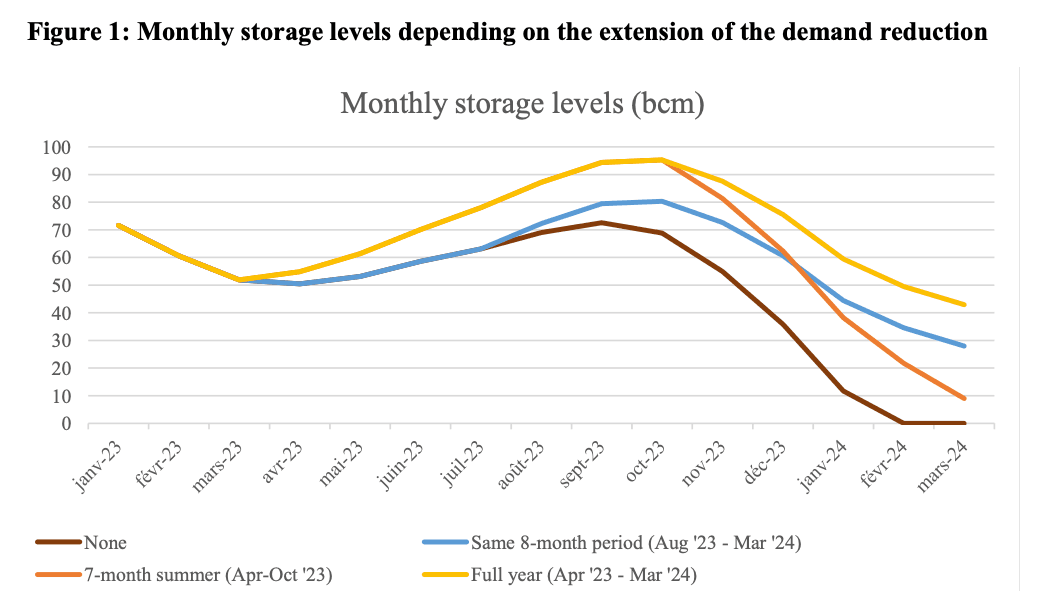
Impact of the assessed scenarios on gas storage levels next winter. Source: European Commission
The worst outcome – quite understandably – would result from a scenario in which the regulation was not extended at all. In that case, at least according to the European Commission's forecasts, natural gas storage facilities would be completely empty as early as February next year.
As can be seen from the chart above, the highest storage levels at the end of next winter can be achieved if the regulation is extended by 12 months. In that case, gas storage levels could exceed 40% at the end of winter.
In calculating the individual scenarios, the European Commission primarily assumes that this year it will no longer be possible to count on a substantial share of natural gas supplies from Russia (roughly 60 billion cubic metres). While Russian gas supplies were relatively high, particularly in the first half of last year, they fell sharply after the Nord Stream pipeline was shut down and subsequently exploded, and now account for less than 10% of natural gas consumption in the European Union.
Translation disclaimer
This article is a machine translation of the Czech original and has not yet been fully reviewed. In case of any doubt, please refer to the Czech version.
Sdílejte článek prostřednictvím:
You might also like

3 October 2026, 07:43

2 October 2026, 21:55
2 October 2026, 15:14