Bill Gates’s reactor: nuclear future between China and America
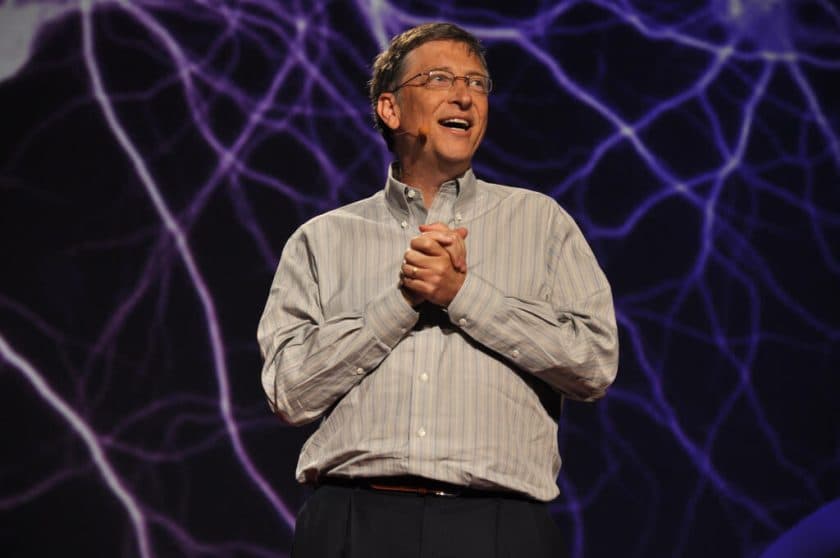
When Donald Trump’s administration tightened conditions for exporting nuclear technologies to China this October, it appeared that the main victim of the escalating trade war would be a project backed by one of America’s most influential entrepreneurs and visionaries, Bill Gates. The former Microsoft founder is an investor and chairman of the board of TerraPower, which is working with China on a fourth-generation nuclear reactor project for the future.
The TerraPower project, built on long-term research in the United States, could have become a target simply because, in the eyes of critics, it enables a technology transfer to the biggest rival – China, an emerging economic and increasingly technological superpower.
Yet a month later, Bill Gates was shaking hands with senior Chinese officials at a major Shanghai forum for importers to China. They discussed how the TerraPower project could support China’s economic development.
However, it was ambitions on a global scale that brought Bill Gates into cooperation with the Chinese state-owned China National Nuclear Corporation (CNNC) three years ago. One of the world’s richest men supports new technologies that will enable humanity to confront the threat of climate change. He attaches exceptional importance to nuclear power in this respect – but the reactors are intended to be much safer, more efficient and more environmentally friendly than today’s models, while also posing no risk of misuse for military purposes. In time, they should also be cheaper to build.
Travelling-wave reactor
Gates joined forces with a country that is perhaps devoting the greatest effort and financial support in the world to the further development of nuclear power. It is in China that TerraPower’s first 600-megawatt prototype reactor is expected to be built within the next few years. The output of a future commercial reactor is expected to be considerably higher still.
The development of TerraPower’s so-called travelling-wave reactor is aimed precisely at all the advantages mentioned above. The reactor is to generate energy for fifty years without replacing its nuclear fuel, which it can utilise far more effectively than today’s power plants. It can use unenriched – that is, “depleted” – natural uranium (predominantly isotope 238) as fuel. Water, as used in today’s reactors, will no longer serve as coolant; liquid sodium will be used instead.
A wave of fission reactions gradually propagates through such a reactor: uranium isotope 238 is converted into uranium 239, then into neptunium and finally plutonium. The logic of the reactor lies in maximising the use of plutonium, rather than separating it for military purposes.
An end to waste problems?
“TerraPower’s idea is to burn uranium 238, which makes up the remaining 99 percent, instead of uranium 235, which accounts for only one percent of naturally occurring uranium,” Bill Gates himself argued some time ago.
According to him, the reactor „burns“ uranium continuously, functioning somewhat like a candle. With this layman’s comparison, Gates illustrates why the reactor can operate for a long time without fuel replacement. Another advantage of TerraPower is expected to be its ability to use waste already accumulated from existing reactors – somewhat inaccurately referred to in Czech as “spent fuel”. (More information about TerraPower technology can be found here, here and here.)
While the TerraPower project is now walking a tightrope between America and China, the historical roots of travelling-wave reactor development can be traced to another former superpower – the Soviet Union. The original concept was explored in the 1960s by Soviet physicist Savely Feinberg.
In the 1990s, the idea was taken up by the well-known American scientist of Hungarian origin Edward Teller, known as the father of the hydrogen bomb. In 2006, Bill Gates and other investors decided to support the project, and TerraPower was founded two years later. Meanwhile, the Russians took a somewhat different path from the original research and have so far been relatively successful in developing the so-called BN series fast breeder reactors.
Nuclear power in the age of supercomputers
Bill Gates himself explained why today’s research is much more promising than it was in the last century, when a genuine breakthrough in developing the promising new technology could not yet be achieved: “Now we have the age of modern supercomputers, we can simulate everything, and we see that with the right materials it might work.”
Until the first commercial reactor is commissioned, nothing is certain, of course – as with any research and development. Nathan Myhrvold, Gates’s representative at TerraPower and former chief technology officer at Microsoft, noted in a recent article for Scientific American that scientists and US national laboratories had explored many alternative nuclear energy projects in the past, but today’s ability to simulate is taking earlier ideas much further. TerraPower, like a number of other nuclear start-ups, has thus moved closer to building its first reactors. If the visionaries behind Microsoft’s boom are right, the 2020s will become another breakthrough period for nuclear power.
It is probably no coincidence that Myhrvold’s article was published at roughly the same time that Bill Gates was shaking hands with Chinese officials in Shanghai and speculation emerged that Washington might throw obstacles in TerraPower’s path. Myhrvold recalls how he and Gates considered humanity’s energy needs in the 21st century in 2006 and concluded that energy savings and the development of renewable sources were excellent trends, but insufficient on their own. From the perspective of the visionaries from Microsoft’s nest, nothing has changed in these considerations even today.
Nuclear power differently
Nathan Myhrvold argues that nuclear power has lost its innovative spirit in recent decades. Power companies supported research and development intended for the “mere” improvement and enhanced safety of the existing type of reactors. That is, reactors originally developed for submarines or aircraft. The fact is that the aforementioned brilliant physicist Edward Teller always questioned the use of submarine designs for commercial nuclear reactors.
The question remains how the TerraPower project will proceed at a time of tense US-China relations. In a way, the announced US restrictions on China may be a positive signal – Washington takes the further development of nuclear technologies seriously and does not want to fall behind the emerging technological power in nuclear energy development. TerraPower is also working with the US Department of Energy on another future-oriented project – a small modular reactor based on molten salts.
Gates’s wake-up call for the US
Bill Gates’s three-year-old agreement with the Chinese may have been quite a loud wake-up call for Americans. The oEnergetice website warned as early as Donald Trump’s arrival in the White House that an American president seeking to “make America great again” would have to respond to growing Chinese competition. At the time, American scientists, economists and environmentalists sent Trump a letter complaining about inadequate support for nuclear research. They stated plainly: “We are forcing innovative and financially strong entrepreneurs such as Bill Gates to build their new projects abroad.” They noted that China is investing heavily in at least five different advanced designs of new nuclear reactors.
On the other hand, it is also unclear what Donald Trump seeks to achieve through his tough stance toward China. The trade war between the two countries is escalating, but the US president is known for using such an escalation of tensions to ultimately force his rival – and potential partner at the same time – into an agreement.
Either way, US authorities will assess individual cases even when applying the tightened restrictions. It is likely that the new limitations will not apply to Westinghouse, which has already transferred a substantial part of its know-how to China through joint projects. Nor is it impossible that Americans will ultimately assess cooperation on the travelling-wave reactor as mutually beneficial.
Gates, Trump and Beijing
Some critics reproach Bill Gates, who supports efforts to mitigate climate change, for not engaging in sharper criticism of Donald Trump, who is instead withdrawing from international climate agreements. Bill Gates probably knows what he is doing and is seeking to win over both Washington, where climate-change arguments currently do not work, and Beijing for his projects.
Although it may sound paradoxical at a time of uncertainty surrounding the current state of US nuclear power, America and China are precisely the greatest hopes for nuclear energy’s future. America because of its developed culture of public-private partnership, in which state-supported research can be further developed by start-ups and innovative companies. China’s great advantage, meanwhile, lies in enormous state investment in innovation and its still-growing domestic market. It is hard to say what Bill Gates thinks of Chinese politics, but there is no doubt that he appreciates the country’s drive for innovation and its approach to the threat of climate change.
The author is a consultant and energy-project specialist at the HATcom agency.
Lead photo: Gisela Giardino, Flickr
Translation disclaimer
This article is a machine translation of the Czech original and has not yet been fully reviewed. In case of any doubt, please refer to the Czech version.