Czech artificial Sun project attracts US scientists
A team of experts from the renowned national laboratory in Princeton, United States, has been working with Czech scientists for a year on a project for a new experimental fusion facility, which is due to be built in Prague’s Libeň district within three years. The laboratory’s activities are funded by the Department of Energy in Washington.
“This is the first time Americans have been interested in using a major experimental facility in the Czech Republic, and that is why they are involved in its funding and implementation,” Radomír Pánek, director of the Institute of Plasma Physics of the Czech Academy of Sciences, told Modern Economic Diplomacy magazine.
Until now, it had been the other way around, with Czech scientists seeking access to top-tier US research infrastructure through participation fees.
Like the Prague institute, the Princeton Plasma Physics Laboratory explores the potential for fusion of the nuclei of light elements, as occurs in stars including our Sun – unlike the now better-known fission of the nuclei of heavy elements in nuclear power plants. After “heavy” uranium, “light” hydrogen takes centre stage. The aim of this research is to achieve an emissions-free and safe way of producing energy from a virtually inexhaustible resource – water.
Artificial Sun
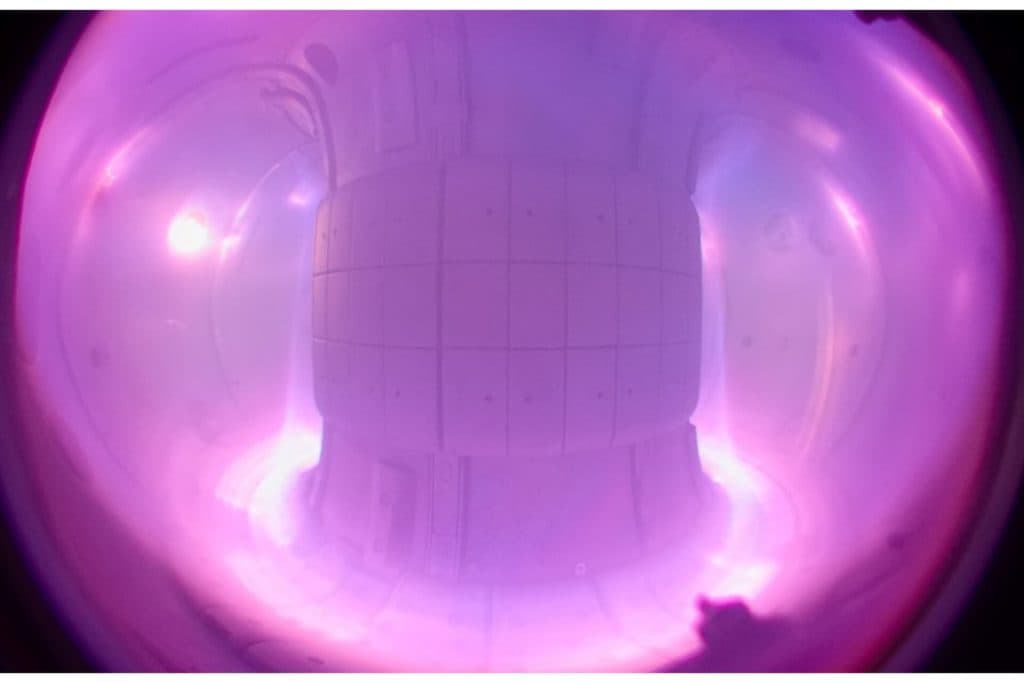
The thermonuclear reaction takes place in hydrogen plasma at incredible temperatures of up to 200 million degrees Celsius in a fusion reactor – a so-called tokamak or stellarator. The new COMPASS-Upgrade tokamak, funded primarily through the Operational Programme Research, Development and Education, will replace the existing COMPASS experimental fusion facility in Libeň. COMPASS arrived in Prague from the UK Atomic Energy Authority’s fusion energy centre in Culham, near Oxford, around 15 years ago.
US-Czech scientific cooperation is also developing promisingly in other areas, including the use of laser infrastructure in Dolní Břežany near Prague and small nuclear reactor projects. However, it has progressed furthest in thermonuclear fusion, as evidenced by last year’s agreement between the US Department of Energy and the Czech Academy of Sciences and its Institute of Plasma Physics.
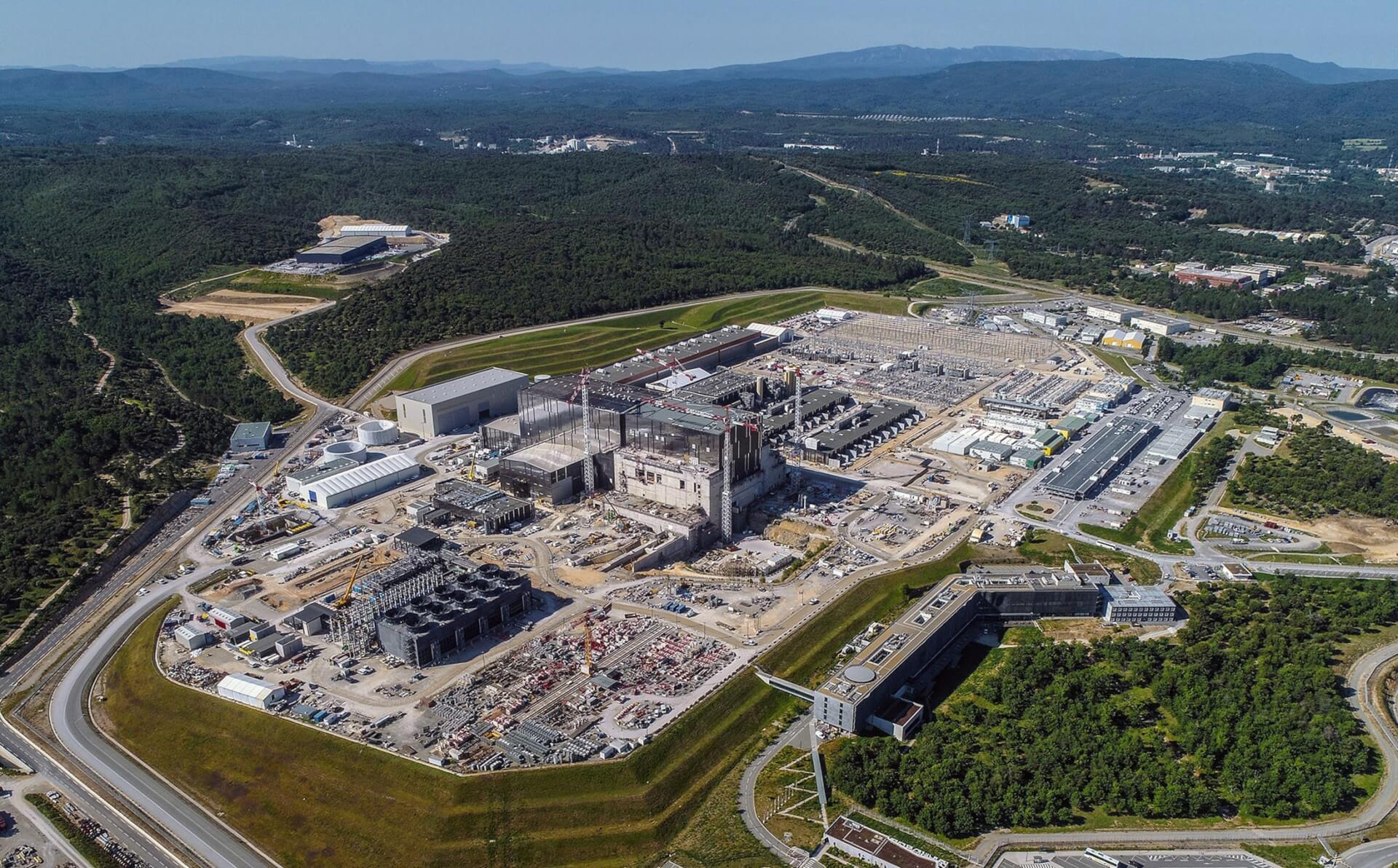
As with other fusion facilities around the world, the results of experiments at Prague’s COMPASS-Upgrade will be used both within the major international project to build the giant ITER tokamak in southern France and, above all, in preparing a fusion reactor that will form part of the European DEMO prototype power plant.
According to Radomír Pánek, cooperation with the Princeton national laboratory is not limited to the tokamak’s technical design and related calculations and modelling. The Americans are also considering supplying one of the components of the Prague fusion facility. In this case, too, funding from the US Department of Energy is envisaged.

The appeal of liquid metals
Why, then, are Princeton scientists so interested in the Prague tokamak? Operators of the Libeň facility will focus, among other things, on crucial research into the use of liquid metals such as lithium, tin and their alloys. Individual components of a future fusion reactor must withstand thermal loads similar to those experienced on the surface of the Sun. With the materials used today, this would lead to rapid degradation and the need for frequent replacement. Liquid metals, however, could ensure the continuous renewal of the surfaces of these components, which will be evaporated by extreme energy flows from the plasma. Radomír Pánek notes that COMPASS-Upgrade will become the first facility capable of testing the use of liquid metals under conditions that are in many respects close to those of future fusion power plants.
The vision of integrating fusion reactors into the energy mix offers humanity great hope, but it is also a “long-distance race”, and we will probably see it sometime in the second half of this century. Prototypes of power plants using energy from tokamaks are expected to begin construction in Europe, China and South Korea in 2035–2040. Radomír Pánek believes that, thanks to the long-term planning of its research and innovation activities, the European Union may have a competitive advantage over other regions of the world in this respect.
However, the development of resilient materials associated with nuclear fusion research has much wider applications across a range of other industries. “It is similar to space research, which accelerated the development of many technologies. We now encounter many of them in everyday life,” stresses the director of the Institute of Plasma Physics. He points out that the study of nuclear fusion has channelled substantial funding, for example, into superconductivity research, the development of advanced materials and cryogenics. The tungsten materials being developed will find applications, for instance, in high-temperature industrial operations.
European ties
As part of its work on the design of the new tokamak, the Institute of Plasma Physics has also established close cooperation with Poland – specifically with the Institute of Nuclear Physics of the Polish Academy of Sciences in Kraków. According to Radomír Pánek, Polish engineers and technicians have experience with major scientific projects: they have participated in building parts of the CERN particle accelerator in Switzerland and the Wendelstein stellarator in Germany. The Polish partners are collaborating on the design of some systems for the new Libeň tokamak and are expected to play a significant role in its assembly and subsequent scientific use.
The main pillar of the Institute of Plasma Physics’s international activities is cooperation within the European EUROfusion consortium, which coordinates thermonuclear research in the European Union. The new Libeň tokamak will effectively become a key European test facility for the use of liquid-metal technologies in future fusion power plants, raising Czech research in this field to world-leading level. Thanks to the high standard of fusion research in the Czech Republic, Radomír Pánek this year became one of two vice-chairs of the governing board of the European Joint Undertaking Fusion for Energy, which ensures the implementation of Europe’s share in the international ITER fusion reactor project. Europe has a 46-percent share in the tokamak project, and Fusion for Energy therefore oversees the coordination of development and deliveries worth €12 billion.
As Radomír Pánek points out, the future Prague tokamak will also become one of the centres of follow-on international research: “We will use almost 100 percent of COMPASS-Upgrade’s operating time in cooperation with foreign partners.”
Opportunity for Czech companies
Czech companies will also participate in the construction of the COMPASS-Upgrade tokamak. Preparations for the power supplies for the Libeň tokamak are already entering their final phase. Current experimental facilities are not designed to generate energy; on the contrary, they require substantial electricity supplies to operate. The new Prague tokamak will therefore also require the construction of new generators, transformers and switchgear. The relevant contract has already been awarded to Elektrotechnika a.s. and its subcontractors, including TES Vsetín.
Further opportunities are emerging in the supply of other tokamak components, such as large coils, the vacuum vessel and the cryostat. Radomír Pánek somewhat regrets that Czech companies have so far not shown much interest in this promising and technologically attractive segment: “As a country with virtually the highest share of industry in Europe, we could be more active in this respect and seek contracts for the ITER project more actively, for example.”
Czech research institutes have nevertheless already achieved significant successes in nuclear fusion research. In cooperation with other institutions, the Institute of Plasma Physics has developed special sensors for the ITER reactor to measure magnetic fields, resistant to high temperatures and radiation exposure. The Research Centre Řež, meanwhile, developed the Helcza electron-gun-based facility for testing the heat resistance of panels on the ITER tokamak’s first wall. According to Radomír Pánek, domestic scientific institutes have so far secured research contracts worth around CZK 200 million for the ITER project.
The article was published on the Export.cz website.
Translation disclaimer
This article is a machine translation of the Czech original and has not yet been fully reviewed. In case of any doubt, please refer to the Czech version.