25 September 2026, 09:51
Loading...
Czech energy sector must be mainly nuclear in future, politicians agree

oEnergetice.cz, ČTK
27 August 2025, 14:53
The Czech Republic’s future energy mix needs to be based on nuclear energy, requiring the construction of more nuclear capacity. Participants in today’s pre-election energy debate held by the Czech Chamber of Commerce agreed on this. The further use of coal remains an open question, with some politicians in the discussion rejecting its phase-out at least until replacement sources are built in the Czech Republic. Representatives of political parties also largely agreed on the need to reassess EU targets in its so-called green policy.
The pre-election energy discussion, held today by the Czech Chamber of Commerce at its Prague headquarters, was attended by representatives of political parties and coalitions that opinion polls give a realistic chance of winning seats in the Chamber of Deputies: Spolu, the ANO movement, STAN, SPD, the Pirates, Stačilo and the Motorists.
The main topic of the debate was energy security and supply reliability in the Czech Republic. Representatives of both government and opposition parties agreed that nuclear power should be the cornerstone of the domestic energy sector over the longer term. For example, ANO deputy chairman Karel Havlíček stressed that, in addition to the planned new units at Dukovany, further new capacity will also need to be built at Temelín, along with small modular reactors.
According to politicians, however, a problem could arise over the next ten years before the new nuclear units are completed. Štěpán Hofman (STAN), deputy minister of industry and trade, therefore called for the rapid construction of new gas-fired capacity to replace coal-fired power plants. Their rapid shutdown was criticised especially by representatives of opposition parties. “The government must realise that until the new nuclear units are built, we will need reliable sources, and that means coal. It must therefore not make conditions more difficult for coal-fired capacity,” said Marcel Dlask of the SPD. Pavel Janeček, a representative of the Motorists, also agreed, saying that the move away from coal is primarily an ideological step.
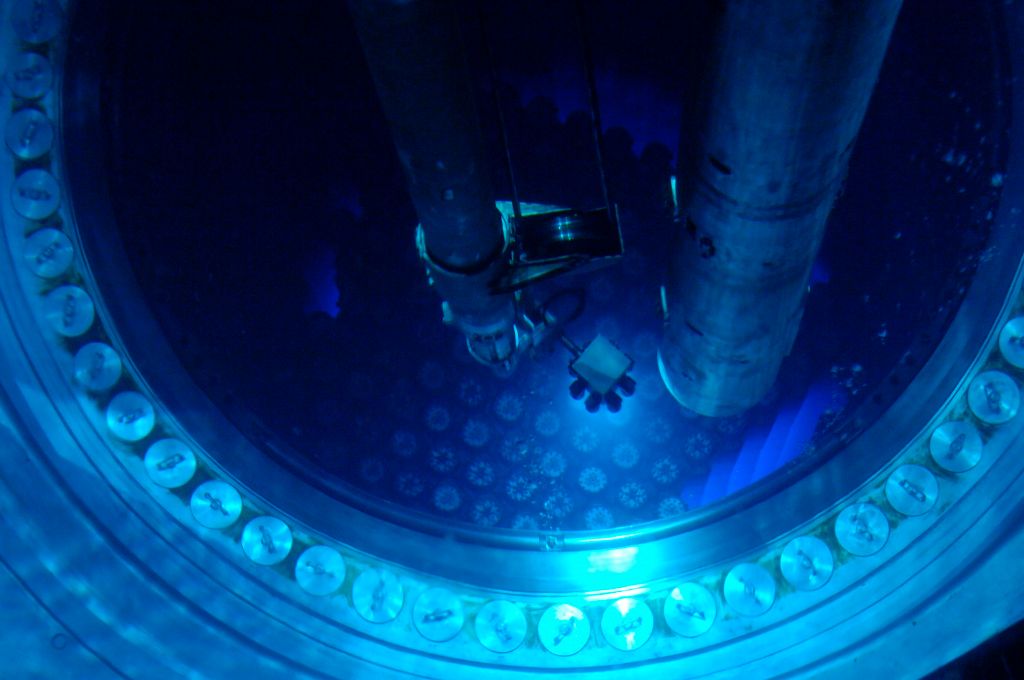
View inside the Temelín nuclear power plant reactor during an outage for fuel replacement, with its characteristic bluish Cherenkov radiation. Source: ČEZ
Ivan Adamec (ODS), chairman of the Chamber of Deputies’ Economic Committee, pointed out that owners of coal-fired power plants will gradually phase out these facilities because they will cease to be economically viable. He also recalled that the government had approved legislative changes under which ČEPS may order coal-fired power plants to operate in the event of an energy crisis.
According to some politicians, the state has also fallen behind in certain areas of the energy sector. Leo Luzar (KSČM) said more attention needs to be paid to the transformation of district heating, which he said is often overlooked. Luzar also said the state should have built up greater reserves of certain resources in recent years. According to Pirates representative Václav Vislous, it is also a mistake that an updated state energy strategy has not yet been approved. He said it is a key document for the further development of the domestic energy sector.
Another topic of the discussion was industrial decarbonisation. Most politicians agreed that EU targets under the so-called Green Deal and for emissions reductions are excessive and often nonsensical. In their view, the next government should therefore seek to amend them or reassess them entirely.
Translation disclaimer
This article is a machine translation of the Czech original and has not yet been fully reviewed. In case of any doubt, please refer to the Czech version.
Sdílejte článek prostřednictvím:
You might also like
24 September 2026, 11:23
24 September 2026, 10:30
24 September 2026, 06:56