
17 October 2026, 13:09
Loading...
German fusion start-up Proxima Fusion secures record funding

David Vobořil
12 June 2025, 06:18
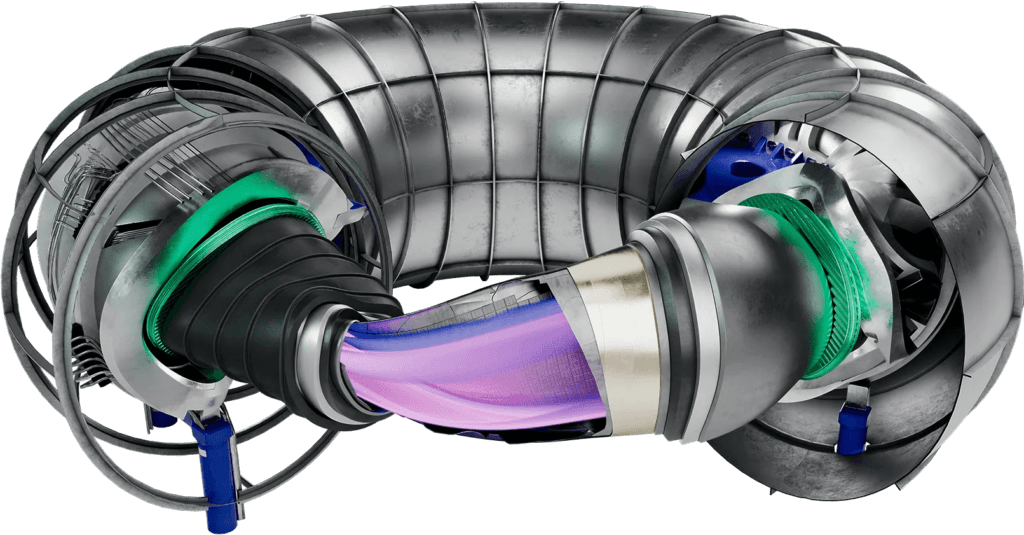
German start-up Proxima Fusion has secured a record investment of 130 million euros, drawing attention from both experts and investors to stellarator technology. The company, founded as a spin-off from the Max Planck Institute, is targeting the development of a demonstration fusion power plant by 2031. The move reflects both growing optimism that nuclear fusion will provide enough clean energy in the near future and Europe's progress towards global leadership in research.
Proxima Fusion has announced the closing of Europe's largest private investment round in nuclear fusion. The company raised 130 million euros, bringing its total private and public funding to more than 185 million euros.
Proxima plans to use the funds to develop one of the superconducting magnets, demonstrating key hardware for a design that is due to be completed in 2027. The subsequent construction of a pilot demonstration power plant, intended to serve as a reference project for commercial reactors, is scheduled for completion in 2031, according to the company's plans.
Continued cooperation with European research institutions and industry will be crucial to meeting these milestones. The project's total budget is estimated at 1 billion euros.
With its technical expertise, robust funding and clear roadmap, the company has a chance to become one of the first players to take the stellarator fusion concept from research laboratories into industrial reality. The key factors now will be not only technological development, but also political will and the ability to innovate.
The company's ultimate goal is to deliver unlimited, safe and clean nuclear fusion energy to the grid in the 2030s. Many advocates consider this an unrealistic timeline, and say large-scale commercial use is still decades away.
Proxima Fusion maintains that all the fundamental physics barriers on the way to a pilot fusion power plant have been overcome, and that industrial-scale production of key components such as superconducting magnets has become the main challenge.
Fusion technology on European soil
Founded in 2023 as a spin-off from the Max Planck Institute for Plasma Physics in Munich, Proxima Fusion is focused on developing a so-called stellarator. This is an advanced type of fusion reactor that uses dozens of extremely powerful magnets, each costing several million euros, to confine superhot gas, or plasma, in an asymmetrically twisted ring shape.
Stellarators use only external magnetic fields to confine plasma, eliminating the need for tokamaks to generate current directly in the plasma. This results in greater operational stability and a lower risk of disruptions—technical failures typical of tokamaks.
The technological design draws on findings from the Wendelstein 7-X experimental fusion facility, the world's largest stellarator, which was commissioned in Germany. It recently set a world record in a key performance metric.
Proxima also uses open-source simulation tools and advanced AI-supported computing methods to optimise the shape and configuration of the magnetic field.
This engineering approach shortens development cycles and increases the likelihood of achieving so-called net energy gain—the point at which a reactor produces more energy than it consumes.
Strategic context and challenges
Globally, Proxima competes with start-ups such as US-based Commonwealth Fusion Systems (1.8 billion USD) and Helion (425 million USD). Even so, it remains one of the few projects in Europe with the potential to bring a stellarator to real-world energy use.
The German government describes fusion as a strategic technology and supports Proxima as a flagship project to strengthen Europe's energy independence. At the same time, the company warns that without systematic government and infrastructure support, there is a risk of technology and talent moving to the US or China.
Several fusion start-ups have told Clean Energy Wire that the US government's recent attacks on science present a huge opportunity for Europe, as many leading fusion researchers want to leave the US. Proxima's team, which has more than 80 people, already includes staff who have held senior positions at companies such as SpaceX, Tesla and McLaren.
Translation disclaimer
This article is a machine translation of the Czech original and has not yet been fully reviewed. In case of any doubt, please refer to the Czech version.
Sdílejte článek prostřednictvím:
You might also like




16 October 2026, 10:16