Martin Ruščák: Small modular reactors must pass through the ‘valley of death’
The Czech Republic is one of the three countries in the world with the greatest expertise in salt technologies in nuclear energy. Czechs could make use of this in developing small modular reactors, Martin Ruščák, director of the Research Centre Řež, says in the second part of an interview for oEnergetice. In the first part of the interview, the director highlighted the major opportunity that small modular reactors could represent for the Czech Republic.
Ruščák also points out that the development of small modular reactors still faces a number of obstacles – they must first demonstrate their economic viability and pass through the proverbial ‘valley of death’.
You say that Czechs could try to develop their own product in the field of small modular reactors. Czech nuclear power has so far been based on pressurised-water, light-water reactors. However, in this context you mention molten salt technology. What do you see as its advantage?
Salt technologies have several advantages. The first is that they are non-pressurised technologies, which has implications for both safety and the cost of the entire project. The second major advantage is that salt reactors operate at high temperatures, which significantly increase the efficiency of the thermal cycle. The third major advantage reflects the fact that we are one of three countries in the world with extensive knowledge of salt technologies in nuclear energy. The other two countries are China and the United States. We cooperate extensively with the United States, with US institutions, on the development of salt reactors – on the basis of an intergovernmental agreement. As part of this cooperation, we also use our LR-0 reactor in Řež.
Was that intergovernmental agreement concluded at the time when Westinghouse was taking part in the tender to complete Temelín?
It was at that time, but if it had only been because of that, I would expect interest to be waning today. But the exact opposite is true. The Americans are asking us whether we are interested in expanding this cooperation. Naturally, we say yes. I do not want to paint an overly rosy picture; the Americans are, of course, pragmatic and will not build castles in the air. But they know that our reactor is very interesting for the task at hand; it is unique even from the perspective of the United States. Moreover, our people have very good knowledge of salt chemistry and salt neutronics. The Americans also appreciate our willingness to cooperate, including the fact that US students work here.
If the Czech Republic were to develop its own product, then, could it be based rather on molten salts?
I have already said that Czech companies certainly will not manufacture everything themselves down to the last screw, and certainly not nuclear fuel. Nevertheless, the Czech Republic can to a large extent create the concept of such a reactor, while being entirely self-sufficient in the areas of the secondary and tertiary cycles. Czechs can also design the primary cycle, but there they have to cooperate with someone. So I am speaking of a Czech project within this framework.
No concessions from regulators
Let us return to the future of small modular reactors themselves. One of the much-discussed obstacles is licensing. Regulators – including the Czech one – say there will be no concessions for small reactors. They would therefore have to meet all the same conditions as large reactors, which could be quite a complicated process.
It is right for the regulator to take this approach. No one wants to compromise on reactor safety. At the same time, however, it is possible to look at how the criteria are defined and whether all criteria need to be defined in the same way for both large and small reactors. This is an issue currently being addressed, for example, in the United Kingdom, which genuinely intends to develop small reactors. Licensing naturally accounts for a significant share of costs. If the licensing costs for a small reactor were to be the same as for a large one, the whole project could lose its purpose. That is why ways are being sought to focus on the specific features of small reactors, especially their high level of passive safety, without having to compromise in any way on overall safety requirements.
The key factor, then, will probably be that small modular reactors make greater use of so-called passive features, which should in itself lead to higher safety. But there are also voices saying that passive safety features have not yet been tested much in practice…
If we look at salt reactors, for example, passive safety – meaning safety ensured by the use of physical principles – will indeed be at a high level. This is precisely due to their non-pressurised nature, which I mentioned. And a change in the reactor’s temperature in itself leads to its shutdown.
According to your statement, small modular reactors should also be deployed in remote locations, presumably including countries that so far have little experience with nuclear energy. Their deployment there may be even more complicated. It will be necessary to build the entire infrastructure, nuclear oversight and ensure safety rules.
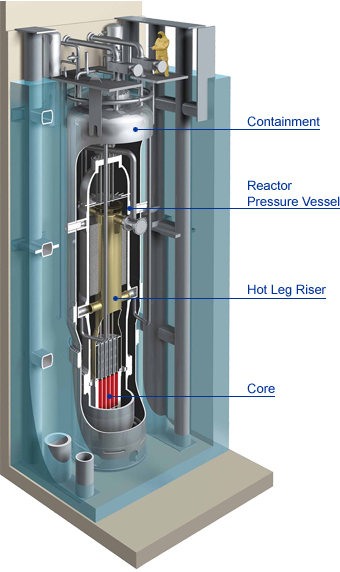
It may be more complicated, but in a certain sense it may also be simpler. Very small reactors, perhaps with an output of one or two megawatts, can be delivered to those remote locations. And even reactors with a thermal output of 50 megawatts need not take up much space. They may have a volume equivalent to, say, three shipping containers.
I assume that such a reactor would still first have to obtain a licence in a developed country with a tradition in nuclear energy…
Exactly. It would be necessary to obtain a licence in a developed country, and subsequently that licence, together with some experience of operating the reactor, could also be applied in another country with a less developed nuclear sector. First, the local regulator can be trained; second, oversight can be ensured because it is a reactor of such small dimensions. Extensive knowledge infrastructure would not necessarily be a prerequisite. It would simply involve delivering a product that you bring in, install and operate. And after some time, you take it away again.
However, it would probably require enhanced security. And if you have small reactors in various remote locations, the costs of providing security could presumably be much higher?
Not necessarily. Security would of course be required, but on the other hand, such a small reactor can be placed in a concrete sarcophagus deep underground. That is not such a major problem. The non-nuclear parts can be outside. We are talking about an area of the order of tens of square metres, which can be protected relatively easily.
There are assumptions – including in the United States – that the British regulator may be more flexible with regard to small modular reactors than the US regulator, for example. Do you think so too?
There is indeed an interesting difference between the British approach and the approach of regulators in the United States or continental Europe, including the Czech Republic. The British approach is goal-oriented. The British regulator says: prove to us that your solution is safe and we will approve it. In this respect, the British approach is not strictly prescriptive. But this does not apply only to nuclear energy; this is how all British legislation works. The British nuclear regulator naturally also has its guidance; it certainly does not say: do whatever you want. It tells you that if you follow certain guidance and meet all requirements, you will receive its approval. But if you propose another approach and convince the regulator that you will achieve the same goals, you will also receive approval.
Czech Republic like Britain?
We have spoken about a certain parallel between Britain and the Czech Republic. Both countries have significant know-how in the nuclear industry. Unlike the Czech Republic, however, Britain has already run into major problems because it now faces an acute shortage of energy sources. In the Czech Republic, by contrast, electricity exports are still the target of criticism.
The question is how much longer we will continue exporting it. Everything depends on the direction in which electricity consumption develops. I am deeply convinced that no country will be able to exist without what we call baseload – the base load of the grid. I do not think it will ever be possible to build the entire energy system solely on individual small sources. And in the Czech Republic, we will always arrive at the conclusion that we essentially have to have either nuclear power or gas. The United Kingdom is in a similar position.
Would not a significant breakthrough in electricity storage change that?
I think such a breakthrough will happen. Batteries will become cheaper. Personally, however, I think it will rather lead to consumption being split between consumption from domestic generation and consumption from the grid. I will have a car with a battery that I charge from my own solar power plant. But if it is cloudy, I will charge it from the grid. And if I am travelling, I will also have to recharge it from the grid. This is, of course, a very simple example, but I am convinced that even the best batteries will not provide electricity storage for an entire country.
You have said that small modular reactors could be used in the Czech Republic mainly for district heating. Does the fact that molten salt technology also holds potential for heat storage play a role?
Yes, salts are also used in non-nuclear applications, for example in solar power plants with large mirrors to produce heat. Salts have a high thermal capacity and can be used to store energy.
Could that be added value for energy production in small modular reactors?
It could, naturally with all the implications that entails. Whenever you convert one form of energy into another, you always incur losses.
An untested but promising path
Could you summarise where you see the greatest advantages and the biggest problems of small modular reactors?
I will start with the disadvantages. It is still an untested path, which is why there is talk of a valley of death in the development of small reactors. There are two critical points. The first is in development, where venture capital often comes into play. The United Kingdom recently launched a competition for small reactor technology designs. More than thirty different technologies entered. Most of them are backed by venture capital. These investors presumably sense that it makes sense if they are putting money into it. But there is an enormous risk that this money will be used to develop a technology that will then not find an application. The second risk is that the technology does find an application, the first small power plant is built, but no investor is found because of some serious issue – licensing or technological – or because the investor cannot be convinced that costs will fall for subsequent units, and no further construction takes place.
Is there not a parallel with another technology – nuclear fusion, where people have been saying for many decades that it really will be here in twenty years?
I do not think there is a parallel here. In the case of small modular reactors, we are closer. The United Kingdom has set itself the goal of having a small reactor built by 2030 at the latest. But it will be very important who licenses such a small modular reactor first and how long such a reactor operates before other countries begin replicating the licensing process.
So is it more a question of time?
It is a question of time, but in this case it is exceptionally important. You always have two essential success factors – you must have production and you must have a market. If these two factors do not come together by 2030, there are serious concerns that the entire idea of small modular reactors will fade away. And when I speak of disadvantages, they also include the as-yet unresolved issue of preventing the misuse of nuclear energy for other purposes. That is not a major problem in countries such as Britain or the Czech Republic, but it may be a problem in countries where we will be seeking a market for small reactors – that is, countries where there is no certainty that everything is under 100% control.
And where do you see the greatest advantages?
A major advantage of small reactors is that you need to invest a substantially smaller sum of money than in large reactors. This has significant implications for investment returns. In nuclear energy, a large part of the total investment always goes towards financing the project. When you have a smaller project, moreover one based on modular construction, it will be completed more quickly. Your costs per unit of capacity are also reduced thanks to cheaper financing. On the other hand, the disadvantage is that unit costs will be higher because economies of scale are at work. However, this disadvantage can be offset by modularity, a larger number of small manufactured units and the shared operation of a larger number of reactors. Other major advantages include factors I have already mentioned – substantial passive safety and flexibility of energy generation.
The author of the article, who also asked the questions, works as an energy projects specialist at the HATcom agency.
Translation disclaimer
This article is a machine translation of the Czech original and has not yet been fully reviewed. In case of any doubt, please refer to the Czech version.