Politics aside: Russian nuclear fuel conquers the West
Swedish company Vattenfall became “famous” in the Czech Republic for selling its German lignite mines to Czech businessmen Daniel Křetínský and Petr Kellner. More precisely, to the EPH holding, over which Křetínský is taking full control, and PPF Investments, through which Kellner, the Czech Republic’s wealthiest man, invests his money.
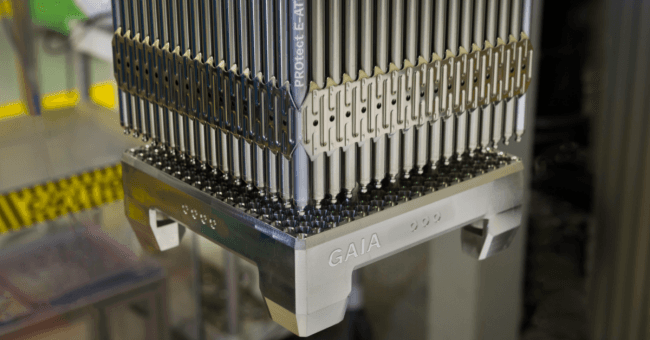
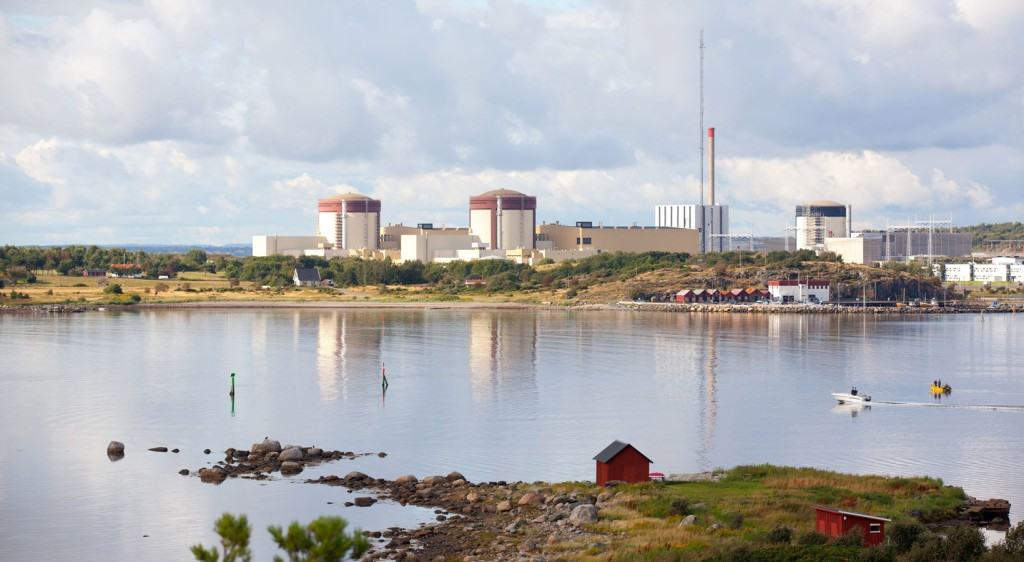
At the end of this year, however, the name Vattenfall is appearing in other global contexts that may also be of great interest to Czech observers. Thanks to an agreement with Vattenfall, Russian company TVEL, part of the Rosatom group, has secured its first commercial contract to supply nuclear fuel for Western-designed PWR pressurised water reactors. The fuel will be used at the Swedish Ringhals power plant, operated by Vattenfall. The Russians are to supply TVS-Kvadrat fuel for commercial operation from 2021; it has already been undergoing testing there for some time.
TVEL is known in the Czech Republic as a supplier of fuel for Russian-designed VVER reactors – currently including those at Temelín and Dukovany. TVEL representatives have previously declared a goal of increasing the company’s share of the global nuclear fuel market from 17 to 22 percent by 2030.
Breakthrough amid sanctions
The Russians will therefore be able to remember this year as one in which TVEL achieved a fairly significant breakthrough in Western markets. This comes at a time of still-intense tensions between Moscow and the West, and while US and EU economic sanctions against Russia remain in force. They do not, however, directly affect nuclear energy.
Already this May, TVEL formed a strategic alliance with the renowned US companyGE, or more precisely with its nuclear fuel manufacturing subsidiary Global Nuclear Fuel-Americas (GNF-A), based in North Carolina. GNF-A is a joint venture between GE and Japanese companies Hitachi and Toshiba, although the Americans played the decisive role in negotiations with the Russians.
In this case, the cooperation is intended to lead to the production of Russian TVS-Kvadrat nuclear fuel directly in America and its supply to nuclear power plants there. It may take many years before actual commercial deliveries begin. Yet the very creation of an alliance with a leading US company in such a strategic field as nuclear power plant fuel represents a major breakthrough.
GNF-A has assumed responsibility for managing the joint project with TVEL in the United States and is also to address the licensing of Russian fuel with the US regulator, the NRC.
Swedish move
When countries such as Turkey conclude energy agreements with Russia today, nobody is surprised. Yet neither in the United States before the inauguration of new President Donald Trump nor in Sweden was there any indication that these countries would be accommodating towards Russia in any way. Especially not in energy. In Sweden’s case, TVEL’s business partner is the state-controlled company Vattenfall.
Stanislav Mitrakhovich of Russia’s National Energy Security Fund, quoted by Nezavisimaya Gazeta, notes that Sweden is among Russia’s harshest critics. Stockholm supports tough anti-Russian sanctions and has reservations about the Nord Stream 2 gas pipeline project. In nuclear energy, the Swedes have until now cooperated extensively with Americans and Japanese.
Sweden is also home to a nuclear fuel manufacturing plant operated by another US company, Westinghouse, which is majority-controlled by the aforementioned Japanese company Toshiba. If Westinghouse won the planned tender to supply fuel to the Temelín nuclear power plant after 2020, it would produce that fuel in Sweden. Westinghouse, like TVEL and France’s Areva, has also secured a contract for part of future fuel supplies for units 3 and 4 at Ringhals.
TVEL versus Westinghouse
The situation at Sweden’s Ringhals nuclear power plant nevertheless gives TVEL hope that it has a chance to succeed in the entirely new market of Western-type PWR reactors. This is also important in its contest with traditional competitor Westinghouse.
Westinghouse supplies fuel not only for PWR units but also for Russian-type VVER reactors – currently for some reactors in Ukraine and, in the past, for Temelín as well. (By contrast, France’s Areva has not entered the VVER fuel market.) The contest between TVEL and Westinghouse will also play out again at Temelín in the coming years.
Nuclear power plant operators can in any case benefit from having two or more options to choose from. The Swedish example, however, also shows that playing politics makes no sense. Vattenfall is simply choosing the model it considers the most economically advantageous.
The important thing is to find a way to achieve the best possible price and the highest fuel quality. In the case of ČEZ’s planned tender for Temelín fuel, this will apparently effectively be a competition between two bidders (although more companies may be approached), in which nobody can be assured of any supplies in advance.
As for TVEL’s Swedish reference project, it may have value in countries that, like Sweden, are known for their emphasis on environmental protection. The Russians can argue that they had to meet demanding Swedish expectations in this area as well.
What is GE’s interest?
While the motivation of a power plant operator such as Vattenfall is clear, it is reasonable to ask what leads multinational engineering giant GE to cooperate with the Russians. In this case, too, the answer is not particularly difficult to find.
Together with Japanese company Hitachi, GE focuses on building a different type of reactor from the aforementioned PWR and VVER designs – namely BWR boiling water reactors. The same applies to GNF-A’s US fuel manufacturing plant in Wilmington, North Carolina, where the fuel produced is intended for boiling water reactors.
Cooperation with the Russians could thus open up the new PWR pressurised water reactor market to GE. Russian-designed TVS-Kvadrat fuel manufactured in America would thereby enter into direct competition with Westinghouse in the US as well. GE Hitachi has already begun providing certain services for PWR reactors in America, and the ability to supply fuel jointly with the Russians would further strengthen its position in this market.
America versus America

Cooperation between GE and Rosatom, TVEL’s parent company, does not end with nuclear fuel. GE Steam Power Systems, which acquired Alstom’s energy division, is actively seeking opportunities at Rosatom’s overseas construction projects, where it would like to supply its turbines.
The Americans have already struck a deal with the Russians to supply a GE turbine for Finland’s Hanhikivi power plant.
GE is now pursuing a similar goal in Hungary, where Rosatom is to expand the Paks nuclear power plant. It appears that the European Commission will no longer stand in the way on the condition that Rosatom launches a tender under European rules for a significant share of the subcontracts. Major contracts are therefore taking shape for non-Russian companies as well. This again favours further cooperation between Rosatom and the GE group, which will moreover manufacture the turbines in Europe. Two new nuclear power plant units are to be built at Paks.
A paradoxical situation is thus emerging in Hungary. US company Westinghouse strongly protested against Hungary’s agreement with Rosatom without launching a tender, and also against Brussels’ intention to turn a blind eye to it. Paradoxically, Westinghouse praised the Czechs, whom it otherwise continues to criticise for cancelling the previous Temelín tender – unlike Hungary, the Czech government wants to negotiate with all potential bidders if further units are built.
On the other hand, another US company, GE, is doing everything it can to become a Rosatom subcontractor at Paks as well.
The author works as a consultant and energy project specialist for the HATcom agency.
Translation disclaimer
This article is a machine translation of the Czech original and has not yet been fully reviewed. In case of any doubt, please refer to the Czech version.