Rosatom completes first reactor for new floating power plant. It is set to supply Arctic mines

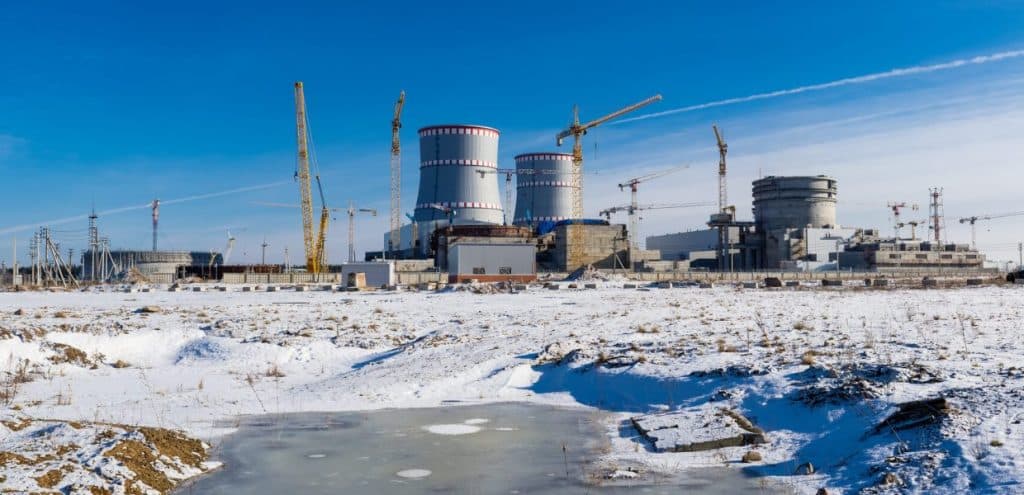
Russia has completed production of the first reactor for a new generation of floating nuclear power plants—facilities where the nuclear reactors are not on solid ground but on a special floating platform that can be towed to its destination. The 58-megawatt reactor was built at a plant near Moscow and will be one of two carried by the first new floating unit. It is intended to supply zero-emission electricity for copper mining in remote Arctic areas of Russia’s Far East. To this day, Russia remains the only country in the world actually operating a floating nuclear power plant.
The reactor was manufactured by the engineering division of Russia’s state-owned Rosatom corporation at the ZiO-Podolsk plant near Moscow. It is the first of two reactors that will be installed together on the first of a planned fleet of new floating units. Four such units are planned in total, and together they are to power a large mining complex in Chukotka. According to Rosatom, this will be the first time industrial mining is powered by electricity from a floating nuclear power plant.
Rosatom CEO Alexey Likhachev described completion of the first reactor as a significant milestone and noted that Russia remains the only country with an operating floating nuclear power plant, and wants to maintain that lead. The company is currently manufacturing 14 similar reactors in total—for floating power plants as well as nuclear icebreakers, for which the technology was originally developed.
What is a “floating power plant”?
A floating nuclear power plant is not a ship that sails somewhere under its own power. It is more like a large floating platform carrying nuclear reactors and all the associated machinery. The entire facility is built in a shipyard, then towed by tugboats to the coast at its destination, where it is anchored and connected to the mainland. From there, it sends electricity to the region—and, if needed, can also supply heat or drinking water if a desalination plant is connected.
The main advantage is that the unit can be moved. Nuclear fuel in the reactor lasts only a few years; when it needs to be replaced or major maintenance is required, the entire unit is towed back to its home port and another one can be brought to the site in the meantime. This means the region is not left without power. And because these units can be mass-produced in a shipyard, much like ships, they can save time and costs compared with building a conventional power plant on site.
This makes sense especially in places where it would be impossible to build a conventional power plant or extremely expensive to extend power lines: in remote Arctic regions, on distant coastlines, on islands, or near isolated mines and factories. Russia sends its floating units to precisely these kinds of locations and says the reactors used have proved themselves in harsh Arctic conditions.
The new reactors are designated RITM-200. They are compact nuclear reactors that Russia originally developed for its modern nuclear icebreakers, later deriving versions for power plants—both floating and land-based facilities in remote areas. A new floating unit is designed to have a capacity of up to 106 megawatts, with its fuel replaced approximately once every five to seven years, and a service life of around 40 years. To put that in perspective, this capacity can cover the needs of a small city and its associated industry.
Five years of experience: Akademik Lomonosov
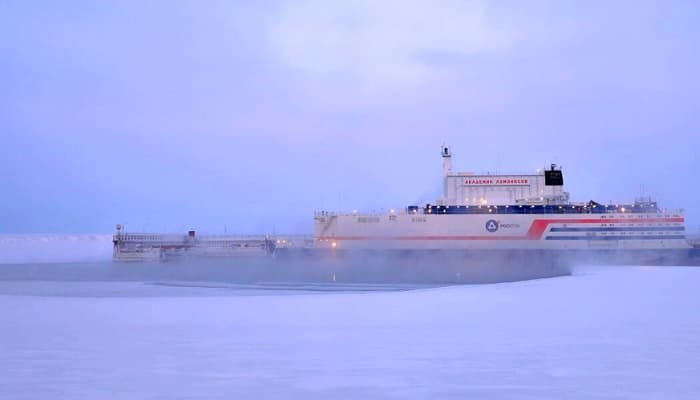
Proof that this is not just theory comes from the Akademik Lomonosov—so far the only floating nuclear power plant actually operating in the world. It has been operating in the port of Pevek in Chukotka since 2020 and is the northernmost nuclear power plant ever. It has older, less powerful reactors (around 70 megawatts combined) than the planned new units, but during its operation it has generated more than 1.2 TWh of electricity, according to Rosatom, replacing the aging Bilibino nuclear power plant and the local heating plant. Compared with it, the new units with RITM-200 reactors are intended to be smaller yet more powerful—a step from a proven pilot project to serial production.
A mobile nuclear plant with its critics
So far, the deployment of floating nuclear power plants has been almost exclusively a Russian undertaking, serving the country’s most remote regions. Rosatom also speaks openly about exporting the technology abroad and is preparing a version for the international market. China, for example, is also studying and developing its own floating nuclear power plant.
The technology also has its critics. Environmental organizations, led by Greenpeace, dubbed the Akademik Lomonosov project “floating Chernobyl” when it was launched and warned about the risks of operating a nuclear reactor at sea—including possible accidents, the handling of spent fuel, and the vulnerability of the sensitive Arctic environment. Supporters counter that in remote, cold regions where renewable energy sources are unreliable and people otherwise rely on fossil fuels for heating and lighting, small nuclear power sources—including floating ones—are among the few realistic ways to ensure a stable supply of clean energy.
Translation disclaimer
This article is a machine translation of the Czech original and has not yet been fully reviewed. In case of any doubt, please refer to the Czech version.