1 October 2026, 18:46
Loading...
Is a gas-based mix really better for Czechia than nuclear?
Vladimír Wagner
26 July 2021, 13:22
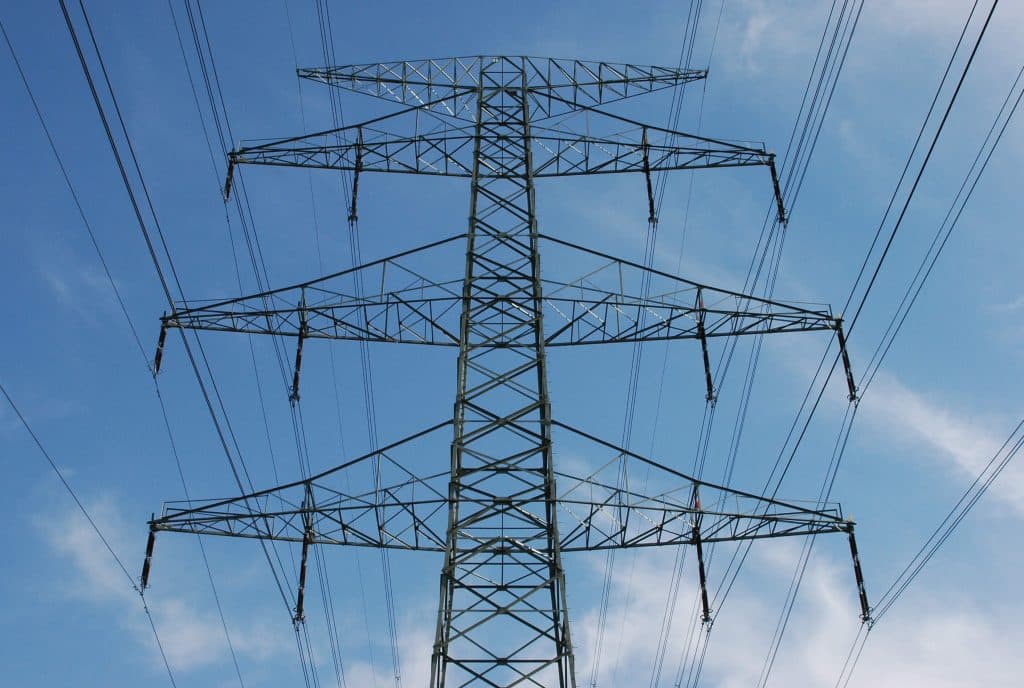
Coal-fired units will gradually have to be replaced. As the price of emissions allowances rises, the cost of not only coal-fired but also gas-fired electricity increases. The transition to a low-emission mix therefore needs to be accelerated. More important than speed, however, is ensuring that the mix we are moving towards suits our geographical and other conditions and is genuinely low-emission, efficient and environmentally sensitive.
A comprehensive interview on energy with Michal Šnobr was recently published. It is certainly interesting, and I recommend listening to it to anyone interested in the future of Czech energy. I fully agree with a number of the views he presents, but others are strongly influenced by the fact that he represents speculative shareholders in ČEZ, focused on rapid personal gain. His time horizons do not differ much from those of politicians, whose visions are primarily shaped by electoral terms and whose priority is winning elections.
Moving away from coal is a necessity; the optimum timing is the question
It has long been clear that Czechia will have to move away from coal, which still covers the largest share of its electricity and heat needs. In earlier years, the gradual phase-out of coal was driven mainly by the depletion of reserves, also limited by established mining limits, and by the gradual ageing of plants that ceased to meet increasingly demanding requirements for reducing pollutant emissions. At present, however, economic pressure caused by rising prices of carbon dioxide emissions allowances and European Union political pressure to close coal-fired power plants are increasingly coming into play.
I also agree with Michal Šnobr that the conditions for renewable sources are limited in Czechia. Since we have no windy coastline and the best wind conditions are in the most environmentally valuable mountainous areas, the realistic potential, especially for wind power, is not very large. Among renewables, the greatest potential lies in photovoltaics. Until the possibility of large-scale storage is resolved, opportunities in this area are also considerably limited. A large part of coal replacement must therefore be achieved either through gas-fired sources or nuclear reactors. I described a more detailed analysis of possible scenarios and risks associated with the transition away from coal-fired sources in an earlier article.
Rely on gas?
It is also true that Germany's Energiewende is based on a transition to a mix built on gas-fired sources combined with renewable ones. Gas will play a very important role there, and combined-cycle gas turbine units will also be used extensively. This is the main reason for Germany's intensive efforts to complete the Nord Stream II pipeline. It is also clear that, as a result, the use of gas combustion in the European Union will have very strong backing in the form of Germany. Michal Šnobr is relying on this when advocating the construction of combined-cycle gas turbine units in Czechia.
On the other hand, gas is not a low-emission source. As Michal Šnobr also notes in the interview, gas sources count only emissions released during combustion, which are half to one-third of those from coal. However, this is a purely formal approach by the European Union. In reality, when leakage during gas extraction and transport is included, greenhouse gas emissions from coal and gas sources are very similar. It is comparable to the situation of the massive replacement of coal in Europe by burning wood harvested in America and shipped across the ocean. This electricity generation from a “renewable” source is also formally clean in the European Union. In reality, however, it is an environmental crime. If the purpose of moving away from coal is to reduce greenhouse gas emissions and the anthropogenic impact on the climate, then replacing it with gas makes no sense whatsoever.
Another factor against gas is the dramatic increase in the price of emissions allowances. Although burning gas requires half as many allowances, as their price rises so does the price of electricity from gas-fired sources. Gas consumption can also be expected to increase, not only in Europe but especially in Asia, where, particularly in China, this is driven more by efforts to reduce harmful emissions choking cities than by efforts to curb carbon dioxide emissions. High prices for this commodity can therefore be expected. We can see now, for example, what high prices of emissions allowances and gas lead to. Electricity prices are becoming very high, and coal-fired sources are becoming competitive with gas again.
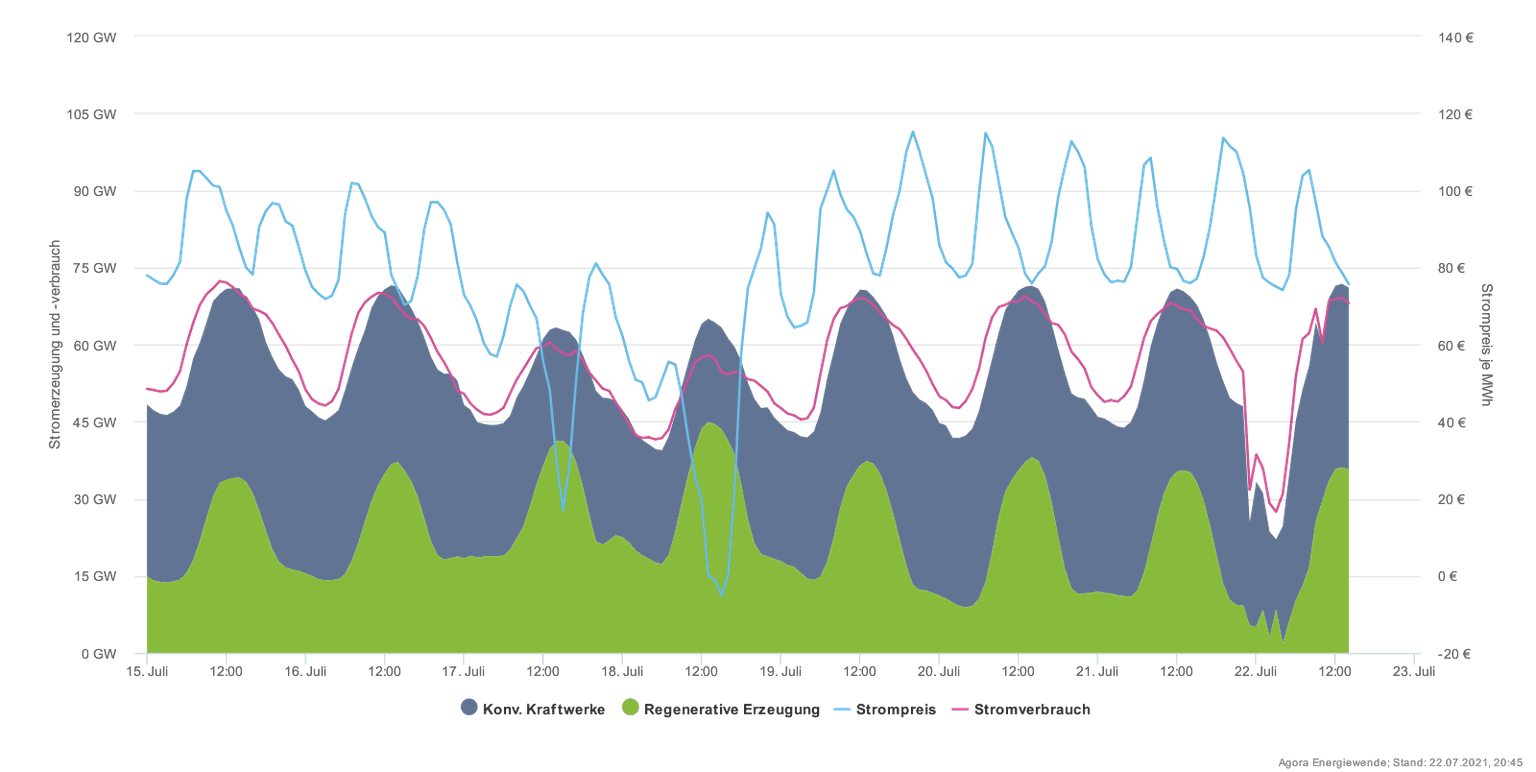
The impact of high emissions allowance and gas prices on electricity prices can be seen in Germany, which also sets prices in Czechia. The past week shows the situation under ideal conditions for photovoltaics. With low weekend consumption, prices can fall to negative values around noon. At other times, however, they range from 70 to almost 120 EUR/MWh. We can also see that conventional sources (grey) still provide a large share of the electricity generation needed in Germany. Germany also has to import some electricity to meet its consumption (purple line) outside the midday photovoltaic peak.
The major question is how the European Union will act when it becomes apparent that replacing coal with gas does not lead to a real reduction in greenhouse gas emissions. Moreover, in Germany and other countries proceeding with the closure of low-emission nuclear units, these too will be replaced by emitting gas-fired plants. We shall see how the public responds to the fact that the huge costs devoted to reducing greenhouse gas emissions do not actually lead to their reduction. It is therefore a question whether EU support for gas will change, just as its approach to replacing coal by massive wood burning is beginning to change.
Michal Šnobr believes Germany will defend gas. At the same time, however, there are countries that are retaining nuclear energy or have more favourable conditions for renewable sources, such as France, Finland, Sweden and Slovakia, and are therefore not as heavily dependent on gas for electricity generation. A change in the European Union's approach to gas cannot therefore be ruled out. Combined-cycle gas turbine plants also need a few decades to pay for themselves. Yet if the EU's position on gas changed, they could end up like the recently completed hard coal-fired power plants in Germany. One example is Moorburg, one of the most modern and efficient of them. Germany can afford such costly experiments, but they could be devastating for Czechia.
Or rely on nuclear?
The lifetime of nuclear sources exceeds sixty years. Investment in building a current large nuclear reactor is very high and must be made over a short period before it starts operation. The investment cost therefore makes up a large part of the electricity price. I thus agree with Michal Šnobr's view that building such a large, long-term investment is very difficult without state backing. The problem is that there is a very high political risk that construction or operation of a nuclear unit will be terminated prematurely. This risk is dramatically reduced if the state stands behind the project. At the same time, a large sum must be invested in construction, which usually requires a loan. The cost of money with state backing is much lower than for a private investor.
A nuclear power plant is a very long-term investment. The price of electricity from it also depends on the repayment period for the investment. It can be a state investment intended to ensure long-term energy supply at a reasonable price for industry and the population, or an investment by a family business aiming to secure long-term electricity supplies for future generations of the company's owners. In this case, given the reactor's very long lifetime, there is no need to insist on a rapid return on investment, and a low price of the electricity generated can be ensured.
The second option is an investment made by a private investor for rapid shareholder profit. In this case, the cost of borrowed money is higher, risk insurance is also more expensive, and the required payback period is shorter. The resulting electricity price is therefore relatively high. This is clearly illustrated by the expected price of electricity from the Hinkley Point C power plant, which uses an investor financing model. An example of a state investment is the Paks II power plant, for which a much lower electricity price is expected. Let us recall that the new unit at Dukovany is expected to use a state-backed financing model. In the European Union, large companies are dominated by firms owned by shareholders who, like Michal Šnobr, focus on rapid personal gain. This is also why it is almost impossible to build a nuclear unit in the European Union without state backing.
Michal Šnobr himself stresses that the gas mix they prefer is not low-emission. Gas is not a low-emission source; nuclear power is. It should also be recalled that the proposed new unit at Dukovany is primarily intended to replace the ageing Dukovany units. If their sixty-year operation can be secured, which may be difficult mainly for political reasons caused by pressure from our neighbours, timely commissioning of the new unit could result in a partial overlap in their operation. In any case, it would not be advisable to delay the preparation and implementation of its construction. Otherwise, we may end up replacing low-emission nuclear power with highly emitting gas, as in Germany.
Green activists very often put forward the idea that construction of nuclear sources is slow and that everything should therefore be focused on building renewable sources. In photovoltaics, even large capacities can be built relatively quickly, as demonstrated by the solar boom in 2010. The situation is different for wind power. Let us recall that we have two selected construction sites for nuclear units, Temelín and Dukovany, which have already undergone numerous assessments and permitting processes. There is also strong support for construction among the local population. We have nothing comparable for wind farms. It may be possible to build several wind turbines within a reasonable timeframe, but capacity equivalent to a nuclear unit can hardly be built faster than one.
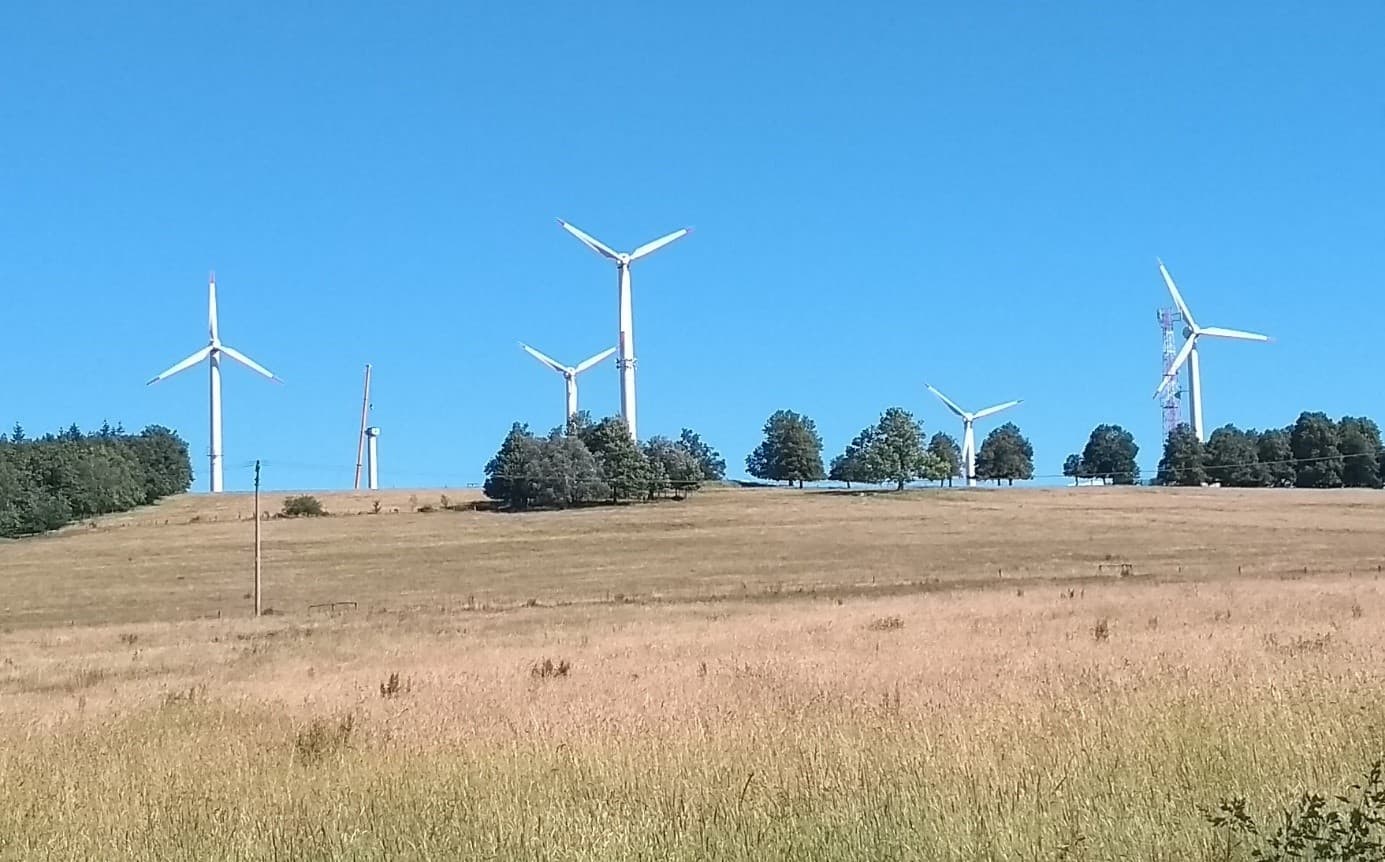
There are not yet many wind turbines in the Jizera Mountains, and they are rather small, but opposition to further construction will grow as their number increases. A few turbines are an interesting sight, but if turbines are everywhere you look in a tourist area, it becomes a problem. (Photo: Vladimír Wagner).
What could the optimum mix be?
If we really wanted to achieve a low-emission mix, the most efficient path would be a combination of nuclear and renewable sources. Photovoltaics are very well suited to covering daytime peaks, especially if the production peak can be broadened through suitable panel orientation. Nuclear units are then suitable for covering baseload. This is higher in winter, which can be reflected in an appropriate schedule for fuel replacement and maintenance outages. Assuming roughly current consumption and its profile, the optimum nuclear capacity for covering baseload is around 7 GWe. This could be ensured by two 1,2 GWe units replacing the existing four units at Dukovany, and by adding two identical units to the two existing ones at Temelín. Covering daytime peaks would require roughly 4 to 5 GWp of photovoltaics. A realistic expansion of wind sources could allow installed capacity of around 1 GWp. Let me only add that when solar conditions are excellent, Bavaria will have large surpluses of solar electricity. When it is very windy, northern Germany will have large surpluses of wind power.
If hydroelectric plants, especially pumped-storage plants, and biomass plants could be increased at least moderately, used primarily for balancing, and if a larger realistically available storage potential were added, the required capacity and, above all, the use of fossil sources could be greatly reduced. The total capacity of coal-fired and gas-fired sources could then fall below 3GWe. If they were used under a capacity payment regime, annual carbon dioxide emissions from electricity generation in Czechia would decline dramatically, by five to six times. From the perspective of actual greenhouse gas emissions, it might be preferable not to replace coal units with new combined-cycle gas turbine plants at all costs. It would be more sensible to replace them directly with low-emission sources. If we take data on Czech electricity consumption and operating conditions for weather-dependent sources from recent years, such a mix could fully ensure both capacity needs and total generation.
It is likely that the transition to electromobility and the electrification of other sectors, such as the rollout of heat pumps, will lead to higher electricity consumption and the need to address this. If commercial small modular reactors or a dramatic breakthrough in storage capabilities could be introduced in the 2030s and 2040s, it would conversely be possible to move away from fossil sources more quickly.
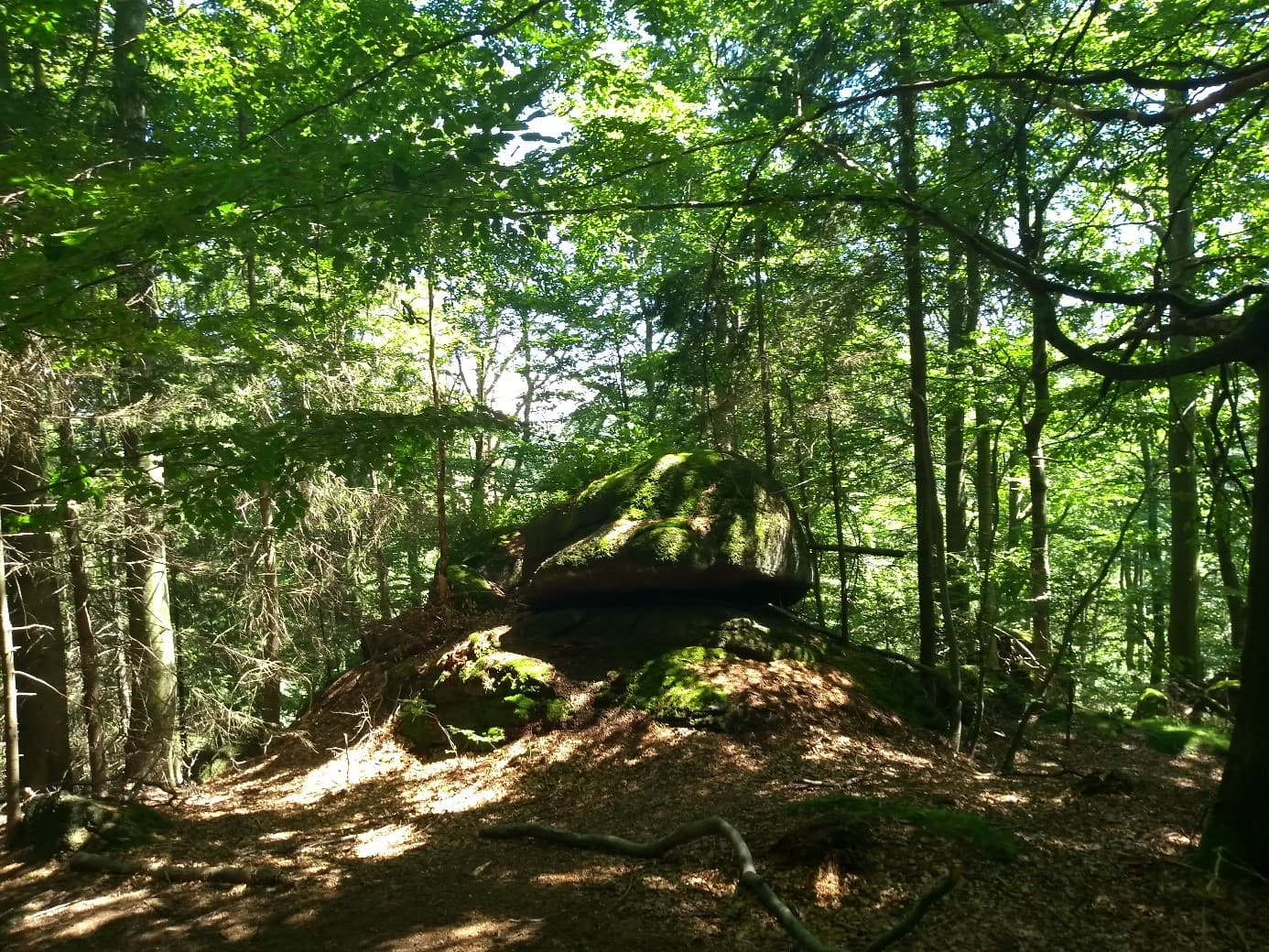
Beautiful mixed forests along the Jizera Mountains ridge trail. Let us be careful not to cause more environmental harm than benefit in the pursuit of reducing carbon dioxide emissions. (Photo: Vladimír Wagner).
Conclusion
Finally, a note on small modular reactors. The gradual increase in the size of nuclear reactors was not an end in itself; it improves economics. A similar process is also taking place with wind turbines, whose size is likewise gradually increasing. With a suitable financing model, a large unit is therefore cheaper than equivalent capacity in small units, particularly when you have a suitable construction site, as is the case with Dukovany and Temelín. Small modular reactors may become genuinely cheaper if they are truly produced modularly in sufficiently large series. However, if the first commercial small modular reactors arrive in the 2030s and 2040s, ramping up their series production to sufficient numbers for their economic parameters to take effect will not happen in time for us to wait for them before building new units at Dukovany. The current situation on the path towards small modular reactors is described in a recent article. Most likely, they will not displace large Generation III reactors, but will enable the use of nuclear sources in decentralised electricity generation and heating.
Postponing the decision to build a new nuclear source until commercial modular reactors are available would mean a dramatic delay in the transition to a low-emission mix. Support for the implementation of one unit at Dukovany, as well as support for building photovoltaic, wind and other renewable sources and storage and balancing elements, should demonstrate our capabilities in different areas and their real potential. How successful this will be depends heavily on political decisions. In this respect, like Michal Šnobr, I am very sceptical as to whether our politicians are capable of implementing strategic decisions. I wrote about this in more detail recently. I too doubt that they can build even a single nuclear unit. In the end, we will most likely end up extending the use of coal units and building combined-cycle gas turbine plants in haste.
We will be able to compare which path to a low-emission mix and to implementing nuclear construction is optimal by looking at countries that have taken different routes. We will see the outcome in Hungary, Finland, Slovakia, France and China, where they have decided to use a combination of nuclear and renewable sources. On the other hand, we will see how Germany's Energiewende fares and what it leads to.
The interview with Michal Šnobr is here: https://www.youtube.com/watch?v=8_iA4zLrFy0
An analysis of the present and future of nuclear energy is here: https://www.youtube.com/watch?v=5Qb5xkSHIcw
Translation disclaimer
This article is a machine translation of the Czech original and has not yet been fully reviewed. In case of any doubt, please refer to the Czech version.
Sdílejte článek prostřednictvím:
Topics:Opinion
You might also like
1 October 2026, 17:03
1 October 2026, 12:05