25 September 2026, 09:51
Loading...
South Korea returns to the path of nuclear energy development
Vladimír Wagner
14 October 2023, 11:59
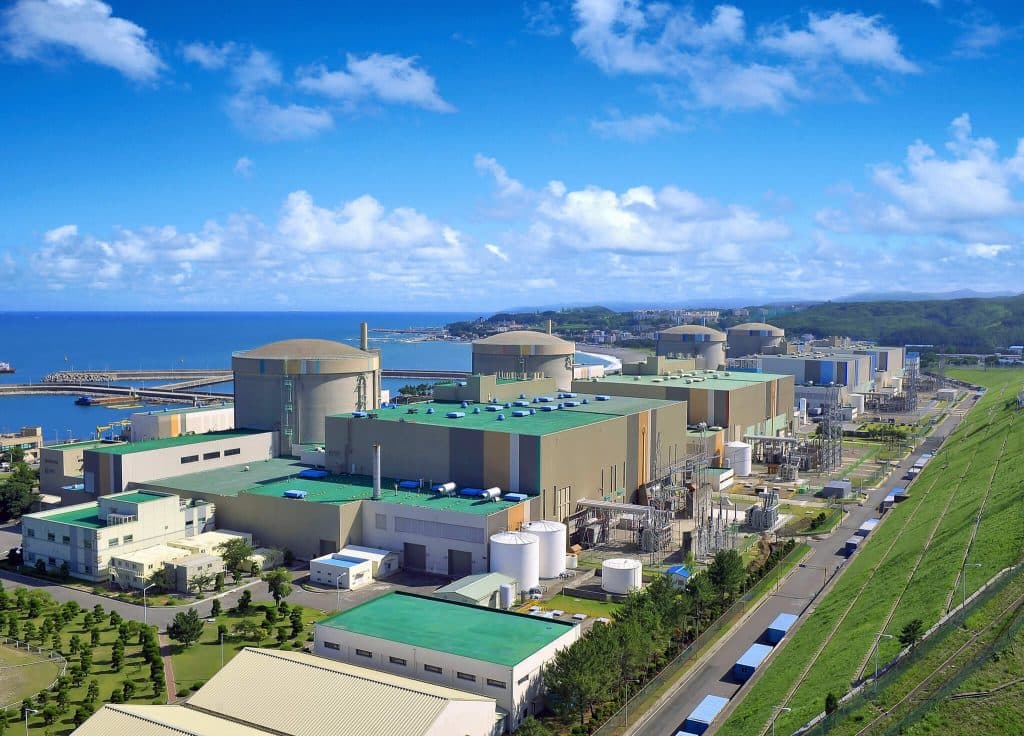
Events in recent years have clearly shown that South Korea cannot do without nuclear energy. Korean society has therefore changed its view of energy policy, and this was reflected in the election results. Further nuclear energy development is also part of the programme of South Korea’s new political leadership. This is very positive, as the South Korean nuclear industry is among the best in the world. Let us look at its experience and potential.
South Korea is among the countries with the most advanced nuclear industries. It is one of those offering Generation III reactors. It is currently participating, alongside France, which we wrote about recently, in the tender to build a new unit at the Dukovany nuclear power plant. It is therefore interesting to examine its experience and potential.
South Korea has an area only around 25 % larger than the Czech Republic, but nearly five times as many inhabitants. Moreover, its interior is highly mountainous. There is therefore relatively little suitable land for settlement, but also, for example, for deploying renewable energy sources. There are no continental shelves along most of its coast; instead, the seabed quickly becomes deep. This limits the potential for offshore wind turbines. South Korea must import energy commodities. As South Korea is located on a peninsula and borders North Korea, it cannot import electricity. The country has gradually become an industrial and economic power with corresponding energy consumption. These are the main reasons why South Korea chose to develop nuclear energy.
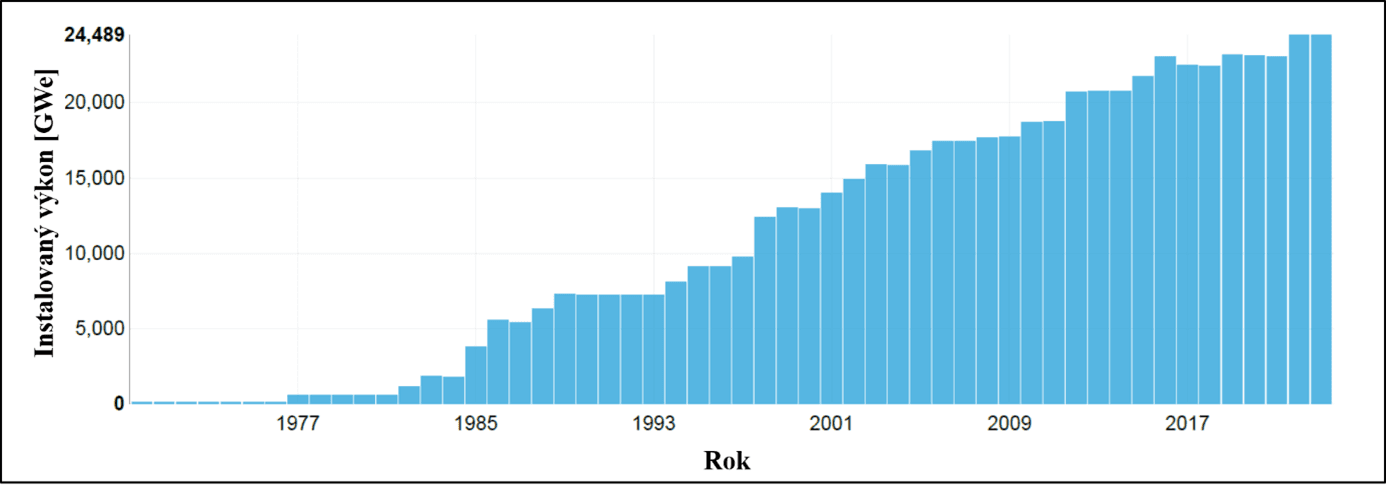
Development of total installed capacity of South Korean nuclear sources. The rapid growth in capacity is clearly visible (source: WNA).
History of Korean nuclear energy
South Korea began developing nuclear energy in the late 1950s. However, nuclear power plants only began entering operation in the 1970s. As in France, the Korean nuclear industry began with very strong US support. However, it also began cooperating with the French industry very early on. The first power reactor in South Korea was therefore built by Westinghouse at the Kori 1 plant; its commissioning took place in 1977 and it entered commercial operation in 1978. Seven Westinghouse and Framatome light-water reactors were then built in the 1980s.
Based on the experience gained and using the US model, the Korean industry embarked on developing its own pressurised water reactor model optimised for Asian markets. South Korea, as a developing industrial country, also wanted to participate in the export of nuclear technologies. This was the OPR-1000 (Optimum Power Reactor 1000 MWe) model, of which twelve are now operating at four power plants. These reactors enabled the rapid increase in electricity generation from nuclear sources at the end of the 1990s, and especially in the current century.
Nuclear energy – an important part of the Korean mix
As early as the first decade of this century, nuclear sources reached a share of more than 30 % of total electricity generation in South Korea. For completeness, it should be mentioned that this included four Canadian CANDU heavy-water reactors. Nuclear energy thus covered around one-third of South Korean needs and supplied the dominant share of low-emission electricity. South Korea planned to increase electricity generation from nuclear sources while also preparing to become an exporter of power reactors and other nuclear technologies. This is currently inconceivable without being able to offer a Generation III reactor.
This was the reason for developing the APR-1400 (Advanced Power Reactor 1400 MWe). It is an advanced Generation III pressurised water reactor. It is based on the OPR-1000 model and thus follows the original Westinghouse concepts, but successfully transitions to newly developed domestic technologies.
The first such reactor began supplying electricity to the grid in 2016. Its original name was Sin Kori (Shin Kori) 3; it is now designated Saeul 1. The Saeul 2 reactor (originally Sin Kori 4) began supplying electricity in 2019. Construction of these reactors began in 2008 and 2009.
Campaign against nuclear energy
As in other advanced Western countries, movements focused on opposing nuclear energy and promoting a transition to renewable sources also began to gain strength here. At the same time, they have major concerns about radioactivity and limited knowledge of its real properties, as well as minimal awareness of the real characteristics and potential of renewable sources. Anti-nuclear sentiment prevailed in society especially after the Fukushima nuclear power plant accident. In 2017, President Moon Jae-in came to power and began South Korea’s phase-out of nuclear energy. His government decided not to extend the operation of existing reactors beyond forty years. Thus, as early as June 2017, the oldest South Korean reactor, Kori 1, was shut down. The second reactor shut down was the oldest heavy-water unit. Although it was only approaching forty years of operation, having entered service in 1983, its operation was ended a few years earlier for technical and economic reasons. At the same time, preparations for construction of the Sin Hanul 3 and 4 units and the planned new Cheonji nuclear power plant were cancelled. Intense discussions also took place over the Sin Kori 5 and 6 units, now named Saeul 3 and 4. An appointed public commission decided to continue construction of these reactors.
It should be mentioned that even this leadership was not opposed to exporting South Korean nuclear technologies and seeking to build Korean Generation III reactors abroad. However, the question was how demand for them would be affected by their phase-out in the home country. When this Korean move away from nuclear energy began to develop, in May 2019 I wrote an overview of South Korean nuclear energy and also described my experience from visiting South Korean nuclear facilities and the Barakah plant in the United Arab Emirates. I expressed the view that reality would eventually lead South Korea back to nuclear energy development.
Challenges for Korean nuclear energy
And this prediction of mine was fully confirmed relatively soon. In 2022, a new political leadership headed by President Yoon Suk Yeol was elected, supporting nuclear energy development. First and foremost, the decision to end operation of all units after forty years was revoked. This concerns the Kori 2 unit, which was due to cease operation as early as 2023, and others. The problem, however, is that South Korea has a very strict and lengthy process for submitting and assessing applications for operating-life extensions. Since such applications could not be submitted until 2022, the operator had to plan for shutdown and did not prepare the relevant units for continued use. It is clear that some of the oldest units will have to be shut down for a period. This will last until all formal and technical requirements for their further operation are met. The aforementioned Kori 2 unit has therefore already had to suspend operation. Preparing older units for safe long-term operation beyond forty years is thus the first major challenge facing the South Korean nuclear industry. It has a great deal of work ahead in this respect in the coming years. At least one unit will be addressed every year until the end of the decade.
Another challenge is resuming construction of the Sin Hanul 3 and 4 reactors. Their construction was re-approved this year, and the start of site works is being prepared. Doosan has also begun manufacturing components for these units. Concrete pouring for the nuclear island should take place in 2025 and 2026, with completion of the units planned for 2032 and 2033. The question is where any further large reactors might be built. The land at the site of the planned new Cheonji power plant already has different owners and is designated for other uses. Land is a significant issue in South Korea, so the question of constructing any further APR1400 reactors or the planned more advanced APR+ version remains open and represents another challenge.
A major challenge is also securing and delivering further foreign contracts. Here, the Korean company KHNP can point to the highly successful project to build four APR1400 units at the Barakah plant in the United Arab Emirates. Three units are already in operation, with the third entering commercial operation at the end of February 2023, and the fourth should begin supplying electricity next year. For these units, it took approximately 8.5 years from first nuclear-island concrete to operation. Moreover, this involved a situation in which an entire nuclear sector, including a nuclear regulator, had to be built in the country completely from scratch.
Preparations for a second nuclear power plant in Poland look promising. It would be located at the site of the Pątnów coal-fired power plant in central Poland. KHNP would build two APR1400 reactors there for Polish energy companies PGE and ZE PAK, potentially eventually four in total. In October 2022, these companies signed an agreement for a future contract, and a preliminary feasibility study was completed at the end of last year. This year, intensive work is under way on its final version, site surveys, the EIA study and other preparatory work. The target date for the project’s first two units is the mid-2030s.
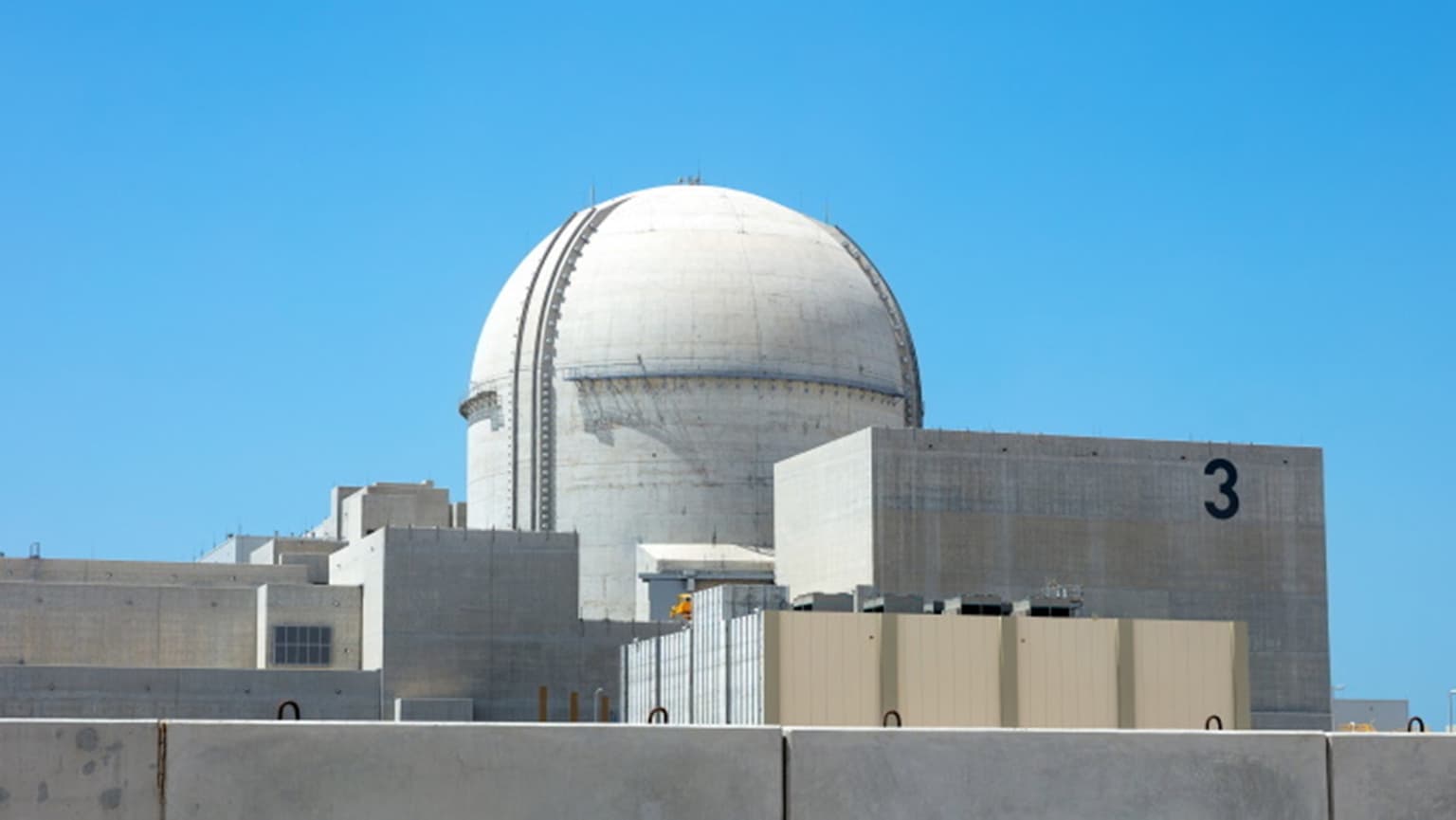
The third unit of the Barakah power plant (source: ENEN).
The South Korean nuclear industry is seeking further opportunities abroad, and not only in building nuclear reactors. Tritium removal facilities are important for heavy-water reactors. This year, under a contract signed in June 2023, KHNP began work on such a facility in Romania. It also plans to participate in the refurbishment of Unit 1 at the Cernavodă plant and completion of Units 3 and 4. These are CANDU heavy-water reactors. As already mentioned, South Korea has this reactor type at the Wolsong plant.
KHNP expects a renaissance and intensive development of the nuclear industry: around one-third of its capacity would be employed in refurbishing and supporting the safe operation of existing units, one-third in building new sources in South Korea, and the final third in exports. This should ensure efficient use of the industrial potential South Korea has in this field at home and abroad. Let us recall that Doosan also has significant capacity in Plzeň, Czech Republic.
Small modular reactors
South Korea also wants to harness the potential of small modular reactors. In July 2023, 42 public and private organisations established the Small Modular Reactor Alliance. This too is a sign of acceleration in this area. Since the beginning of the century, KHNP has worked on the SMART small compact integrated pressurised water reactor, with thermal capacity of 330 MWt and electrical capacity of 100 MWe. The project involved cooperation with Saudi Arabia, with subsequent exports of these reactors to the Middle East envisaged.
In 2020, work began on the i-SMR modular configuration, which would be optimised to replace electricity and heat production from coal-fired power plants. Individual modules would have an electrical capacity of 170 MWe. The option of using a configuration with one module as a small reactor is also envisaged, but a configuration with four modules and total electrical capacity of 680 MWe should be optimal. This could serve as an ideal and economically efficient replacement for coal-fired electricity and heat sources. A configuration of eight modules, with capacity of 1 360 MWe, could potentially replace ageing large nuclear units in the future. The configurations would be used not only for electricity and heat generation, but also for desalination and hydrogen production. Work is now under way on the basic design. They should be commercially offered in the 2030s. South Korea is also working on licensing conditions for small modular reactors.
Offer for the Dukovany tender – APR1000
South Korean company KHNP has entered the tender for a new unit at Dukovany with the APR1000 model. This is a scaled-down version of the APR1400, also optimised for European conditions. This reactor was successfully certified for the European Union between 2019 and 2023. Since March 2023, it has therefore been a reactor approved for EU conditions. Let us recall that the European version of the APR1400 unit has held this certification since 2017. Certification of the APR1000 unit was overseen and supported by CEZ (Czech Republic), Fortum (Finland), Tractebel (Belgium), EDF (France), EnergoAtom (Ukraine), Gen Energija (Slovenia) and NRG (the Netherlands). It is therefore clear that interest in such a unit is not limited to the Czech Republic. Work is now under way to certify this unit in its home country. KHNP is pursuing this not only because it is a condition of the Dukovany tender.
Along with the other two bidders, KHNP has submitted its final bid in the tender for the new Dukovany unit. All three will now be assessed. As the preceding text shows, this will certainly be a very strong offer with a substantial chance of success. It will be very interesting to gradually learn its details as they emerge. I would also mention one circumstance that often appears in the press. As stated in the section on the history of South Korean nuclear energy, Korean reactors were based on US Westinghouse models, with domestic solutions gradually replacing the US ones. The APR unit is therefore associated with a licensing dispute between KHNP and Westinghouse. It should be stressed that this is a dispute between companies which may have financial implications for KHNP, but does not affect the potential implementation of construction in the Czech Republic or Poland. Proceedings are under way in US courts, and one of Westinghouse’s claims was recently rejected. Indeed, in September 2023, a US court dismissed one of Westinghouse’s lawsuits.
We have already written about Doosan Škoda Power in Plzeň, but the intensive cooperation between South Korea and the Czech Republic in the nuclear field concerns not only industrial companies, but also research and education. Knowledge of the Czech environment and numerous collaborations with Czech industry promise a very significant share for Czech companies in implementation of construction should KHNP win the Dukovany tender. I wrote in greater detail about South Korea-Czech Republic cooperation in the nuclear field in the aforementioned 2019 overview.
Conclusion
South Korea is, and will remain in the future, one of the key players in nuclear energy technologies. It has now returned to developing nuclear energy in South Korea itself, which should increase nuclear electricity generation. This is a highly positive shift, important for the development of nuclear energy use worldwide. It is clear that its offer in the Dukovany tender will be very interesting. However, even if another bidder wins, KHNP will have a very strong role in the renaissance of nuclear energy in Europe. Cooperation between the Czech Republic and South Korea in nuclear technologies will also continue to develop and contribute to the European Union’s transition to low-emission energy.
Translation disclaimer
This article is a machine translation of the Czech original and has not yet been fully reviewed. In case of any doubt, please refer to the Czech version.
Sdílejte článek prostřednictvím:
Topics:Opinion
You might also like
24 September 2026, 11:23
24 September 2026, 10:30
24 September 2026, 06:56