25 September 2026, 09:51
Loading...
A fourth pumped-storage power plant to be built at Orlík Dam

oEnergetice.cz, ČTK
10 June 2026, 12:01
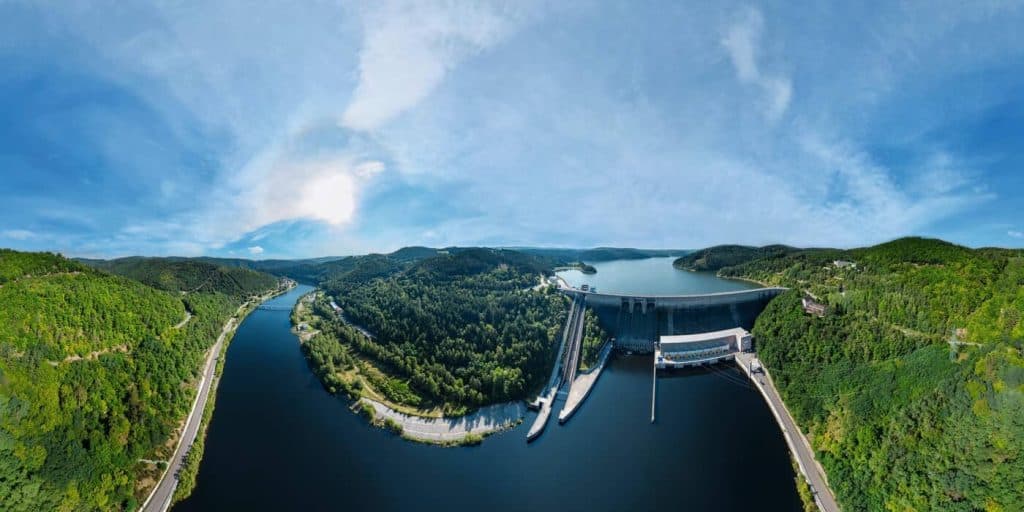
ČEZ will build a large pumped-storage power plant at Orlík Dam at a cost of eight billion crowns, making it the fourth facility of its kind in Czechia. ČEZ CEO and chairman Daniel Beneš told journalists today.
Thanks to a complete modernisation of the existing power plant, it will be possible to pump water to Orlík from the lower-lying Kamýk reservoir and store up to 750 MWh of energy at a time, he said. That is the daily consumption of 80,000 Czech households. The main phase of the modernisation will begin next year and is due to be completed in 2033.
Czechia currently has large pumped-storage power plants at Dlouhé stráně in the Šumperk region, Dalešice in the Třebíč region and Štěchovice near Prague. All are owned by ČEZ.
The modernisation at Orlík, for which Litostroj Engineering of the Wikov Group will be the general contractor, will enable two of the four generating units to operate in both directions. According to Beneš, the plant will therefore be 50% a conventional hydropower plant and 50% a pumped-storage plant.
Beneš and Deputy Prime Minister and Minister of Industry and Trade Karel Havlíček (ANO) recalled at today’s presentation of the project at the power plant that Czechia’s most recent pumped-storage power plant, Dlouhé stráně, was built 30 years ago. According to Beneš, the Orlík project had been in preparation for almost eight years and involved a complex public tender. In the final stage, the choice was between two major bidders from Czechia and Austria. "Only four companies worldwide have this expertise," Beneš noted. The winner submitted a better price offer, he said.
Havlíček said pumped-storage reservoirs had proven their worth and were a major trend worldwide. He welcomed the fact that the work for ČEZ would be supplied by a domestic company. Beneš pointed out that while the existing pumped-storage power plants in Czechia had been built from scratch, this project would modernise an existing facility.
Over the coming decades, Orlík is expected to serve as a large battery. The difference in water level between the Kamýk and Orlík reservoirs is 70 metres, which power engineers can use effectively. An advantage of the new pumped-storage power plant will be that it will be built within the existing facility and will not require additional land. The conversion should be carried out gradually, with at least two of the four generating units always remaining in operation.
Engineers will gradually modernise all four generating units at Orlík while retaining the plant’s total capacity of 364 MW. Capacity of two times 95 MW will be provided by conventional one-way turbines, while two times 87 MW will be used for pumped-storage operation thanks to the installation of reversible turbines. This will make it possible to store up to 750 MWh of energy at a time, increasing energy storage capacity at Czech pumped-storage power plants by more than 12%.
Most work is planned indoors, where technicians will dismantle the old equipment and install new technology. The plans include not only changing the type of some generating units, with two of the four original Kaplan turbines dating from 1961 to be replaced by Francis turbines, but also new generators and related equipment. The changes will enable operation in two modes – electricity generation and water pumping. During periods of surplus energy, water can be returned to the upper reservoir and energy stored. When electricity is needed, the entire process will be reversed and the plant will rapidly supply power to the grid.
"When, for example, there is a lot of sunshine, a lot of wind and insufficient demand, we pump water upwards. When there is a peak, we let it flow down. But this balancing takes place during the day; it is not a case of storing electricity for days, weeks or months," Beneš described the principle.
He noted that the operating rules permit only hourly changes. Petr Kubala, CEO of Povodí Vltavy, said the launch of the new power plant would not result in any major change in reservoir water levels. The maximum fall could be between two and 2.5 metres at Kamýk and up to 20 centimetres at Orlík. "All water-level fluctuations will remain within the scope of the existing operating rules," he added.
ČEZ has so far refurbished around 40 generating units at more than 20 hydropower plants, with the modernisation increasing the average efficiency of hydropower sources by four to ten percent, depending on the plant and turbine. Thanks to investments to date of around five billion crowns, the power plants will, according to ČEZ, be ready in the coming decades for zero-emission electricity generation, secure supplies and the production of the same volume of electricity using less water.
Translation disclaimer
This article is a machine translation of the Czech original and has not yet been fully reviewed. In case of any doubt, please refer to the Czech version.
Sdílejte článek prostřednictvím:
You might also like

24 September 2026, 11:23

24 September 2026, 10:30
24 September 2026, 06:56