China installed eight times more large-scale solar capacity than the EU last year

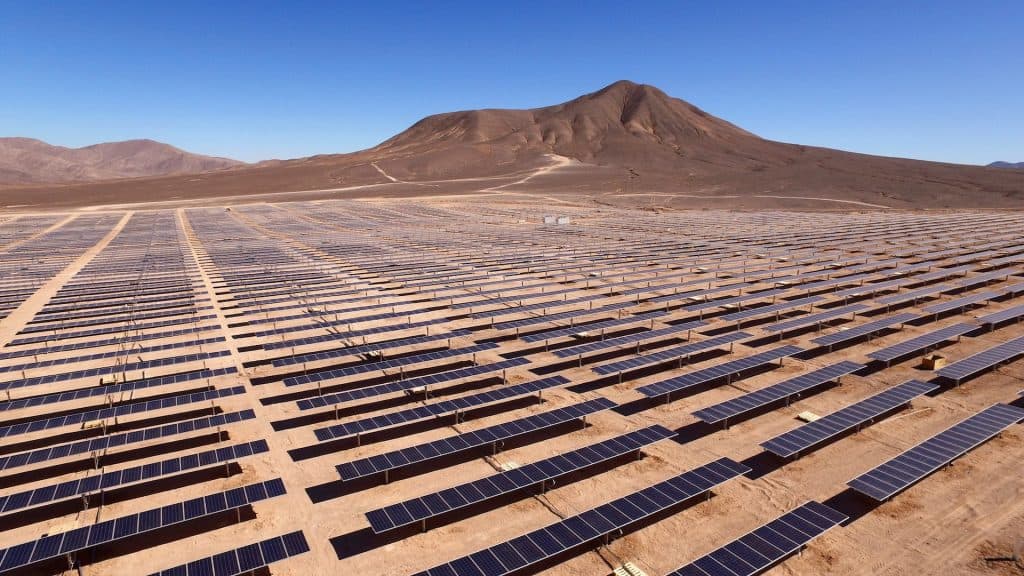
China dominated solar power plant installations in 2024. In just one year, 277 GW of large-scale solar capacity was built in the country, roughly four times as much as in the European Union. Projects in the Kubuqi Desert in the country’s northeast are particularly intriguing: because of their size and location, they have been dubbed the Great Solar Wall.
According to preliminary estimates by China’s National Energy Administration, the installed capacity of so-called utility-scale solar power plants—those with a capacity of more than 1 MW—exceeded 880 GW in China in 2024. China therefore has more large-scale solar power plants than any other country.
A total of 277 GW of utility-scale solar capacity was installed in China in 2024 alone. That is roughly eight times the amount installed in the European Union, where around 27.5 GW was added in the same year (utility-scale installations account for 42% of the total 65.5 GW), and more than twice the total 121 GW of utility-scale capacity connected in the United States by the end of 2024.
European countries are also lagging behind China in the total installed capacity of large solar farms. According to data from the European association SolarPower Europe, around 142 GW is currently operational in the EU, less than a quarter of China’s capacity.
Planned projects also suggest that China has no intention of slowing down in the coming years—in fact, quite the opposite. According to data from the Global Solar Power Tracker, compiled by Global Energy Monitor, more than 720 GW of solar capacity is under development: around 250 GW is under construction, nearly 300 GW is in the pre-construction phase, and 177 GW is in announced projects.
China is building a Great Solar Wall
Solar power is thriving in the country’s interior and north. Some of the largest projects are located in Inner Mongolia and the north of the country. Projects planned in the Kubuqi Desert in Inner Mongolia are particularly noteworthy.
It is a sandy, sparsely populated area that has become an attractive location for solar power projects thanks to its sunny weather, flat terrain and proximity to industrial centres. In the future, these projects are also expected to supply electricity to the whole of Beijing.
The installed capacity and number of projects here are so large that, because of their location in the north of the country, they are sometimes referred to as the Great Solar Wall. Plans envisage around 100 GW of installed capacity spread across sites up to 400 kilometres long and 5 kilometres wide, spanning Inner Mongolia and neighbouring regions.
Around 13 GW of this megaproject is already in the pre-construction phase. Other projects have also been announced, including the Ordos Desert Control solar farm and the Xinjiang-Sichuan Power Export solar farms. They boast the largest planned capacity among announced development projects, with each project set to have a capacity of 8.5 GW.
The area is also home to a solar farm resembling a galloping horse – Junma Solar Power Plant. Completed in 2019, it was entered into the Guinness Book of Records as the largest image created using solar panels. It generates approximately 2 TWh of electricity a year.
Translation disclaimer
This article is a machine translation of the Czech original and has not yet been fully reviewed. In case of any doubt, please refer to the Czech version.




