California is curtailing renewable generation more often. Solar curtailment rose by nearly a third last year

The U.S. state of California continues to expand renewable energy rapidly, particularly by building photovoltaic power plants. However, as their installed capacity grows, so does the need to curtail their output each year. Last year was no exception: the volume of unused generation rose again, reaching a new record.
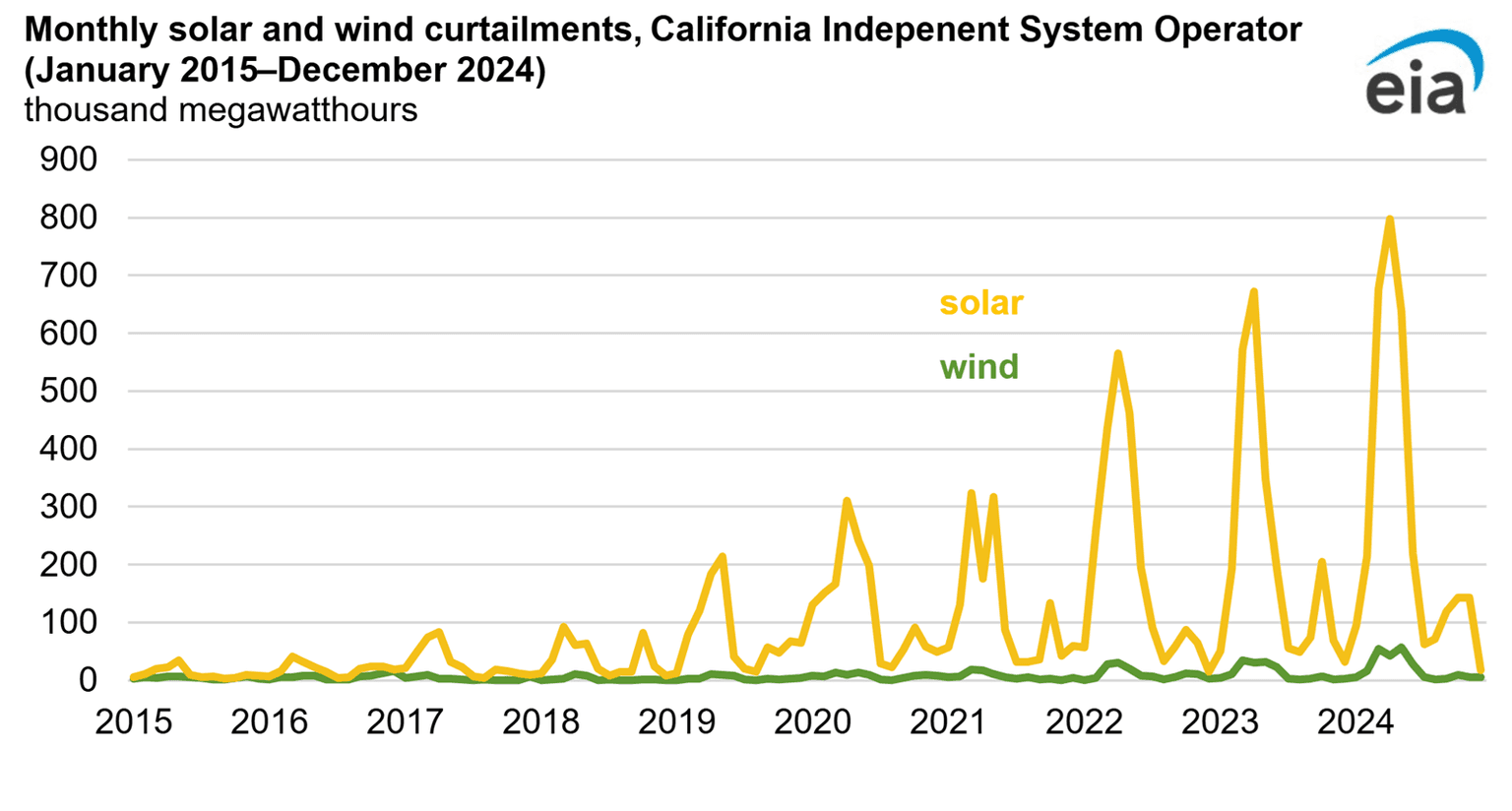
The California Independent System Operator (CAISO), which operates most of California’s power grid, is curtailing an increasing volume of renewable generation to balance supply and demand. According to the U.S. Energy Information Administration (EIA), CAISO curtailed 3.4 TWh of solar and wind generation last year. This represented a year-on-year increase of 29%.
According to the EIA, solar sources accounted for most of the curtailed generation—93% in total. CAISO curtailed output mainly in spring, when solar generation was already relatively strong but electricity demand was not. The growing curtailment of solar and wind generation is primarily linked to the increase in their installed capacity across California’s grid.
In 2014, California had 9.7 GW of solar and wind capacity; last year, the figure had reached 28.2 GW. However, these figures include only large solar and wind farms; smaller rooftop solar installations at homes and businesses also account for a substantial share of capacity. Overall, California has around 49 GW of photovoltaic capacity, including areas outside CAISO’s territory.
According to the EIA, California’s grid operator also curtails solar generation to make room for gas-fired power plants. A certain share of gas-fired plants must remain online to meet grid security requirements, particularly to cover evening demand peaks, when output from photovoltaics falls to zero.
Solar generation meets almost half of demand on the CAISO grid between 8 a.m. and 4 p.m. Demand rises in the late afternoon and evening, however, as households increase their consumption. Rising grid load and the need for electricity from sources other than solar are particularly evident on hot summer evenings, when solar plants are no longer generating and air-conditioning demand remains high.
Batteries and hydrogen offer a solution
The expansion of battery storage could help reduce solar curtailment, with hydrogen production potentially playing a role in the future as well. California’s installed capacity of large-scale battery storage rose to 11.6 GW last year, 45% higher than in 2023. According to the EIA, projects to produce green hydrogen, which will be blended into natural gas, are also gradually emerging in the state.
Translation disclaimer
This article is a machine translation of the Czech original and has not yet been fully reviewed. In case of any doubt, please refer to the Czech version.




