Czechia is at the bottom of the European Union in terms of renewable energy development, as data from the European statistical office Eurostat show. Acceleration zones, which the government is due to approve by the end of August following public consultation, could help.
The energy crisis caused by the US-Israeli attack on Iran has brought the ability of renewable energy sources to increase energy self-sufficiency back into the debate. Czechia has considerable potential in this respect, as renewables account for just 16.6 percent of total energy consumption in the country, according to Eurostat. Only Malta performs worse in the European Union in this regard. The EU average exceeds 47 percent.
By 2030, the share of renewables in Czechia’s gross energy consumption is to reach 30.1 percent. The target was set by the National Energy and Climate Plan of the Czech Republic (NECP), approved by the previous government, and Ministry of Industry spokesperson Štěpánka Filipová confirmed that efforts to meet it are continuing.
Martin Sedlák, programme director of the Modern Energy Association, points out that Czechia has set its targets correctly but is lagging behind in their implementation. “Czechia is still at the bottom of Europe in its use of renewables. It is crucial that planned capacity does not remain only in tables and strategies, but translates into real projects. The key will be agreement with municipalities and the ability to demonstrate the concrete benefits of wind energy for local residents,” Sedlák says.
“It is in the Czech Republic’s interest to keep pace with the trend of renewable energy development if it does not want to have more expensive electricity than other countries. It especially needs to step up on wind power,” says Karel Polanecký, energy expert at the Hnutí Duha environmental movement.
They want a “rational” mix
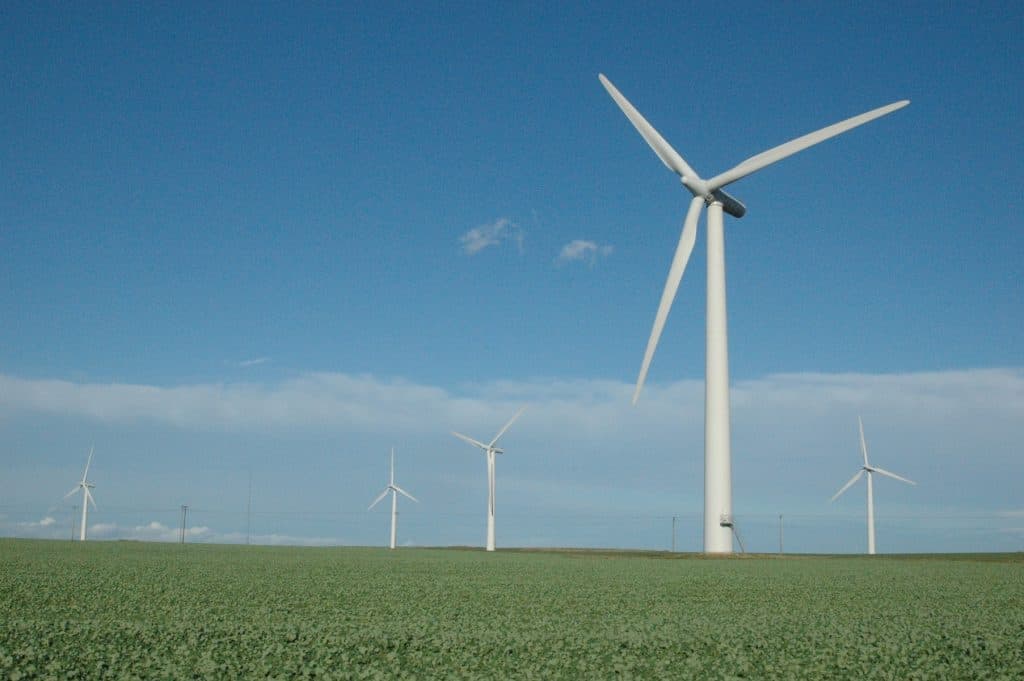
The biggest debate in the country at present concerns the development of wind power. The government has presented a proposal for acceleration zones in which wind and photovoltaic plants will be able to be built under an accelerated permitting regime. Czechia has committed to designating acceleration zones, so the government must do so by 31 August this year. Otherwise, Czechia will lose tens of billions in European funding.
“The Ministry of Industry and Trade aims to ensure that wind turbines are always developed with regard to the locations and their residents. Acceleration zones are suitable, for example, on degraded and industrial sites, such as brownfields or former mining areas. The development of wind power is assisted by operating support allocated through auctions; the second auction offered more than 360 MWe,” spokesperson Štěpánka Filipová said.
The official position of the current leadership of the Ministry of the Environment on renewables, and wind power in particular, is more reserved than that of the previous government. “Our position is not sceptical about the technology of wind turbines as such, but about their thoughtless placement in the Czech landscape. We see the path to a 30 percent share of renewables primarily in the massive development of rooftop and brownfield photovoltaics, the sensible use of biomass and the modernisation of hydropower plants. The priority is for sources to be stable and not disrupt either grid stability or the character of the landscape. We will meet the figures in the government’s commitments through a rational mix, not pressure,” ministry spokesperson Veronika Krejčí wrote to Ekonews.
63 percent of Czechs support wind turbines
According to a WindEurope study focusing on wind turbine installations in Europe in 2025 and the outlook to 2030, wind energy covered approximately 19 percent of electricity consumption in the European Union. €45 billion was invested in new projects in 2025.
The largest additions of new capacity were recorded mainly in Germany, which contributed more than 5,200 megawatts, Turkey with 2,100 MW and Sweden with 1,800 MW. The share of wind energy is also growing in Poland, which added 800 MW of new capacity last year.
The total installed capacity of Czech wind power plants reached 372 MW, representing one percent of total installed European capacity. Only 13 MW of wind capacity was installed in Czechia last year. Even war-torn Ukraine managed to install more capacity, adding 325 MW.
“Wind energy is a clean and affordable source, while Czech companies also manufacture components for the construction of wind turbines,” recalls Sedlák of the Modern Energy Association.
According to a recent March survey by the Focus agency, around 63 percent of people in Czechia support wind power. Only 13 percent oppose its expansion. As the Fakta o klimatu platform notes, wind generates less than one percent of renewable electricity in Czechia.
Photovoltaics are no longer growing as quickly
Between 2022 and 2024, Czechia managed to connect around one gigawatt of new solar plants each year. However, after years of record growth, photovoltaic development has now slowed. Data from the Solar Association show that the total number of newly connected photovoltaic plants fell last year to 27,300, with a total peak capacity of 696 MWp. Compared with 2024, this represents a drop of more than 17,000 installations and 271 MWp, or nearly one-third of capacity.
The main reason for the overall decline in the Czech market is the situation in the household segment. “This development is again due to the interruption of subsidy programmes, which also led to the collapse of several installation companies,” the Solar Association states.
By contrast, the corporate sector is growing. “It has also taken off thanks to interest-free loans from the National Development Bank, with which we cooperate. Although we also see a slight decline here compared with last year, we expect this segment to maintain its pace in the coming period,” says Jan Krčmář, executive director of the Solar Association.
While photovoltaic construction is stagnating, the deployment of battery storage is growing. An important impetus came from the Lex OZE III amendment, which from 1 October 2025 enabled standalone battery systems to connect to the grid and opened the market for them to provide balancing services and flexibility trading.
Biomethane for longer support
The Modern Energy Association points out that biomethane production plays an essential role in European energy sovereignty. In Czechia, biogas and biomethane production (a purified version of biogas, editor’s note) is the dominant renewable energy source. They use biomass or food waste. According to the CZ Biom association, the country has biogas plants with electrical capacity of around 500 MW.
“The Czech Republic aims to produce almost 500 million cubic metres of biomethane in 2030. If used in transport in the form of bio-CNG, this amount could replace diesel for all buses in Czechia,” says Jan Habart, chairman of the CZ Biom association. “However, production last year reached only 17 million cubic metres, and the development of the sector cannot do without massive investment in the expansion of biomethane plants,” Habart adds.
Auctions that the Ministry of Industry and Trade plans to announce at the end of April are intended to support production of this green gas. They are to support biogas plants in upgrading for biomethane production. Most biogas plants built during the “boom” between 2011 and 2013 will see their operating support end after twenty years, i.e. around 2031 to 2033. If a biogas plant begins purifying gas and injecting it into the grid, it can receive support for another fifteen years.
In recent days, representatives of six agricultural and energy organisations have signed the “Call for the sensible development of biogas”. The document, addressed by the signatories to the Ministry of Industry and Trade and the Ministry of Agriculture, warns that excessive support for biomethane may not be suitable for all biogas plants. “Neglecting combined heat and power generation could ultimately lead to a wave of biogas plant closures where conversion to biomethane would not make economic or technological sense,” the statement says.