A fence at a family home in Velká Chuchle can generate electricity. The original wooden pickets have been replaced by unusual solar panels. It has thus become one of nearly 41 thousand new power plants connected to the grid last year.
In the part of Velká Chuchle set on a hillside sloping down towards the Vltava, you feel more as though you are somewhere outside Prague than in a bustling metropolis. This is mainly thanks to the surrounding greenery, rocks and picturesque views. The local idyll is spoiled only by noise from the nearby Strakonická road, which reaches here with every passing car. Although the busy road linking the capital with southern Bohemia is part of local life, not everyone has grown used to it.
Viktor Kobes particularly dislikes the noise. That is one reason why he began leaning towards vehicles with quieter drivetrains. Some time ago, he first bought a plug-in hybrid and then a fully battery-electric car. He would like the roar of engines from the surrounding roads to disappear altogether.
“Motorcycles should be banned first, because when motorcyclists occasionally practise riding at 200 km/h on Strakonická at night, it makes a terrible racket. The same goes for the hairpin bends here,” he says, pointing to the places where the road rises from Velká Chuchle towards Slivenec.
He is referring to the planned European Union ban on the sale of new cars with internal combustion engines from 2035. From that year, new cars sold in the EU should produce no local carbon dioxide emissions.
Just as Viktor Kobes is a fan of cleaner mobility, he liked the idea of generating electricity from the sun to cover at least part of his home’s consumption. Running his car could thus become even cheaper, while his household would become more energy-independent.
He searched for a company for two years
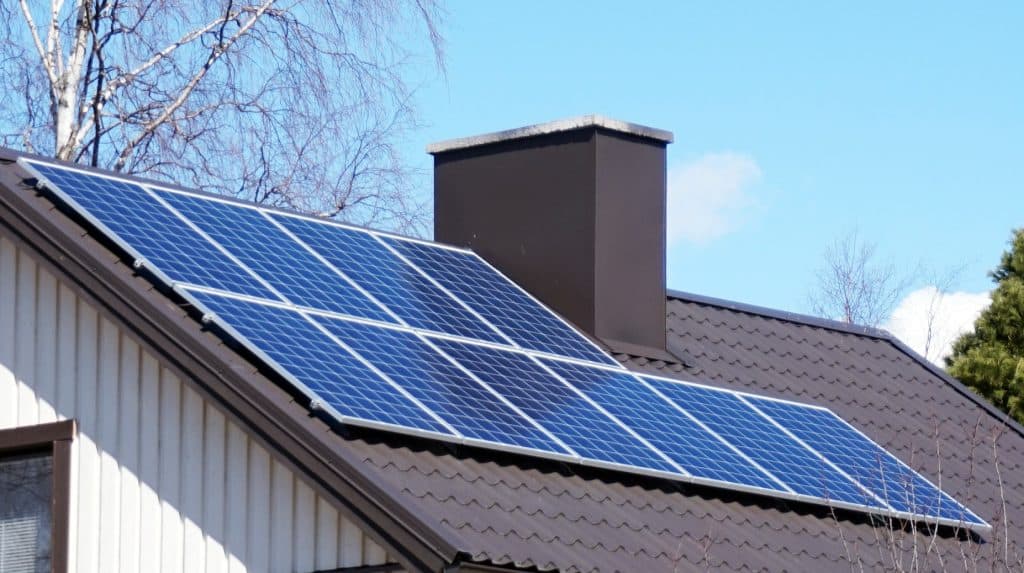
However, the roof, most commonly used for this purpose on family homes, was off limits in his case. “It is too complicated,” he says, pointing to the house covered with red tiles. The roof is irregular, with roof windows and dormers. “There is not enough space for solar panels, and it probably would not look good either,” he believes.
When considering where to place the solar installation, he initially also looked at solar roof tiles. Their main advantage is that they look like ordinary fired-clay tiles. Moreover, each contains just one solar cell.
However, he rejected this option because of its higher price and more complicated maintenance. Ground-mounted solar panels also made no sense at his family home, as the plot is partly shaded. That left the carport and the fence. Kobes decided to use both.
His idea, which required a more complex solution than simply placing panels on the roof, did not generate much enthusiasm among solar installation suppliers. “Nobody wanted to take it on. I looked for a company willing to build the fence for two years,” he says.
In the end, two companies took it on: a manufacturer of aluminium pergolas and an installation company from the Rokycany region, which likes unusual solar projects. “Most companies do not want to take on atypical installations, but we like challenges and seek new, individual and unconventional solutions. Previously, for example, we had carried out solar projects on façades, ground-mounted installations and bespoke carports,” says Petr Šolek, the company’s co-founder and director.
The solar fence was a first for them, although they had previously considered adding it to their offering. “It is an unconventional solution, but it may be suitable for someone who has no other place to put solar panels,” Šolek explains.
The most complicated part was working out how to install the gate in relation to the cables that needed to be run.
Building the fence cost around half a million crowns. The solar section cost roughly 200 thousand, while the rest went on the aluminium structure. The price also includes three spare solar panels that Viktor Kobes has stored in case one needs replacing.
It captures rays from east and west
It is not immediately obvious that this is a fence made of solar panels. An ordinary passer-by will probably notice only that it looks completely different from those at neighbouring homes. That is why it attracts attention. Only after a moment does one realise what it is made of.
The panels making up the fence are framed by a grey aluminium structure, while the individual sections are separated by concrete posts. The whole thing looks elegant and modern, almost as if it were an unusual designer creation.
The fence separates a well-kept garden from a quiet street in a residential neighbourhood, with little foot traffic and few cars. On the garden side, the panels receive sunlight from the east. The surrounding shrubs are trimmed, nothing shades the panels, and they can generate electricity during the morning. When the sun moves west after midday, the part of the fence facing the street generates electricity.
Kobes started the project last year. He waited two months for the panels and another month for the structure. The fence began producing electricity at the turn of October and November. Although the panels work even when it is cloudy, their output is not the same on overcast days. This is particularly true in winter, when there is also less daylight. “Output over the winter averaged between three and six hundred watts. I expect it to improve in spring,” Kobes says.
The fence has a nameplate capacity of 4.5 kW, while the carport has a capacity of around three kilowatts. Kobes wants to responsibly assess how much electricity the solar installation can actually generate and what consumption it can cover only in summer, or once the power plant has been operating for a full year. “I have only been generating for a few months now, and it is also the worst part of the year,” Kobes explains.
Will it attract vandals?
The orientation and tilt of panels are important for optimal solar performance. It is best to face them south, or towards several cardinal directions other than north. At Czech latitudes, the ideal panel tilt is approximately 35 degrees. The solar panels forming the fence, which stands perpendicular to the ground, therefore have lower efficiency than panels installed under ideal conditions. The loss is expected to range between ten and twenty percent.
However, Kobes has factored this in. The advantage of his project is the combination of solar panels on the carport and the fence, which does not have an ideal tilt but can generate electricity from both sides. This gives him a supply of solar energy throughout the day in summer. If neither the household nor the car uses the electricity produced, and Kobes does not want to send it to the grid, he can store surplus power in a battery for later.
Although Czechia has experienced a boom in household solar power plants in recent years and solar panels are now seen much more often on family homes, they are most commonly installed on roofs. Installations on façades or fences are less common. Besides the aforementioned tilt, Pavel Hrzina of the Solar Association sees further drawbacks and risks. “In structural terms, a solar fence is the same as any other fence made of glass panels. It will therefore be more vulnerable to damage from flying stones and, unfortunately, will also invite vandalism,” he says.
According to distributors’ data, nearly 41 thousand new solar power plants with a maximum capacity of 967 megawatts were connected to the grid in Czechia last year, alongside Viktor Kobes’s installation. These were mainly households, which added installations with a combined capacity of 429 megawatts. More than 84 percent of the power plants were supplemented with batteries, and the average capacity of a power plant reached 10.5 kilowatts.
However, installed capacity at family homes was half that of the previous year. Demand was affected both by changes to available subsidies and by lower energy prices. More companies, on the other hand, began building their own energy sources.
The article was published in Reportér magazine.