9 October 2026, 06:22
Loading...
Solar boom on Czech apartment blocks: up to five million available and 70% savings on electricity costs
Ekonews.cz
3 October 2024, 15:59
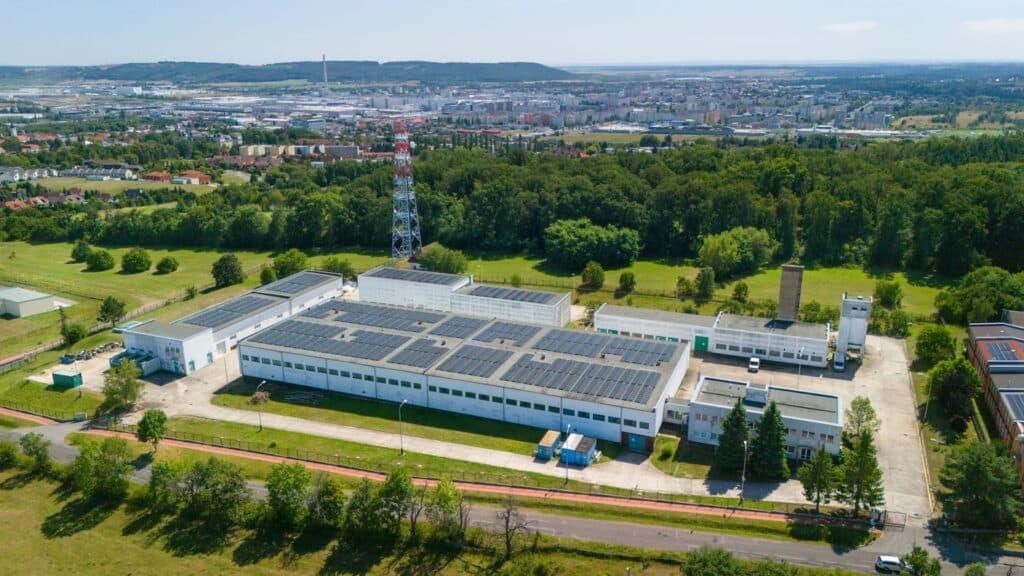
Interest among unit owners’ associations in apartment buildings in installing photovoltaics has increased tenfold this year. They are also attracted by the upfront payment of subsidies. The associations are now learning how to share energy and send it, for example, to municipal buildings and private companies.
A beige three-storey building in Ostrov, in the Karlovy Vary region, has three entrances, 24 apartments and, since this March, 76 photovoltaic panels on its roof that convert sunlight into electricity. In total, this photovoltaic power plant (PV plant) has an output of 31 kilowatts in full sunlight. It is also connected to a battery with a capacity of 58 kilowatt-hours.
For the local unit owners’ association (SVJ) to acquire a photovoltaic power plant was a logical step. “In the past, we completely insulated the building, added new insulation, replaced the roof covering, upgraded the electrical wiring and so on,” says Roman Kubišta, vice-chairman of the SVJ.
“In 2009, we completed our first PV plant with an installed capacity of 14 kWp, which is connected directly to the distribution grid. This year, another electricity source followed. This PV plant supplies electricity directly to the individual apartments and common areas of the building, adds Kubišta, who was involved in the project from the outset.
Overall, the power plant, including battery storage and the establishment of a single metering point, cost several million Czech crowns. The SVJ covered most of the costs from its savings and used a subsidy from the New Green Savings programme for apartment buildings for the remainder.
According to Kubišta, obtaining the support went smoothly. “We still applied under the older rules, when the subsidy was provided after completion of the investment project and connection of the source to the distribution grid. Today, the situation regarding subsidies is even more favourable,” Kubišta says.
Built and connected within a year
Twenty-three of the association’s 24 members agreed on the acquisition and technical solution for the power plant. As Kubišta explains, using photovoltaics in an apartment building can be technically arranged in several ways – from those that are administratively simpler, less demanding in terms of time and cost, to those that are more technically, administratively and time-consuming.
“We assessed all the options and ultimately chose the solution that brings us the greatest possible economic benefit. We also selected Bluenet NTS, a company with dozens of similar projects behind it,” Kubišta stresses. However, negotiations with the distribution company were the most demanding part, he says. In total, implementation took almost a year, from signing the contract to connecting to the distributor.
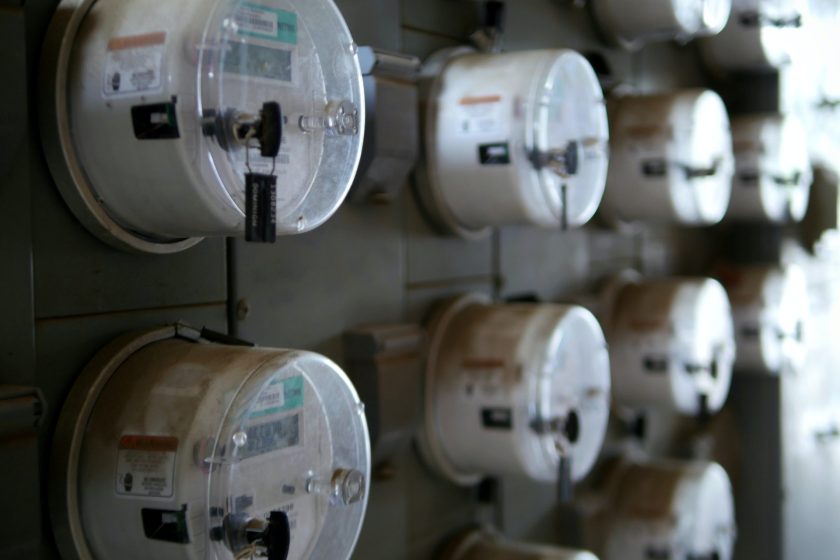
The owners divide the electricity generated so that each apartment is entitled to an amount of electricity from the photovoltaic power plant corresponding to its share of the floor area. The Ostrov SVJ is approaching the point where it will cover 70 percent of its consumption from photovoltaic panels and the battery. The expected savings should correspond to this, meaning that people’s electricity expenses will fall by an average of 70 percent.
“We are currently preparing to use surpluses by sharing electricity with buildings owned by our town and other private companies in Ostrov. For the pilot programme, we selected a primary and nursery school, an elementary art school, the municipal swimming pool, as well as, for example, a deli. The necessary registration with the Electricity Data Centre is currently under way, Kubišta explains.
He expects to send the first shared kilowatt-hours to these buildings within a few months. So far, the association is satisfied with the progress of the power plant’s trial operation, which is meeting its expectations. However, Kubišta would advise other SVJs to install PV systems only on buildings that are in good technical condition. “A properly designed photovoltaic power plant offers the potential for substantial savings, but installing a PV system on a semi-derelict building with a leaking roof and faulty electrical wiring seems rather foolish,” Kubišta says.
Interest is tenfold higher
The Ostrov building is one of many in Czechia that have decided to generate their own electricity. Over the past year, it has even been possible to speak of a solar boom on the roofs of apartment buildings. “Interest from SVJs in photovoltaic power plants is more than ten times higher than last year,” notes René Milota, managing director of Acetex, a company specialising in PV systems.
“One reason is the more favourable design of the New Green Savings subsidy scheme, where support is provided in the form of a subsidy paid upfront,” Milota explains. Growing demand is also driven, he says, by the simplified approval process: installing photovoltaics on an apartment building now requires the consent of a simple majority of apartment owners, whereas before 2023 the consent of ideally all owners was required.
For each entrance, Acetex typically installs a power plant with an output of 15 to 30 kWp. Several factors determine how much a building can save thanks to the plant. “It depends on the type of PV system configuration. An installation with a battery makes the most sense, because without one apartment owners save only 20 to 25 percent on energy costs, whereas with a battery they save 50 to 90 percent depending on battery size and on switching their electricity supplier from fixed prices to spot prices,” Milota explains.
A simple rule applies: the larger the battery, the higher the energy savings. “Associations are usually most concerned about investing in batteries, but this is not a rational assessment, because apartment buildings are eligible for a high subsidy for batteries,” Milota says. A typical 50 percent subsidy for an apartment building seeking an installation with batteries ranges roughly from 800,000 to five million Czech crowns.
35 applications arrive each month
The growing interest is also evidenced by data from the Czech State Environmental Fund, which administers the subsidy. From last September, when the programme was launched, to the end of the year, the fund received 82 applications worth almost 64 million Czech crowns. That is an average of 25 applications per month. This year, it has received 276 applications worth 233 million, or 35 applications per month. Owners of apartment buildings most often seek insulation of the building envelope, with photovoltaic power plants usually forming part of larger projects.
“In the case of PV systems for apartment buildings, support is calculated based on the installed capacity of the photovoltaic panels, the capacity of the storage system and the number of connected apartments. There is no cap on it. Essentially, the only limitation is the size of the roof on which unit owners’ associations and housing cooperatives want to install photovoltaics, says Stanislava Beyerová, spokeswoman for the fund.
According to Milota, it is ideal to store electricity in large-capacity batteries during hours when it is cheap, free or negative on the spot market. Their advantage is that during periods of high prices – for example, in the evening – apartments can consume electricity from the battery that was either generated from solar power or purchased by the SVJ at the lowest spot prices of the day. “At the same time, the battery can retain a reserve for sale on the spot market when prices are highest, for example between seven and nine in the evening. By storing cheaper energy in large-capacity batteries, the building locks in a low electricity price for evening consumption,” Milota explains.
One photovoltaic system for each entrance
Sales and consumption are then controlled by an energy management system, which calculates a day ahead when energy from the batteries will be consumed in the building and whether there will also be energy available for sale on the spot market. According to Milota, it is important to be able to manage energy flows so that no electricity spills into the distribution grid at an unfavourable time, typically around noon and during the early afternoon.
Conversely, surplus electricity should be sold to the grid regularly when conditions are favourable. Installation companies know how to manage this and also offer several different smart energy management solutions.
However, installing photovoltaics on an apartment building is not the same process as installing them on a family home. Many installation companies have no experience with the range of specifics associated with apartment buildings, which is why, according to Milota, choosing a company plays a crucial role. “One specific feature of apartment buildings, for example, is that each entrance must have its own photovoltaic system with one inverter per entrance, so that apartment owners in one entrance can use electricity exempt from distribution charges,” Milota advises.
Republished from the online portal EkoNews.cz, a website covering business and sustainability.
Translation disclaimer
This article is a machine translation of the Czech original and has not yet been fully reviewed. In case of any doubt, please refer to the Czech version.
Sdílejte článek prostřednictvím:
You might also like

8 October 2026, 10:05