The Netherlands lacked solar power plant builders. That gave us a boost, says Aleš Spáčil
“I will not lie to your readers. We started out by competing on price,” says Aleš Spáčil, co-owner of Czech company Greenbuddies, which delivers turnkey photovoltaic power plants to fourteen European Union countries. “Today, our clients are interested in something else – above all, flexibility,” he adds in an interview with MED magazine. All of Europe is struggling with a shortage of workers, and Greenbuddies has the know-how to assemble teams from different countries and manage them operationally.
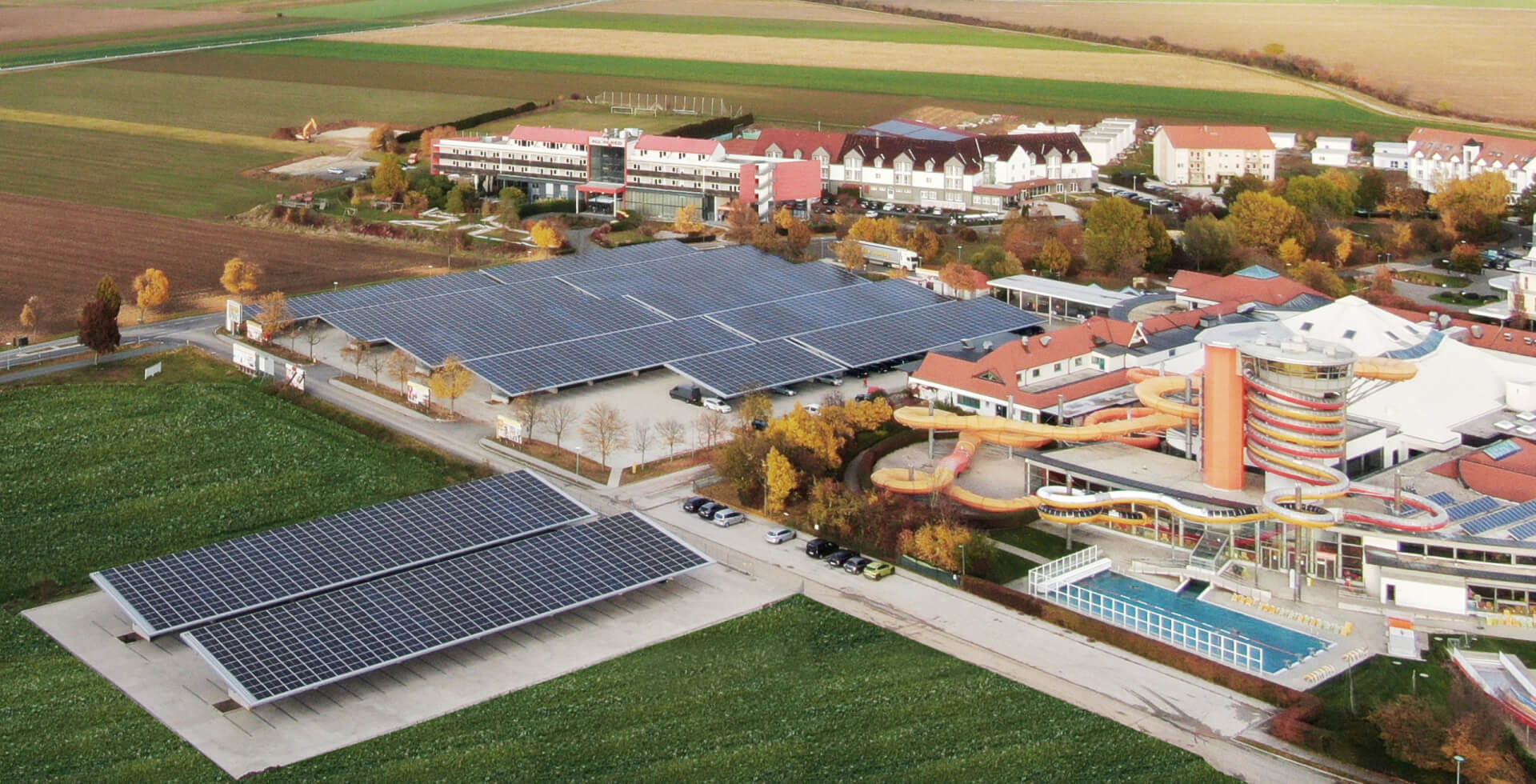
Certainly not. In our first year, our turnover was around two and a half million koruna. We said we would get it up to ten and be satisfied. In the second year, it was 45 million. Then things took off. We now have several companies in the Greenbuddies group whose combined revenues will exceed 400 million koruna this year. The total capacity of the photovoltaic power plants we have installed exceeds 700 megawatts. We also supply carports – canopies covered with photovoltaic panels that also protect vehicles from rain or hail. They are typically fitted with charging equipment for electric vehicles.
How did the idea to establish Greenbuddies come about?
We used to meet at the flat of Ondřej Vodsloně, my partner at Greenbuddies. His wife is Italian, she cooked spaghetti and we came up with our business plan. After many years in management positions, we wanted to be our own bosses and have no superiors. We then agreed to establish the company on the top floor of Divadlo na Jezerce theatre in Prague’s Nusle district.
You founded a Czech company, but with the intention of building photovoltaic installations in foreign markets…
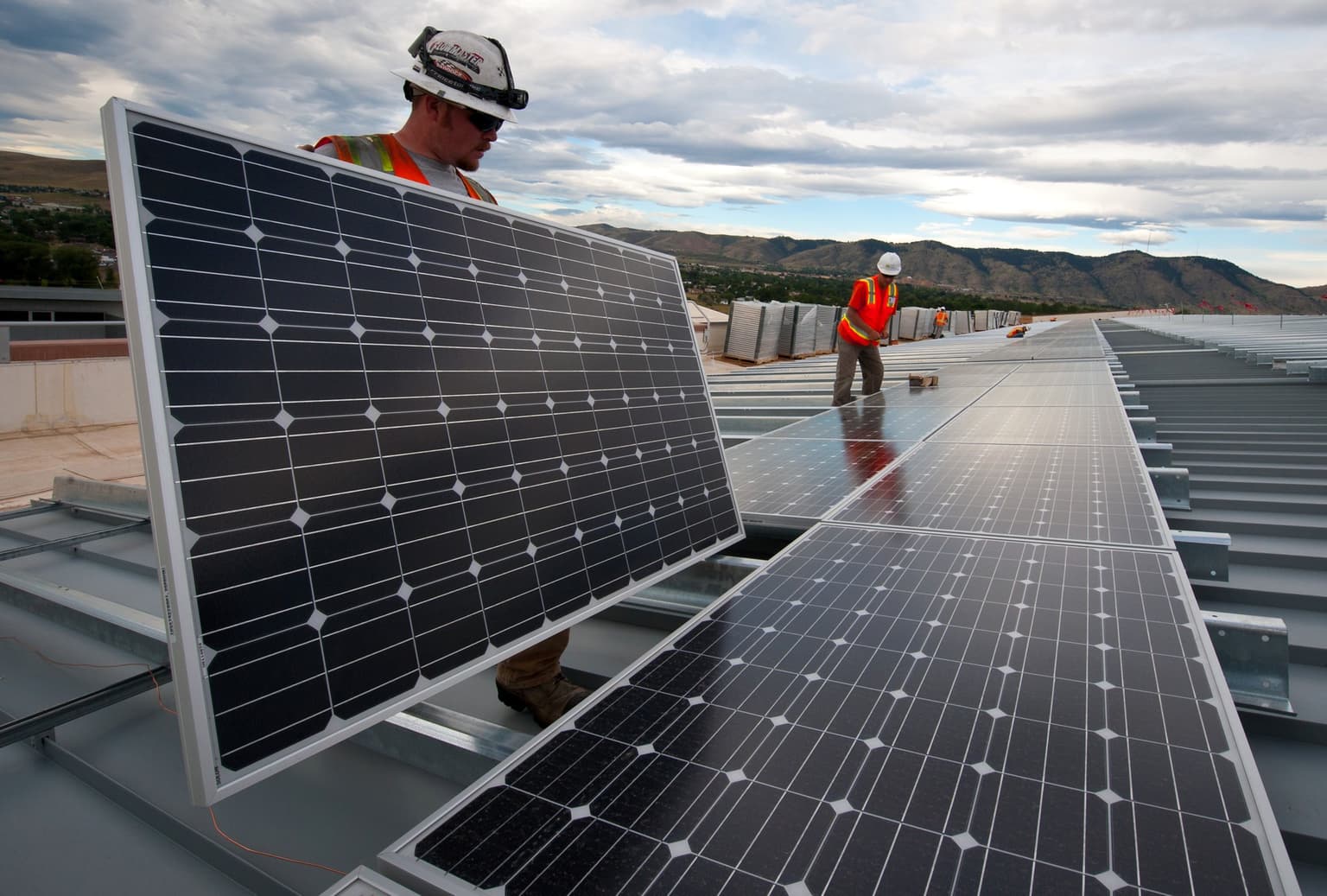
The original plan was to go only to Germany. Through our previous work for international companies, we had experience with installation and service companies in Czechia. We decided to reach an agreement with them and export their work to Germany. But it worked like a vacuum cleaner. There was great interest in our deliveries, our clients appreciated the quality of our work, contracts kept coming in, we hired more employees and set up operating processes and quality parameters. The contracts became increasingly complex and increasingly large.
You now position yourselves as an EPC contractor, meaning the final supplier for an entire project, as indicated by the acronym for Engineering, Procurement, Construction. What was it like at the beginning?
We started out as a supplier of labour, of worker teams. We gradually moved into the position of an EPC contractor, which also supplies all materials and a complete solution. For a company to become an EPC contractor, it must have sufficient financial strength because it has to purchase all the components. We did not have that strength at first.
Who was the EPC contractor when you focused on supplying labour?
For example, major Western European energy groups such as E.ON, EDF and Engie. Then there were companies known specifically in photovoltaics, such as ib vogt and Greencells, or specialised companies in the Netherlands. E.ON remains one of our customers, and we certainly will not resist working with it, even as our path moves towards EPC contracts.
European specialists
You started on the German market, but the Netherlands soon followed. Was that because the Dutch had decided to develop photovoltaics more extensively at the time?
It was more of a coincidence. Sometime in 2018, I read that the Netherlands lacked companies to build solar power plants. We set up a small, modest stand at the Solar Solutions trade fair and invited companies that we thought might be interested in ordering services from us. It worked, and a project manager on one of the Dutch construction sites expressed interest in working with us more closely. Today, he is the director and co-owner of one of our companies, Greenbuddies Energy in the Netherlands. As someone familiar with the local environment, he opened doors for us. And we are strong in the Netherlands because the entire photovoltaic market there is strong. I can support this with figures – around 200 watts of photovoltaic capacity per person are installed in Czechia, compared with about 500 watts in Germany and 800 watts in the Netherlands. All municipalities are planning their own solar power plants, and panels are being installed on almost every roof. And the market continues to grow.
Was it not risky to enter the German market at the outset? One would expect strong competition there…
The German market is also very attractive. Not least because of the country’s size.
Was there still plenty to do there?
Of course. Germany has recently completed a number of large 100-megawatt power plants installed without any subsidies. German distribution companies are building them. And further opportunities are emerging.
What other markets have you entered besides Germany and the Netherlands?
The Netherlands is still our strongest market, followed by Germany. Italy has grown significantly for us, and I have high expectations for France. We started working with a French sales representative who became our employee. We also have several attractive projects in Croatia, for example. One of our main strategic goals is diversification; we are currently present in fourteen European countries. If I had to say where photovoltaic power plants are the most difficult to build within the European Union, I would certainly name countries such as Bulgaria, Romania and Poland, because professional and relatively inexpensive local companies operate there. Then there are Spain and Portugal, because labour costs are not high and they are also very far from us.
Some Czech entrepreneurs building power plants around the world have established their companies abroad. You manage all your business from Prague. If I understand correctly, you are a Czech group focused specifically on European Union markets. Do you also have ambitions in other parts of the world?
We are, of course, a Czech group. Besides several companies in Czechia, we have one entity in the Netherlands, but it deals only with development, not construction. Construction is handled by Greenbuddies group companies based in Prague. We make use of EU agreements on the free movement of people, services, capital and labour. That works. But once you go outside the European Union, the conditions are completely different. We had many opportunities to build in the United Kingdom. After very demanding analyses, we gave up on them because the risks associated with post-Brexit UK legislation are too high.
You have gradually started to focus more on the Czech market as well. What is the current share of your business in Czechia and abroad?
We expect that the majority of new photovoltaic installations will be in Czechia next year. But that does not mean we will have fewer contracts abroad. Czechia is now experiencing a major boom. I am convinced that we have the greatest photovoltaic experience of anyone here.
Many companies that operated here in the past are returning to the Czech market…
Yes. Many smaller Czech companies that operated here ten or twelve years ago are returning. Yet there is a major difference between how power plants were designed in the past and how they are designed today. The way individual components are handled has also changed considerably. Our main competitors are multinational companies. They too are slowly returning to Czechia. However, we have a major advantage over them: our strength is the combination of international experience and knowledge of the local environment.

Knowing your strengths
Let me return to your entry into foreign markets. How significant are the barriers you have to overcome when you establish a Czech company targeting Germany and other European countries?
I tell myself that perhaps one day, when I finish with my own business, I will advise companies on how to enter foreign markets. Czechs tend to be overly cautious and afraid to venture out into the world. Another major Czech weakness is poorer foreign-language skills compared with countries such as the Netherlands, Belgium or Denmark. My basic advice would be not to be afraid to do things honestly, clearly and transparently. And to have a clear idea of the strengths I can offer the market. I will not lie to your readers – we started out by competing on price. Today, our clients are interested in something else – above all, flexibility. All of Europe is struggling with a shortage of people to build power plants. We have the know-how to assemble teams of workers from former communist countries and manage them operationally. At the outset, it is important to study the legislation of the particular EU country thoroughly and then monitor legislative differences in other member states. A huge advantage of the EU is the harmonisation of law. Once you learn the basic rules, you are able to work in any European country. This applies not only to labour, but also to supplying goods.
Do you encounter any protectionist barriers?
We do. They are more about the problems in different countries with recognising Czech occupational safety standards and individual certifications. We have always found a way in the end, but in Italy and France specifically, it is very bureaucratically demanding. They have very detailed standards that discourage many companies. A local consultant can help.
So among your subcontractors, which send worker teams to foreign projects, there are also companies from other Central and Eastern European countries. Do Czech companies remain among them?
Czech companies are still among them, but their share is declining. If you compare current inflation in Czechia with relatively lower inflation in the eurozone, while the koruna-to-euro exchange rate has not changed significantly, you find that Czech labour has become relatively expensive. At the same time, opportunities in Czechia are genuinely increasing substantially. There are not many available workers, which is why we are bringing in worker teams from neighbouring countries. And for certain work, we hire teams directly in the country where we deliver our installations – typically electricians who connect the power plant to the grid.
Could we look at where you source the individual components? Solar panels probably come mainly from China…
They come from Asia. It is not always China…
Which other countries?
Vietnam, India, Turkey. However, a great deal has changed in this respect since I started. Panels have effectively become a commodity. If a contractor chooses from standard panels recognised by banks and included in the top tier of Bloomberg’s list, they cannot go wrong. Banks conduct their own technical analyses, and Bloomberg’s list is updated once a quarter. Another key component is inverters, which are supplied to Europe mainly by four companies – two are Chinese, while the other two are not Chinese but also manufacture largely in China. Europe accounts for a smaller part of total production. You cannot go wrong here either. From this perspective, the most complicated choice is the mounting system, where surprisingly, in our experience, mistakes can be made. The mounting system must not damage the roof; it has to last not only for the warranty period but for twenty-five or thirty years, it must not rust and must not start wobbling after a few windstorms. Choosing a good mounting system is an art; there are a vast number of manufacturers. Fortunately, thanks to our long-term experience, we have already selected suppliers that we know are of very high quality.
Nobody took up the challenge
Are there any Czech suppliers among them?
No. To be honest, I thought there would be an opportunity for Czech suppliers in this segment and that they could thus make an impact on the global solar industry. But nobody took up the gauntlet. There are manufacturers of mounting systems in Czechia, but their products would have to be significantly better and they would have to want to venture out into the world. We work with foreign suppliers because they have proven themselves for us.
Do you think Czech manufacturers could still establish themselves in this segment on foreign markets?
I am afraid the cards have already been dealt. The product would have to be distinctly better than what is currently on the market.
So from Czechia, you export services – besides the final solution and your know-how, you also supply labour. In the category of goods exports, these may be more like re-exports?
Not even re-exports, rather exports of goods from another country. We purchase them at a port in the Netherlands and transport the components directly to the installation site.
Your first step on the way to the Netherlands was a trade fair stand. I assume that participation in trade fairs remains important in your sector…
Certainly. We do not target consumers; we provide the final delivery for investors in photovoltaic projects. I would recommend that everyone in an industrial market arrange as many meetings as possible in advance at a trade fair. At a recent trade fair in Munich, we had nearly one hundred pre-arranged meetings with potential partners over three days. These are not visitors who happen to notice that we are there. Such meetings do not, of course, have to take place only at trade fairs. In cooperation with the CzechTrade agency, for example, we invited local companies to a seminar at the Czech House in Brussels. A similar meeting took place at the Czech embassy in The Hague. We presented what we do, but also arranged for the participation of a local Dutch lawyer, a representative of an insurance company specialising in solar power plants, and one of our satisfied customers. A lively discussion was followed by networking, with Czech food and beer available. Within four months, we had orders in the Netherlands worth more than one million euros from new clients we met at the embassy in The Hague.
Will you continue with similar events?
We thought CzechTrade was the right channel. We are now preparing a similar event in Rome and may organise it ourselves. It is good to have a mention of the official patronage of a Czech state institution on the invitations and for the event to be opened by the ambassador. But it can also be done without the Czech lion emblem. The important thing is to invite representatives of local companies to an attractive venue that feels suitably prestigious.
How else could the Czech state support companies in your sector?
I do not think direct financial support is entirely necessary. Knowledge-based and image support are important. For certain volumes, export loans are a good thing.
Would you use, for example, an export loan backed by state export credit insurer EGAP?
We do not need one; we are growing organically and do not have a single koruna in loans. Hypothetically, I can imagine that a company from the Vysočina region could manufacture mounting systems and succeed in the first phase – someone abroad might say they would like to buy from it and like its product. Such a company would probably need help financing the delivery, because foreign competitors are more or less able to arrange this.
What should knowledge-based support look like?
When most companies enter foreign markets, they need high-quality market analyses – from both a customer and a competition perspective. Such analyses must be carried out by someone who understands the nature of the particular delivery and does not confuse different business models. A number of companies would probably also welcome initial help finding potential customers. None of this should be done formally, but with expertise and a genuine desire to help.
The interview was prepared for and originally published on Export.cz.Translation disclaimer
This article is a machine translation of the Czech original and has not yet been fully reviewed. In case of any doubt, please refer to the Czech version.