25 September 2026, 09:51
Loading...
Turning point for Kněžice: one of Czechia's first biogas plants fights for survival

oEnergetice.cz, ČTK
17 June 2026, 15:02
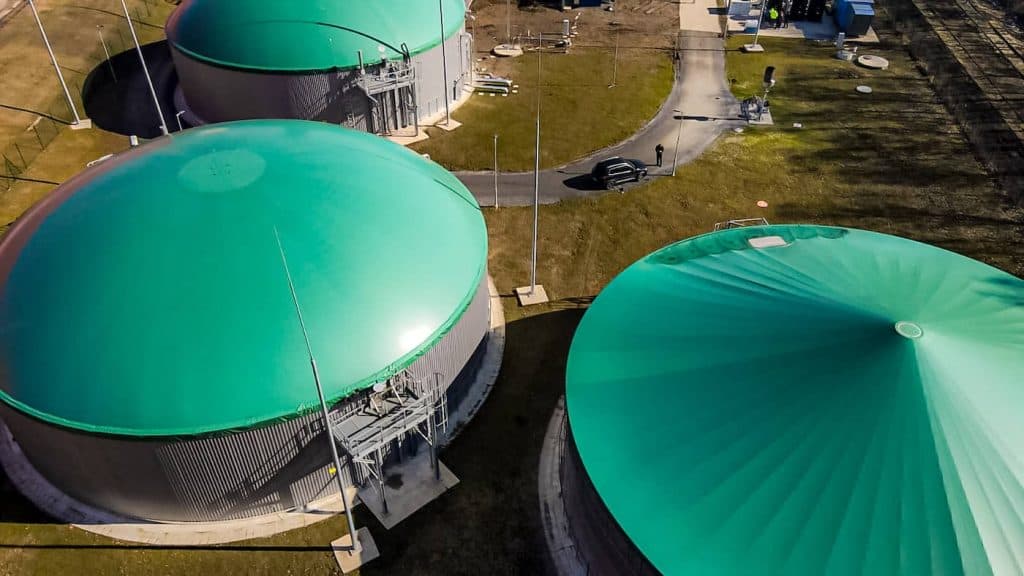
Dozens of biogas plants will face pressure to curtail or cease operations due to changes in state support, as generation will no longer be economically viable for them. The so-called green bonus, which provides a preferential purchase price for electricity from biogas plants, is guaranteed by the state for 20 years of operation. This August, operating support will end for the biogas plant in Kněžice in the Nymburk district, Czechia's first energy-self-sufficient municipality. Thanks to the plant and a biomass boiler house, it supplies low-cost heat to around 160 municipal properties and family homes. Switching to biomethane production is unrealistic for many plants, while the terms of the new modernisation support are highly disadvantageous for municipal projects, Kněžice Mayor Milan Kazda (independent) and Adam Moravec, head of the biogas section at the CZ Biom association, told reporters today.
Operating support currently consists of the selling price at which the municipality sells electricity to a trader and the green bonus, meaning the municipality receives a total of 4,70 Kč per kWh. "This will end on 21 August; we will fall to 3,45 Kč, but only during periods when the price is between zero and 3,45 Kč," Kazda said. He said it is currently impossible to estimate the loss precisely, but he expects a significant reduction in operations and a drop in revenue of at least two million crowns a year.
According to Kazda, upgrading biogas to biomethane would not pay off, as the nearest gas pipeline is four kilometres away. The municipality also sought battery storage, but did not receive reserved capacity from the distribution system operator. "There should probably be an individual approach to every biogas plant, because a facility that processes 10.000 tonnes of biodegradable waste a year cannot simply be brushed aside and shut down just because we are unable to create the right conditions," Kazda added. He said the municipality has not yet decided whether, after operating support ends in August, it will move to modernisation support or use it from next year, when it may be possible to negotiate better terms.
To receive modernisation support for a further 15 years, the municipality would have to make investments of around 20 million crowns. However, according to Kazda, the modernisation decree defines eligible costs unclearly. Moreover, the legislation recognises only replaced components that are no more than five years old.
According to Moravec, experts have long pointed out the unclear design of the modernisation support system, but the state has so far failed to respond to these calls, and support is now focused mainly on biomethane production. "On the other hand, there are projects such as Kněžice and many others that make highly efficient use of heat, meaning that it makes no sense, either energetically or economically, to introduce another solution there," Moravec said.
According to Moravec, three more biogas plants will face the same fate as Kněžice this year. One has already moved to the modernisation support scheme, while another is seeking to switch production to biomethane or change the terms. "The terms are moving in some way. We welcome the discussion we are currently having with the Ministry of Industry and Trade and the regulatory authority, where we can already see some effort to level the conditions so that support for biomethane and for these highly efficient biogas plants is balanced," Moravec added. He noted that changes to the terms cannot be delayed, as the number of biogas plants whose operating support expires will increase in the coming years. Another nine will be affected next year, while support for most will end around 2032.
According to Moravec, another problem is the approaching end of support for heat generation from solid biomass, which has only been announced until the end of this year. Its continuation requires notification by the European Commission, but the state has not yet begun negotiations.
The Kněžice biogas plant processes organic waste from nearby farms, particularly livestock slurry, residual silage and grass, as well as the contents of septic tanks from the municipality and surrounding area. The facility also replaces a sewerage system and wastewater treatment plant. From these inputs, it produces biogas, electricity, hot water for heating most of the municipality, biomass heating pellets and agricultural fertiliser. The biogas plant, which has one combined heat and power unit with an electrical capacity of 330 kW, operates continuously.
The local biogas plant has operated since 2006, when it was the 13th to be built in Czechia; there are now around 540. Renewable energy technologies cost the municipality of 530 residents 138 million crowns. A subsidy covered most of the costs, while the municipality took out a loan for the remaining 43 million crowns. The payback period for the biomass boiler house and the waste-processing biogas plant, which made the municipality largely energy self-sufficient, was 14,5 years.
Translation disclaimer
This article is a machine translation of the Czech original and has not yet been fully reviewed. In case of any doubt, please refer to the Czech version.
Sdílejte článek prostřednictvím:
You might also like
24 September 2026, 11:23

24 September 2026, 10:30
24 September 2026, 06:56