Mayor from the Tachov region: Three Bavarian districts pledge to limit wind turbines near the Czech border

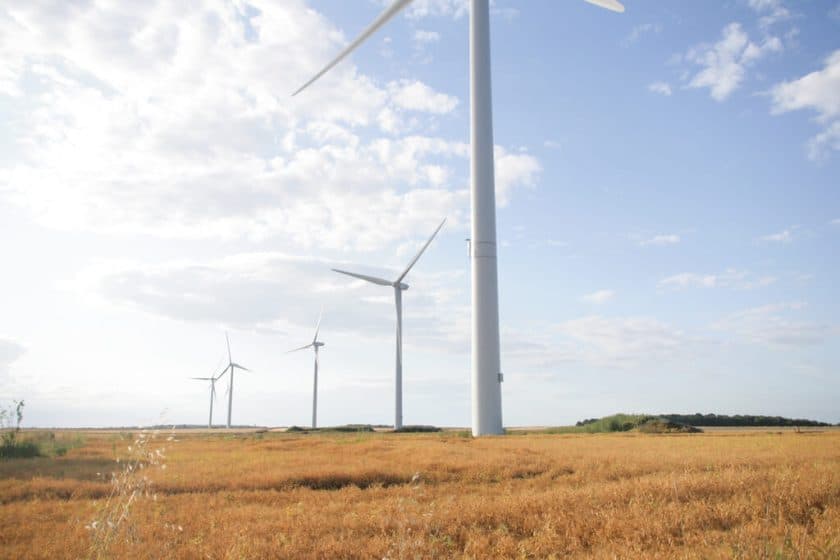
Three Bavarian districts bordering the Plzeň Region have pledged to the Czech side that they will significantly reduce the number of sites near the border where wind farms may be built in the future. The ČTK news agency was told this by Dana Lesak, mayor of Obora (an independent on the STAN candidate list), who has opposed the planned wind turbines near the border. According to the mayor, German authorities have approved a one-kilometre buffer zone along the Czech border where investors cannot build wind turbines. Some had been planned just tens of metres from the border ridge of the Český les in the Tachov and Domažlice regions.
Of 24 planned wind energy areas along the European Green Belt in the districts of Tirschenreuth, Neustadt an der Waldnaab and Schwandorf, 11 have been cancelled and ten reduced, while three areas have been retained, according to the mayor. The Green Belt refers to thousands of kilometres of land stretching from the North Sea to the Black Sea along the former Iron Curtain, where nature had an unintended opportunity to develop.
Czech municipalities, the Plzeň Region and the Czech Ministry of the Environment (MŽP) had long protested against wind farms near the border. “Bavaria ultimately accepted the Czech side’s comments, and wind turbines will be allowed to stand at least one kilometre from the state border,” said Jan Kroupar, head of the regional department for nature conservation. At a round table in Obora last week, the Germans officially stated that they would not build any closer to the border, he said. “The new proposal is scheduled to be adopted on 22 July, and the second phase of public consultations begins on 15 August,” Lesak added.
According to Tomáš Peckert, director of the Český les Protected Landscape Area, mayor Lesak was the main “driving force”; among other things, she convened two round-table meetings. Nature conservationists had not expected such a concession, he said, and the German side had substantially scaled back the plan. Peckert described it as “a 180-degree turn”. The Germans also say these are potential sites and that not all of them need to be developed, as investors may opt for other locations. The projects that remain in the development plans are in areas that are less prominent in terms of elevation, already beyond the horizon of the Český les, or in more forested terrain rather than open areas, Peckert said.
According to Kroupar, the Bavarian districts have now removed wind turbines close to the Czech border from their regional development plans, which are comparable to the Plzeň Region’s regional development principles. “They did this in response to comments officially submitted by the MŽP as part of the international EIA (environmental impact assessment), and to opposition from Czech municipalities. They want to have better communication with them in the future,” he said.
“This step is an important signal, and we explicitly appreciate it. In our view, however, one kilometre is not enough to preserve the Green Belt in the long term as an important corridor for habitats and a cultural-historical landscape,” said Johannes Bradtka, head of the Association for the Protection of Landscape, Species and Biodiversity.
The Czech side and Bavarian associations had initially proposed a three-kilometre setback. According to Andreas Meier, district administrator and chair of the Upper Palatinate North Regional Planning Association, the objections received were taken seriously and a mutually acceptable solution is being sought. Lesak added that Meier had done a great deal to help reach a compromise.
According to Kroupar, construction of wind turbines and solar farms in the protected landscape area is heavily restricted by a spatial planning study prepared by the protected area together with the region and approved by the municipalities. “We protect the landscape here, and they hardly even let us put up a wooden gazebo,” Lesak said.
The only exception so far is a pair of nearly 250-metre towers right on the border, which are expected to be built near Bärnau and Obora, where two wind turbines had already been approved, according to Kroupar. “Discussions are still ongoing, though, because Bavarian municipalities and associations are also unhappy with this, and the case is before a German court,” he said. Lesak added that four administrative lawsuits, joined by Czech municipalities, have been before the administrative court in Munich for three quarters of a year. She hopes the court will rule in their favour.
Translation disclaimer
This article is a machine translation of the Czech original and has not yet been fully reviewed. In case of any doubt, please refer to the Czech version.




