Where wind farms already operate in Czechia, people more often vote for further development

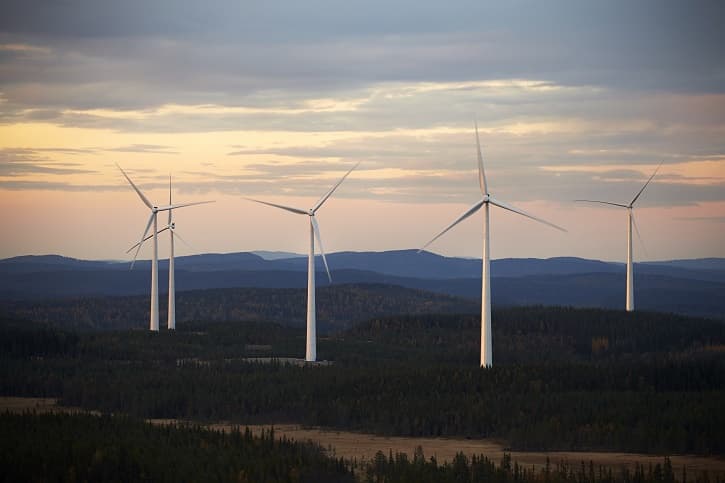
In municipalities where wind farms are already operating, an average of 67 percent of residents voted in referendums over the past 20 years in favour of further development. By contrast, in municipalities without this experience, 80 percent voted against and only 20 percent in favour. This is according to an analysis of 71 referendums on wind farms held between 2006 and 2025, conducted by social geographer Bohumil Frantál of the Institute of Geonics of the Czech Academy of Sciences. The Chamber of Renewable Energy Sources and the Czech Wind Energy Association reported the findings in a press release today.
According to Frantál, the analysis showed a significant link between referendum results and whether residents already had first-hand experience with wind farms. “In municipalities where wind farms are already operating nearby, people are less afraid of negative impacts and tend to see the benefits as positive,” he said.
He also said that people are much more likely to express support for wind farms in referendums when the questions are worded specifically rather than generally. In referendums where, for example, a specific number of planned turbines or other clarifying information was included, the results so far have been approximately 70 to 30 in favour of the wind farms. For general questions about possible wind farm construction, the ratio was exactly the opposite, at approximately 30 to 70.
The Chamber of Renewable Energy Sources and the Czech Wind Energy Association said that while last year’s referendums on wind farm construction produced roughly even results, opposition has clearly outweighed support in the results recorded so far this year.
According to Michal Janeček, chairman of the Czech Wind Energy Association, and Štěpán Chalupa, chairman of the Chamber of Renewable Energy Sources, the issue of so-called acceleration zones is playing an important role in this year’s referendums. But acceleration zones are not specific projects in themselves, and designating them does not mean that a certain number of wind farms will automatically be built in a given location, Janeček stressed.
“When people hear about acceleration zones today, they may picture a large number of wind farms eventually being built around their municipality, surrounding it on all sides. Fear of the theoretical scale of future construction can then alarm people, leading them to vote against wind farms,” Janeček added.
According to Chalupa, when local residents are engaged in open communication and given verified, transparent information, there is usually no problem gaining acceptance for construction. “With their lack of transparency, ambiguity and, ultimately, absurd conditions, acceleration zones will do more harm than good,” Chalupa said.
At the end of July, the government approved acceleration zones for the development of renewable energy sources on a much smaller scale than envisaged in a plan prepared by the previous government. The cabinet reduced the area designated for fast-track permitting of wind farms to around 11 percent of the area originally proposed. Of the 110 locations initially identified, 61 remain: 49 designated for wind farms and the rest for solar power plants.
Translation disclaimer
This article is a machine translation of the Czech original and has not yet been fully reviewed. In case of any doubt, please refer to the Czech version.