
20 October 2026, 15:34
Loading...
Infographic: Electric mobility in the European Union and comparison with the Czech Republic

Jan Budín
19 September 2017, 08:42
Transport electrification is one of the areas of the energy sector receiving increasing attention. According to statistics published on the EAFO (European Alternative Fuels Observatory) website, more than 550,000 electric vehicles and plug-in hybrids were already on European Union roads in June 2017. As the number of plug-in cars on the roads grows, so does the number of charging points: according to EAFO, 100,860 were in operation in the EU in the middle of this year, of which more than 10% were fast-charging points with a capacity above 22 kW. Who are Europe’s leaders in electric mobility, how quickly is the number of charging points growing, and what is the projected development of electricity consumption in electric mobility? Our new infographic provides the answers to these questions.
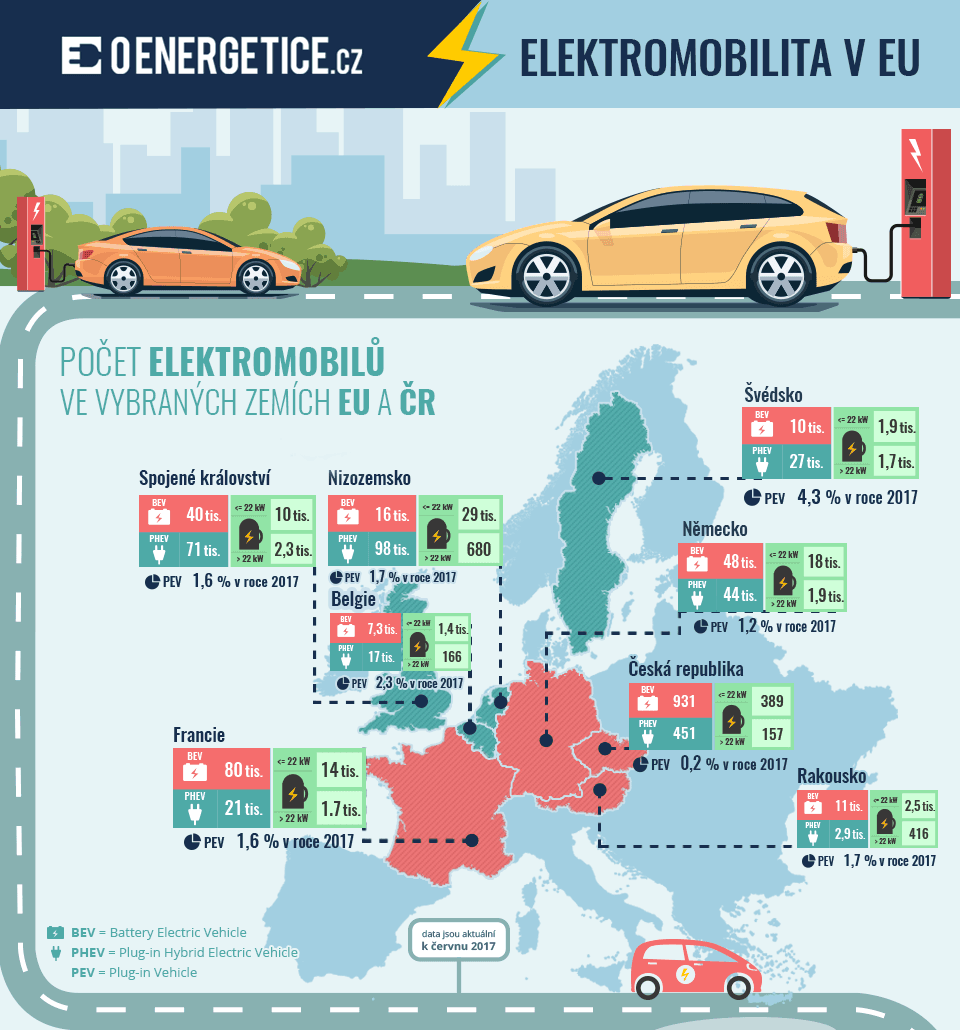
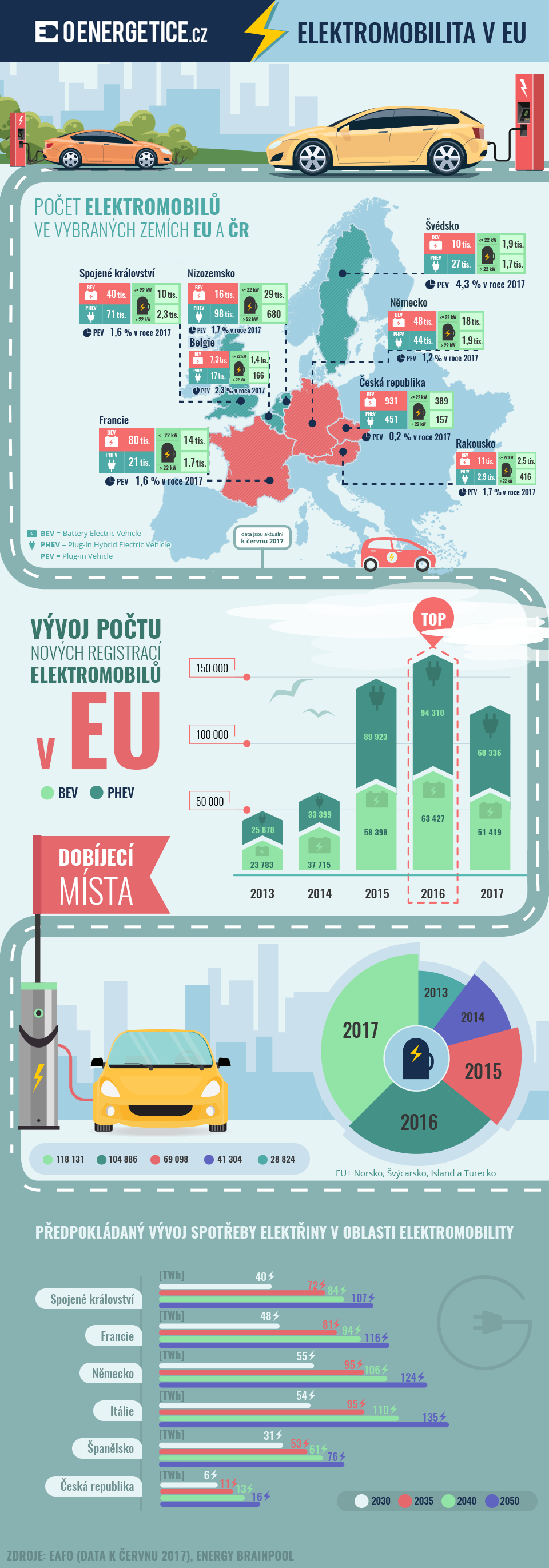
The Netherlands is the clear EU leader in terms of the total number of electric vehicles and plug-in hybrids, and it also operates the most charging points. According to EAFO, around 16,000 electric vehicles (BEV – Battery Electric Vehicle) and 98,000 plug-in hybrids (PHEV – Plug-in Hybrid Electric Vehicle) were on the road in the Netherlands in the middle of this year. Owners of plug-in electric vehicles (PEV – Plug-in Electric Vehicle) could charge their vehicles at almost 30,000 charging points (29,308 points with a capacity of up to 22 kW and 680 points with a capacity above 22 kW).
The image below shows the seven European Union countries with the highest number of electric vehicles and plug-in hybrids, together with the number of charging points broken down into up to 22 kW and above 22 kW. Besides the Netherlands mentioned above, these countries include the United Kingdom (111,000 vehicles in total), France (101,000 vehicles in total), Germany (92,000 vehicles in total), Sweden (37,000 vehicles in total), Belgium (24,000 vehicles in total) and Austria (14,000 vehicles in total). For comparison, the map shows the number of electric vehicles, plug-in hybrids and charging points in the Czech Republic.
In addition to the number of plug-in cars, each country also shows the share of these vehicles in total car sales in that country this year.
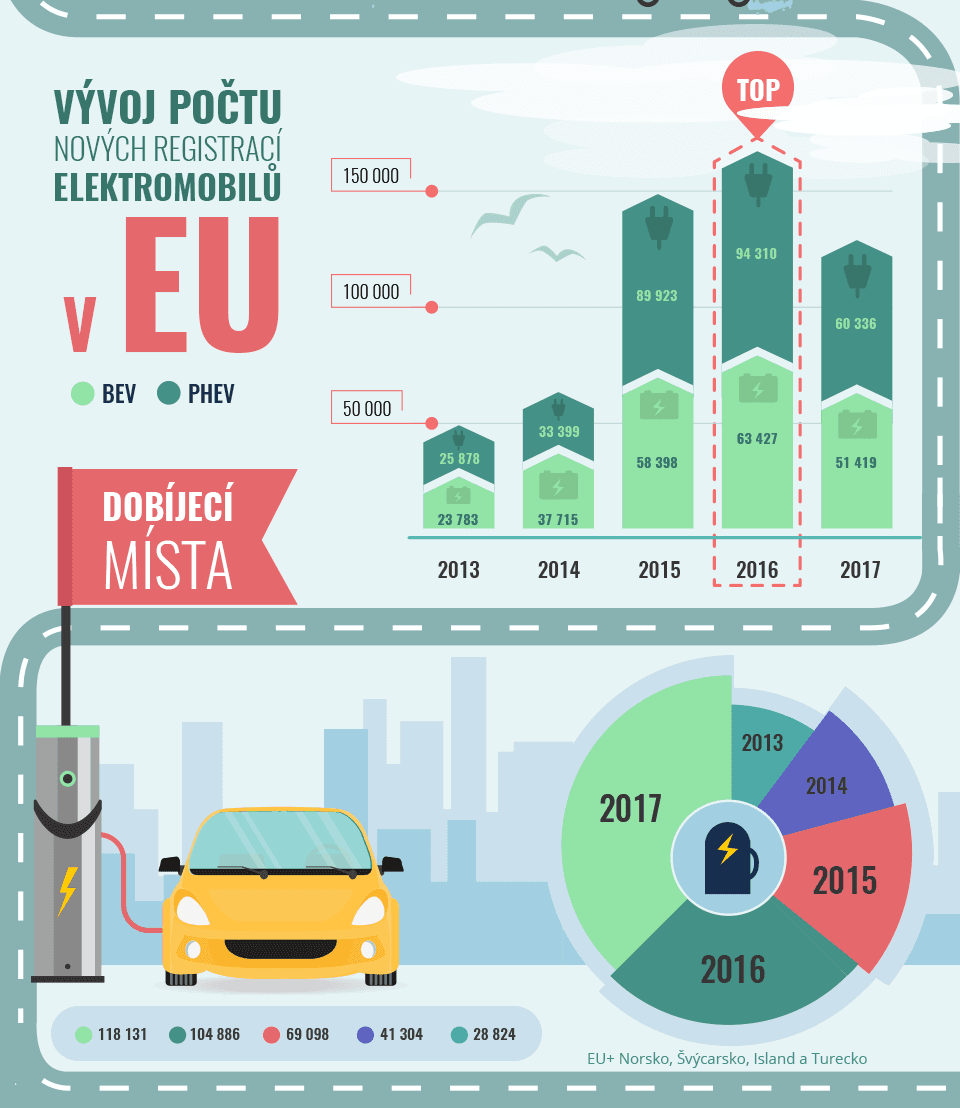
The following image shows the development of new registrations of electric vehicles and plug-in hybrids in the EU, as well as charging points in the EU together with Norway, Switzerland, Iceland and Turkey. The figures for new registrations show a continuing preference for plug-in hybrids over electric vehicles, as well as an upward trend in the total number of new registrations. The figures for 2017 cover the first six months.
Electricity consumption to rise by up to 830 TWh by 2050
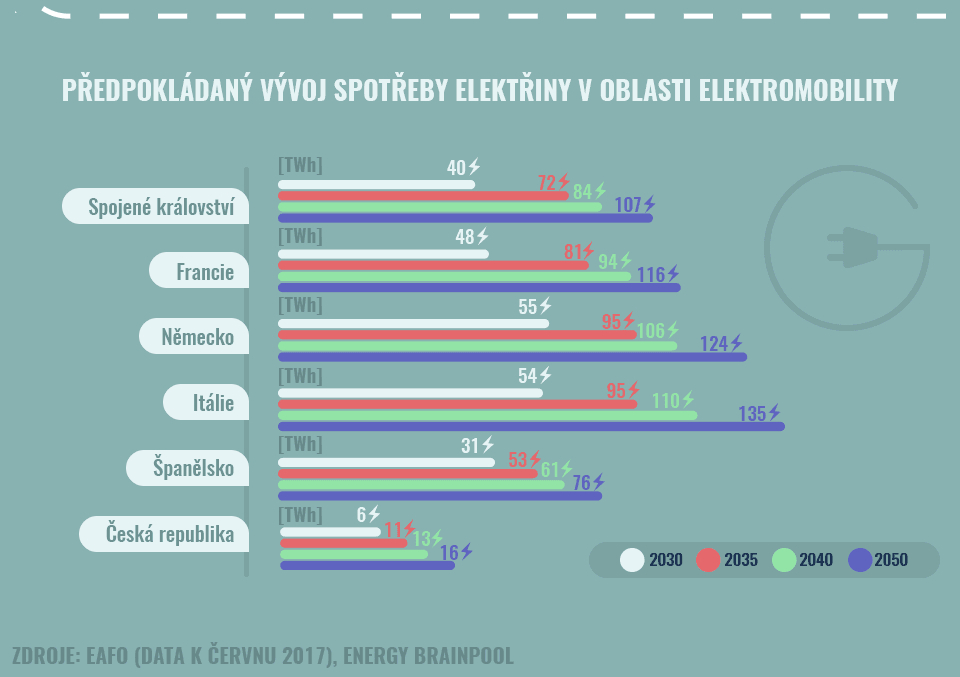
A widely discussed issue in connection with the development of electric mobility is the increase in electricity consumption caused by charging electric vehicles. In its latest energy outlook, EU Energy Outlook 2050, German institute Energy Brainpool estimates that a 100% transition of the private transport sector to electric vehicles would increase electricity consumption in the EU by approximately 830 TWh by 2050. For comparison, a total of 3,234 TWh of electricity was generated in the EU in 2015.
The countries for which Energy Brainpool expects the highest electricity consumption in electric mobility in 2050 are shown in the following image. For comparison, the expected development in this area in the Czech Republic is again included.
The full infographic on electric mobility in the EU can be downloaded here.
Translation disclaimer
This article is a machine translation of the Czech original and has not yet been fully reviewed. In case of any doubt, please refer to the Czech version.
Sdílejte článek prostřednictvím:
You might also like


20 October 2026, 12:55
20 October 2026, 10:49

20 October 2026, 06:13