20 October 2026, 15:34
Loading...
PSA HybridAir and MDI’s air-powered car
Tomáš Jirka
2 May 2016, 21:17
In recent years, the number of alternative vehicle propulsion systems has been growing like mushrooms after rain, but did you know that there are concepts for vehicles powered „solely“ by air? Both mentioned in this article come from France and are linked by the fact that, although the concepts are functional, they have apparently not made it into production due to economic and technical constraints.
PSA: HybridAir hybrid technology
In 2013, the PSA group unveiled a vehicle concept in Geneva featuring HybridAir technology, which it described as a major breakthrough in hybrid technology. In short, it can be described as short-term propulsion using compressed air, which is „injected“ into the combustion chambers instead of fuel. Its aim, naturally, as with all hybrid technologies, is to reduce fuel consumption in urban driving or other stop-start conditions, where unnecessary losses occur due to braking and subsequent acceleration. Another aim was to reduce the cost of this technology compared with „conventional“ battery-based solutions.
The first vehicles fitted with this system were due to appear on the market in 2016 and, thanks to its low production cost, were expected to include vehicles in the B and C segments, namely the Citroën C3, C4 and Peugeot 508, which has a hybrid-electric version (RXH). The manufacturer promised fuel savings of up to 45 % in urban operation, which is indeed a very good result, on a par with electric full hybrids.
This was proprietary technology developed by the group in cooperation with Bosch. According to the then head of the team, Karim Mokaddem (who left at the end of 2014, while the entire development team of around 180 people was also downsized in early 2015), they did not cooperate with MDI, discussed below; this was also confirmed by MDI head Guy Negre. However, on 23 January 2015, development of the technology was suspended for financial reasons (around EUR 500 million was needed to complete it), and no further information has emerged to date.
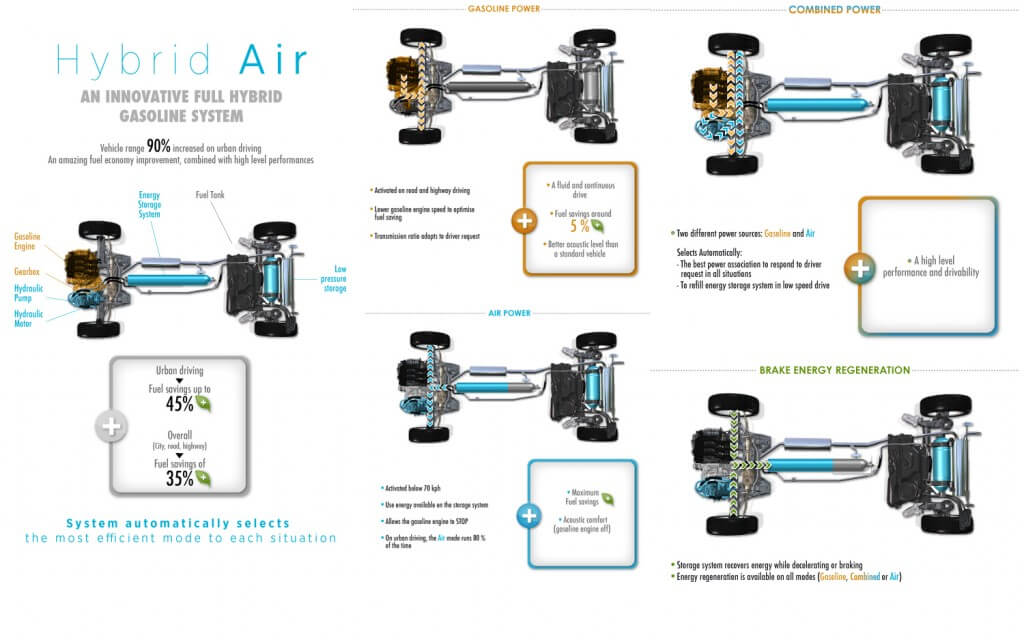
More specifically, it involved a combination of an internal combustion engine (in the Peugeot 208 HybridAir and Citroën C4 Cactus Airflow concepts presented (opening photo), this was a naturally aspirated 1.2-litre three-cylinder PureTech engine tuned to 82 hp), a compressor and two pressure tanks replacing the batteries. One was located in the centre tunnel and the other, at lower pressure, near the rear axle (a balancing chamber). During braking, the compressor pressurised air into the higher-pressure tank so that, when setting off, this air could be used instead of fuel for injection into the cylinders. This was intended to reduce consumption to a Prius-like 2 litres per 100 km, although we all know how such measurements work under the NEDC cycle.
Both propulsion systems drove the front axle as needed through an automatic transmission with a planetary gearset. Due to high development costs and uncertainty over the high sales volumes needed to recoup them, development was halted, and air hybrids have, at least for now, become too expensive an option for real-world use despite their originally intended low production costs.
MDI: a small air-powered car
The development of an air-powered vehicle is being pursued by MDI (Moteur Developpment International, with a factory in southern France, headquarters in Luxembourg and a business centre in Barcelona, where it says it is working on international expansion), founded in 1991 by Guy Negre. In 1995, it built its first prototype for testing, which had an internal combustion engine for longer journeys and an air engine for short (urban) trips. This confirmed its core vision that zero-emission vehicle operation is possible. The MDI Cat and MDI Minicat were officially unveiled in 2003, with high expectations for the near future.
Everything suggests that MDI’s air-powered car will become one of the greatest inventions of the new century. Engine designer and inventor Mr Guy Negre has developed a new engine capable of powering a car at speeds of up to 110 km/h, with a range of up to 300 km on a single fill and a cost of less than CZK 0.40 per kilometre. Not only does it produce no exhaust emissions, it also cleans the air.
States the Czech „representative“ autonavzduch.cz
The vehicle has a conventional piston engine, but not an internal combustion engine, as has been common for the past 200 years. The engine is powered by compressed air from a plastic tank, where pressure reaches roughly 30 to 50 MPa. Ambient air is drawn into the piston and compressed (to approximately 15 MPa), raising its temperature to around 400 °C. At this point, compressed, relatively cool air from the tank is injected; at this temperature, it expands rapidly and drives the piston. Only air at a temperature of -30 to 0 °C leaves the engine exhaust and, according to the manufacturer, it can therefore be used to cool the interior. The inlet atmospheric air is even said to be cleaned by filters so that the outlet air is cleaner.
As with today’s electric vehicles, it is therefore a locally zero-emission vehicle. Its problem is its dependence on outside temperature, though in the opposite sense to electric vehicles. The warmer the intake air, the worse it is for the vehicle. Given the temperature of the „exhaust gases“, however, cooling this air is not a problem.
The second problem is the gradually declining pressure in the tank, meaning engine power falls as kilometres are driven. The range per tank in MDI test vehicles was around 200 – 300 km (in 2007) or 1000 km (in 2010), although official information about an almost non-existent vehicle is difficult to verify, and at least the latter claim is fairly unbelievable.
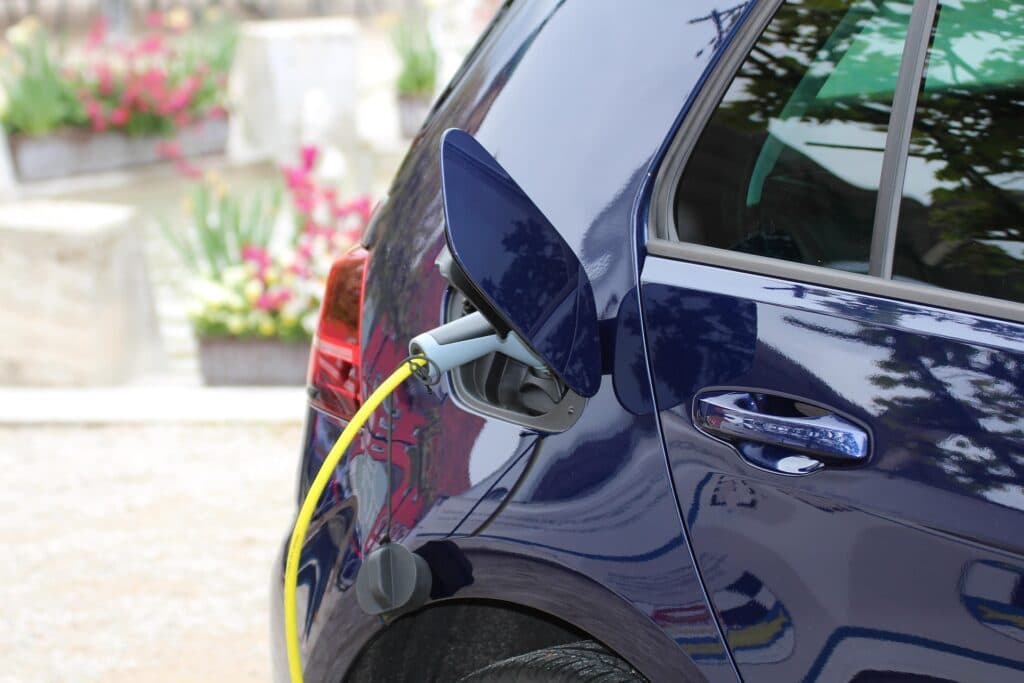
The 175-litre compressed-air tank can be filled either at a special filling station (due to the high pressure; the station itself is simply a compressor), where it takes around 3 minutes, or by connecting it to the electricity grid, where the tank can be filled by a small built-in compressor (the equivalent of an electric vehicle’s onboard charger) in around 3 hours, though it is questionable whether the tank pressure can really reach such high values this way. The cost of either method should be in the order of crowns (depending on the electricity price), but part of the energy (around 30 %) is lost through substantial heating of the compressed air.
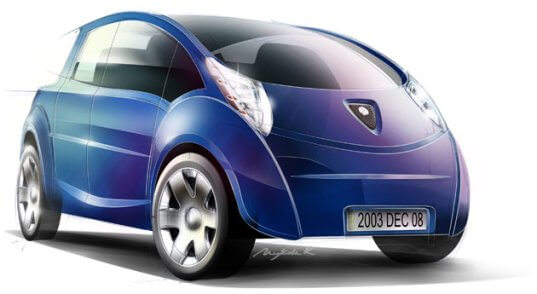
Beyond propulsion, MDI also pursued innovation in other aspects of vehicle development. The fibreglass body design, intended to reduce weight, was influenced by aerodynamics, though it looks amusing from today’s perspective. MDI also boasts a fully digital instrument cluster (it should be noted that this information is now 10 years old), which is entirely commonplace today, while it also decided to omit all wiring and replace it with radio transmission, saving several tens of kilograms.
In 2008, Indian company Tata considered buying a licence, and with the help of Zero Pollution Motors, the vehicle was to be offered in the US with a promised range of up to 1000 km. Since then, however, there has been complete silence, and it seems this is how air-powered cars will remain, although the ZPM website still features bold plans for 2015 to 2018 involving an updated air-powered „vehicle“ priced at around USD 10,000.
Translation disclaimer
This article is a machine translation of the Czech original and has not yet been fully reviewed. In case of any doubt, please refer to the Czech version.
Sdílejte článek prostřednictvím:
You might also like

20 October 2026, 12:55
20 October 2026, 10:49
20 October 2026, 06:13