
8 November 2026, 13:59
Loading...
European Commission likely to recommend 90% cut in CO2 emissions by 2040
Klára Čeperová
20 January 2024, 13:31
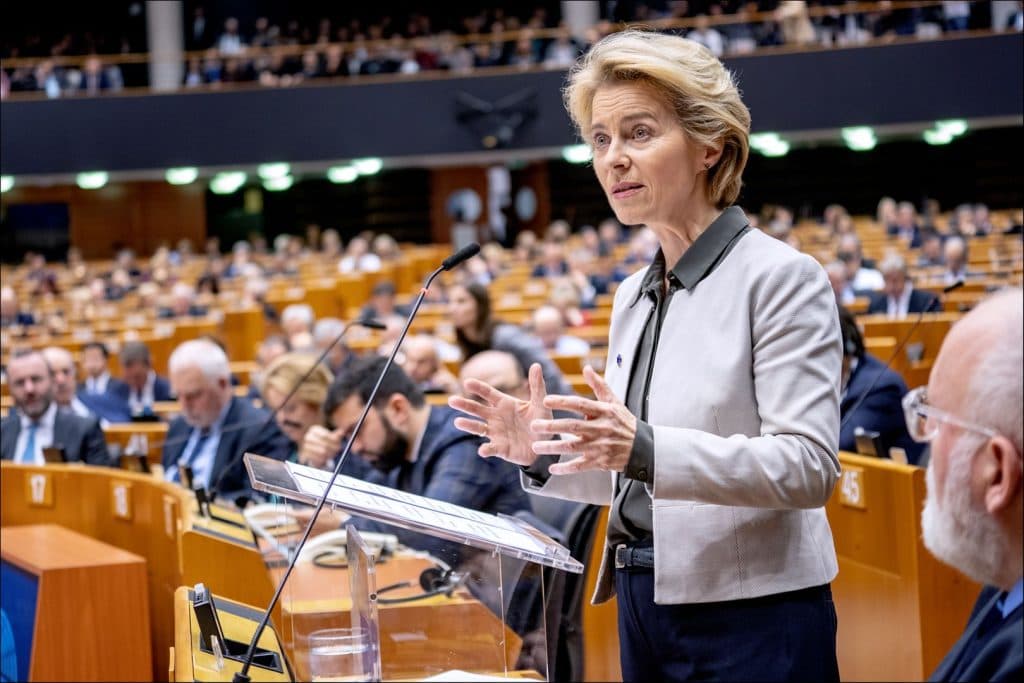
The European Commission is preparing to recommend that the EU cut net greenhouse gas emissions by 90% by 2040, compared with 1990 levels. This would put the EU on track to reach net zero emissions by 2050. Several EU countries have expressed support for the plans. Hungary, for example, is skeptical. France and Germany have yet to take a position.
The European Union is preparing its first climate target for 2040, which is intended to bridge the gap between the current targets of cutting net emissions by 55% by 2030 and reaching net zero by 2050. The Commission is expected to publish its 2040 plan in a proposal due to be presented on February 6, Reuters reported.
While the bloc has already committed to cutting emissions by at least 55% by 2030, compared with 1990 levels, and reaching net zero by 2050, activists say this interim target will be the EU executive’s climate “legacy.”
European Parliament elections are due to be held in June, and the new target will test political appetite for continuing Europe’s ambitious green agenda. The agenda faces opposition from some governments and industries concerned about the costs, even as climate change brings more destructive heatwaves, floods and wildfires to Europe.
The planet’s red lines
Environment ministers from the EU’s 27 member states met in Brussels on January 15 to exchange views on the issue for the first time and consider the Commission’s decision.
Wopke Hoekstra, the EU climate commissioner, has already made clear that he “will defend a minimum target of at least a 90% net emissions reduction by 2040,” in line with the recommendation of the European Scientific Advisory Board on Climate Change, which recommended a range of 90-95%.
“There is no alternative to respecting the planet’s red lines,” Hoekstra said as he arrived for the meeting in Brussels.
The Dutchman added, however, that striking a balance between industrial competitiveness and climate action would be “extremely important going forward.”
Once the Commission submits its proposal, the EU’s regular legislative process will begin, involving the European Parliament and the Council of EU member states, and usually lasting up to two years.
Supporters
In this context, several EU countries have backed the 90% target, starting with Denmark, which made its position clear in December. Other supporters include Ireland and Bulgaria.
The new Polish government also appears to have initially offered its support, through State Secretary for Climate Urszula Zielińska, who attended the ministerial meeting in Brussels.
Alongside those mentioned, Finland, Sweden, Luxembourg, the Netherlands and Spain also often work together on climate issues—all are members of the global “high ambition coalition,” founded in 2014.
Skeptics
Hungary, which will take over the presidency of the Council of the EU after Belgium’s current six-month term, has not backed the 90% target championed by the EU climate commissioner.
“We would like to see the proposal,” State Minister for the Environment Anikó Raisz said, stressing that “national circumstances need to be taken into account.”
The landlocked country, which gets more than 80% of its gas from Russia, is bound by a long-term contract with the Kremlin until at least 2036.
Raisz said her country “would like to see realistic and achievable targets for 2040.” Other EU countries known for not being climate champions, such as Italy and Malta, have yet to signal their preferences.
Cautious heavyweights
Germany and France, the EU’s two largest countries, have also yet to take a position.
In Brussels, senior civil servant Sven Giegold said that “the federal government has not yet taken a definitive position.” The former Green EU lawmaker noted, however, that a landmark 2021 ruling by Germany’s Federal Constitutional Court requires the country to cut emissions by 91% by 2040.
“That is also a benchmark for the European target,” he explained, criticizing the media for suggesting that EU countries set the Commission’s proposals. “I don’t believe we will act as if the pace is already being set by the large member states,” he added.
France, which has recently undergone a change of government, has also not made its recommendation known.
Paris is nevertheless insisting that nuclear power be recognized in the text and that a “low-carbon” energy target for 2040 be adopted as an alternative to the EU’s current renewable energy target.
Translation disclaimer
This article is a machine translation of the Czech original and has not yet been fully reviewed. In case of any doubt, please refer to the Czech version.
Sdílejte článek prostřednictvím:
You might also like

8 November 2026, 08:10
7 November 2026, 17:23
7 November 2026, 13:37