9 October 2026, 06:22
Loading...
MND plans to store carbon dioxide underground in Moravia. It is still surveying sites, seeking funding and emitters
Ekonews.cz
8 April 2024, 13:35
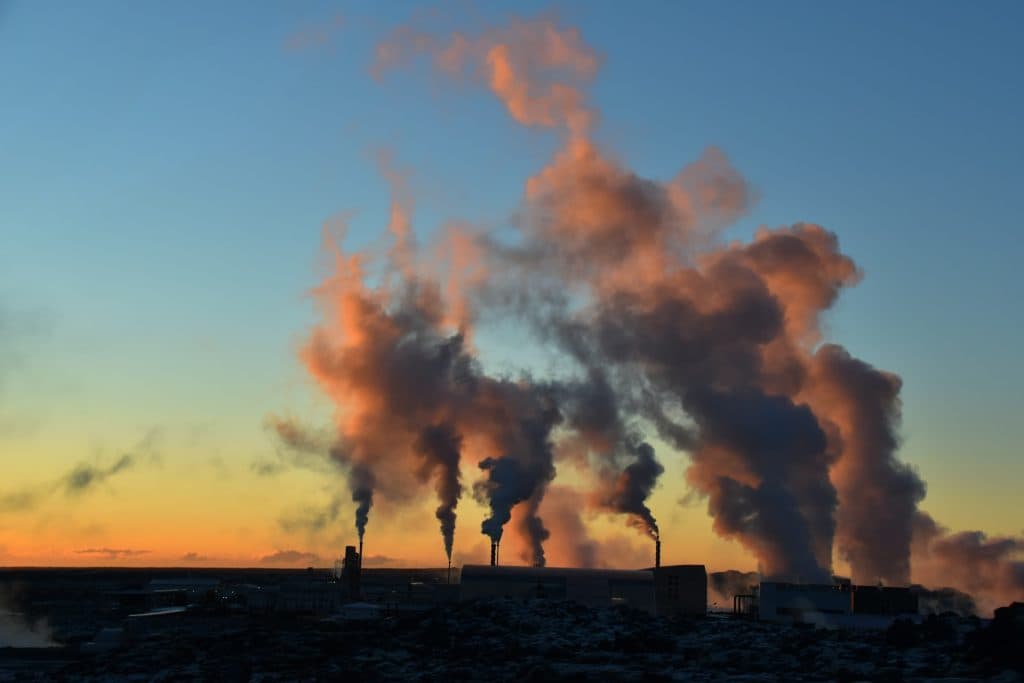
Many industrial companies will struggle to decarbonise their operations without carbon capture technologies. Czechia therefore also needs to address the issue of storage sites where compressed carbon dioxide could be stored. Mining company MND is already surveying its first locations.
MND, which belongs to the KKCG investment group of billionaire Karel Komárek Jr, aims to play a leading role in carbon capture and storage in Central Europe. It already has its first projects ready. For its main project, called CCS Moravia, MND is working with cement producer Heidelberg Materials CZ.
The project concerns the future capture of CO2 released during clinker production at the Mokrá cement plant near Brno. The carbon dioxide is then to be stored in suitable underground structures in South Moravia. According to Michal Sasín, director of New Business Development, MND Energy has expertise, thanks to its focus, in identifying and exploring deposits, carrying out drilling work, and designing and operating underground gas storage facilities.
First, a test costing hundreds of millions of euros
German group Heidelberg Materials first wants to test the technology in the Norwegian city of Brevik, where it plans to store CO2 in subsea areas of the Norwegian continental shelf. MND plans to store 800,000 tonnes of carbon dioxide annually at the site from 2034. In total, an estimated 23.4 million tonnes of compressed CO2 could be accommodated underground there.
Both companies want to secure subsidies from the European Innovation Fund (Innovation Fund “large scale”). “The application deadline is early April, with the evaluation expected at the end of this year. The project's total investment costs are substantial, amounting to hundreds of millions of euros,” Sasín explains. That corresponds to billions of Czech crowns.
“Unfortunately, given the geographical location of our country, we cannot use the same storage technology as in Norway,” explains Klára Šestáková, spokesperson for Heidelberg Materials CZ. “Unless a complex Europe-wide network of pipelines transporting CO2 to one of the subsea storage sites is built, storing compressed CO2 in selected deep rock structures appears to be the most suitable option in Czechia,” she adds.
Czechia has not yet drawn inspiration
MND also wants to discuss permanent CO2 storage with other emitters and plans to turn CCS Moravia into a future “CCS hub”. However, Sasín also points out that no national strategy or vision yet exists for carbon capture, storage and potential utilisation.
According to him, the development of the technology requires not only suitable underground storage sites but also infrastructure to transport CO2 to locations with storage potential. “Czechia should draw inspiration from the legislation of countries enabling faster development, such as Denmark, Norway, the United Kingdom and Sweden,” Sasín says. At a minimum, a government regulation specifying the financial security required for operating storage sites will need to be issued, as the Ministry of the Environment also confirmed to Ekonews.
MND, together with the Czech Geological Survey, VŠB – Technical University of Ostrava and the Institute of Geophysics of the Czech Academy of Sciences, is currently evaluating the CO2-SPICER project. Since November 2020, it has examined the potential for storing carbon dioxide in the rock environment of the reservoir of the Zar-3 oil and gas field in South Moravia, where the final phase of oil and gas production is under way. The project is due to end on 30 April.
Academic project to release results soon
“Once production ends, a pilot experiment involving the storage of supercritical carbon dioxide (something akin to liquefied CO2, author’s note) is planned. Based on a detailed analysis of the production history and modelling, storage capacity has been determined at 70,000 tonnes of carbon dioxide. The pilot project at the Zar-3 site will follow on from CO2-SPICER and provide the first real-world experience with storage. It must therefore be carried out on a small scale to minimise the associated risks,” says Juraj Franců of the Czech Geological Survey.
The pilot experiment is to be called CCS Moravia and will draw, among other things, on the experience of MND staff from the CO2-SPICER project. Meanwhile, discussions are under way on whether any greenhouse gas emitters will join the project.
“Unfortunately, there are concerns that major emitters would rather relocate somewhere where decarbonisation is not demanded of them to the same extent, because they simply cannot bear the costs and would not prosper here. Czech industry faces a difficult test, because the emitters themselves certainly do not have the budget for it,” Franců adds.
Transporting it makes no sense
One way to “avoid” storage sites is to directly link CO2 capture to the production of, for example, synthetic e-fuels, which are meant to be carbon-neutral. However, according to a market expert who works at an industrial facility and wished to remain anonymous, this is unrealistic under Czech conditions. “To produce e-fuels using captured CO2, you also need green hydrogen. And we will never have it in large quantities in Czechia,” the source told Ekonews.
Nor does transporting compressed carbon dioxide by truck to locations with more storage sites make financial sense. “It does not stack up either economically or in terms of carbon footprint,” the unnamed source says.
According to the EU Geological CO₂ storage summary study, prepared by research institution Geological Survey of Denmark and Greenland, Czechia has the greatest potential for storing CO2 in saline aquifers. These are remnants of prehistoric seas beneath an impermeable layer of rock. The study estimates Czechia’s total storage capacity at around 600 million tonnes.
Republished from online portal EkoNews.cz, a website covering business and sustainability.
Translation disclaimer
This article is a machine translation of the Czech original and has not yet been fully reviewed. In case of any doubt, please refer to the Czech version.
Sdílejte článek prostřednictvím:
You might also like

8 October 2026, 10:05