28 October 2026, 13:08
Loading...
In March 1964, it was decided that the historic Czech town of Most must make way for coal mining

oEnergetice.cz, ČTK
24 March 2024, 07:47
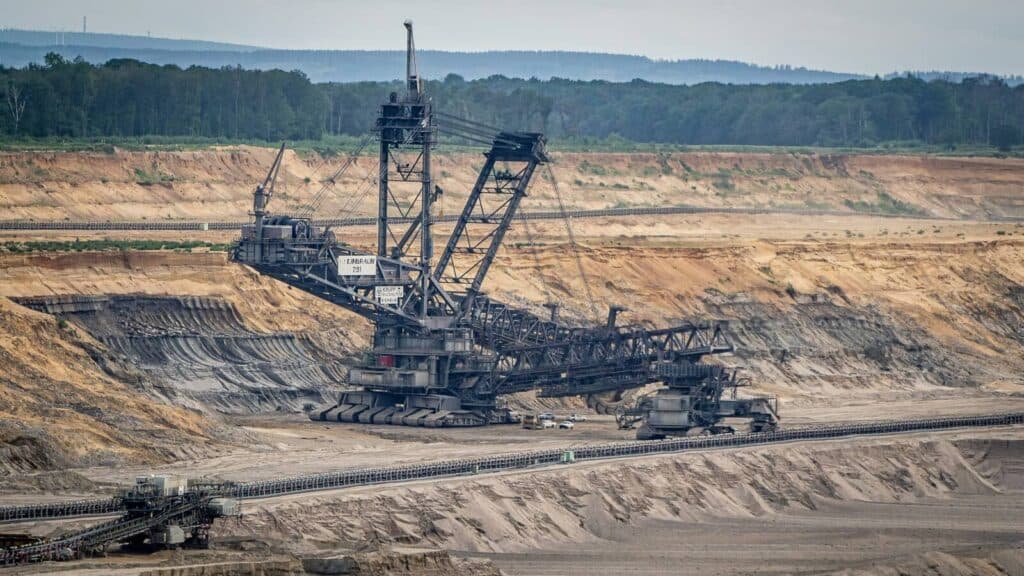
In the post-war years, more than 80 villages in northern Bohemia disappeared because of lignite mining. The most prominent example is old Most, which was condemned to make way for millions of tonnes of coal by a decision made on 26 March 1964. Of old Most, with its more than 750-year history, only the relocated Gothic Church of the Assumption of the Virgin Mary and the remains of Hněvín Castle were preserved. Demolition of the town was finally completed on 1 April 1987.
The first historical references to settlement at the site of today’s Most appear in the Latin Chronicle of the Czechs by Cosmas, dating from the 10th century, when a route across the local marshland ran over wooden bridges. The town takes its name from these bridges. Huge coal deposits were discovered around Most in the 18th century, and in the 19th century the railway reached the town, where a sugar refinery, porcelain factory, steelworks, brewery and municipal museum were built.
After the Second World War, most of the town’s original German-speaking inhabitants were expelled (from 1938 to 1945, Most was annexed to the German Reich as part of the Sudetenland). At the beginning of the communist era in 1948, around 45.000 people lived there. The town had a compact centre with many Gothic buildings.
Demolition of old Most began in 1965. The town, with a population of around 55,000, could today have rivalled any historic preservation area in the country for the significance of its monuments, but was gradually razed with explosives over the next two decades. The oldest parts of the town were destroyed within the first ten years. The 1911 theatre building, for example, was demolished in 1981; the local brewery, founded in 1470, was torn down in 1972; Most cemetery, dating from 1853, had already been lost by the end of the 1960s; and the 1 May Steelworks, which opened in February 1914, were demolished in 1974 and 1975. The only monument saved was the Gothic Church of the Assumption of the Virgin Mary, built between 1517 and 1550, which was moved 841 metres along railway tracks in 1975. The church was reconsecrated in 1993.
Construction of the new town, including its centre, began at practically the same time. The first project completed there was the former Communist Party of Czechoslovakia (KSČ) building, followed by a department store, which opened for business in 1976. A 25-storey, 96-metre-high skyscraper opened there in 1984. It remains one of the most prominent landmarks of the town, which now has a population of almost 65,000. It originally served as the headquarters of the North Bohemian Lignite Mines (SHD). Construction began in the 1970s, and until the end of the century it was the tallest building in Czechia, excluding church towers.
From 1965 to 1985, the old town of Most and its surroundings slated for demolition—including the villages of Velebudice, Sýřice, Dolní Jiřetín, Čepirohy and Rudolice—provided a cheap and authentic backdrop for war films. Documentaries and films from the so-called Czech New Wave were also shot there, including The Joke and Case for a Rookie Hangman. The Soviets filmed in Most most often, but Americans (in The Bridge at Remagen), Poles and Germans also shot there.
Estimates suggest that, from an economic perspective, demolishing old Most paid off, generating almost three billion crowns in profit. A total of 89,275.007 tonnes of lignite were mined, about 89 per cent of the reserves in the area. Mining in the Most town pillar was halted at the turn of 1990 and 1991.
Translation disclaimer
This article is a machine translation of the Czech original and has not yet been fully reviewed. In case of any doubt, please refer to the Czech version.
Sdílejte článek prostřednictvím:
You might also like

28 October 2026, 11:10

28 October 2026, 09:08