
28 October 2026, 15:10
Loading...
Europe has 37 LNG terminals in operation; Czechia uses Dutch Eemshaven

oEnergetice.cz, ČTK
28 June 2024, 16:28
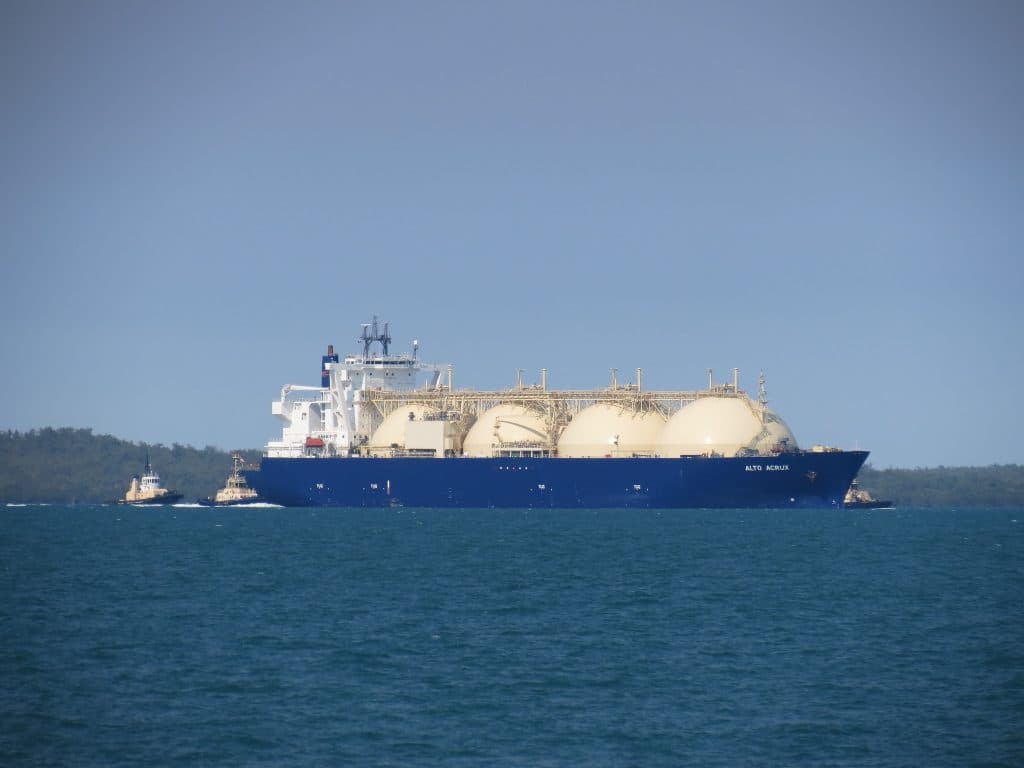
Selected data on liquefied natural gas (LNG) terminals in Europe (construction has begun in Stade, northern Germany, near Hamburg, on a new onshore terminal for processing and onward transport of LNG, which will also have capacity for Czechia):
– A number of European countries, including the Czech Republic, have been seeking to diversify their natural gas supplies since Russia launched its military invasion of Ukraine in February 2022. The European Union aims to end its dependence on Russian gas by 2027. According to the European Commission (EC), the share of Russian gas in EU imports of the commodity fell from 45 percent in 2021 to 24 percent in 2022 and 15 percent in 2023.
– The EU wants to increase the share of renewable energy sources, while Russian gas is increasingly being replaced by Norwegian gas and imports of liquefied natural gas (LNG). In 2023, LNG imports accounted for around 37 percent of Europe’s gas consumption, according to the US analytical institute IEEFA, compared with 34 percent in 2022 and 19 percent in 2021.
– The largest share of LNG reaching Europe comes from the US (46 percent), followed by Qatar (12 percent), Russia (11.7 percent) and Algeria (5.6 percent). According to IEEFA data, the largest LNG importers are France, Spain, the Netherlands, the UK, Italy and Turkey.
– The Czech Republic also secures LNG supplies. Last year, the partly state-owned energy company ČEZ secured gas supplies through 2027 at the LNG terminal in Eemshaven, the Netherlands, which began operations in mid-September 2022. At the time, it was the first liquefied natural gas terminal to come into operation in Europe since the start of the war in Ukraine. Other energy companies, including the UK’s Shell and France’s Engie, have also booked capacity at the terminal alongside ČEZ. The terminal recently handled its 100th LNG vessel, with 37 ships delivering gas for the Czech Republic. Czechia has thus secured 3.4 billion cubic metres of gas there since the terminal opened, more than half of the country’s annual consumption. According to the ČEZ energy group, Russian gas was excluded from supplies to the terminal, with most cargoes arriving from the US. The terminal consists of two vessels, Eemshaven LNG and Energos Igloo, which allow the commodity to be stored and regasified.
– Construction began today in Stade, northern Germany, near Hamburg, on a new onshore terminal for processing and onward transport of LNG. From 2027, Czechia, in cooperation with the ČEZ group, will have a long-term lease on annual capacity of two billion cubic metres of gas there. According to Industry and Trade Minister Jozef Síkela, this should be enough to cover around a quarter of current domestic annual consumption. EnBW and SEFE have already secured the other two long-term stakes in the terminal; the latter was formerly Gazprom Germania. Czechia’s capacity lease at the Eemshaven terminal expires in 2027.
– According to the US institute IEEFA, a total of 37 LNG terminals are in operation in Europe, with another 17 under construction or in the planning stages. Spain, Italy and France have the most.
– Germany is seeing a major expansion of infrastructure, with LNG terminals commissioned by the state now operating in Wilhelmshaven, Lower Saxony, and Brunsbüttel, Schleswig-Holstein. A purely commercial terminal has also been established in Lubmin, Mecklenburg-Western Pomerania. The state-funded terminal near the island of Rügen in the Baltic Sea is now awaiting full commissioning. The terminal in the German port of Stade is expected to be Germany’s first onshore LNG terminal.
– LNG (liquefied natural gas) is natural gas that has been liquefied by cooling it to minus 162 degrees Celsius. After extraction and liquefaction, it is transported either by sea in tankers or by rail, and over shorter distances also by road freight. The liquefied gas is delivered either to end customers or to special terminals, where it is transferred to storage tanks. It gradually evaporates there and is fed into gas pipelines as conventional natural gas.
– LNG takes up around 600 times less space than natural gas, which is its biggest advantage for storage and transport. By comparison – compressed natural gas (CNG) takes up 200 times less space.
– LNG has so far been used mainly in road transport, first in the 1950s in the former Soviet Union as fuel for tractors. It was later adopted in transport primarily for long-distance buses and freight vehicles, as well as in shipping and rail transport.
Translation disclaimer
This article is a machine translation of the Czech original and has not yet been fully reviewed. In case of any doubt, please refer to the Czech version.
Sdílejte článek prostřednictvím:
You might also like

28 October 2026, 13:08

28 October 2026, 11:10

28 October 2026, 09:08
