25 September 2026, 09:51
Loading...
Czech electricity consumption rises year on year for first time since 2021

David Vobořil
10 January 2026, 12:49
Net electricity consumption rose year on year last year for the first time since 2021. However, it still did not reach the levels seen before 2023. Despite a below-average pace of electrification by international comparison, consumption in the Czech Republic should continue to grow, according to ČEPS. This follows from a comprehensive report on the Czech electricity sector in 2025, published this week on the oEnergetice.cz portal.
While the decline in electricity consumption that had persisted since 2021 came to a halt in 2024, 2025 saw a modest increase, with consumption rising by approximately 2.3 % year on year. Net consumption reached 59.3 TWh. This remains below consumption levels before 2023. In 2018, 2019 and 2021, consumption was approximately 5 % higher than last year.
Temperature was one reason for the year-on-year increase in consumption. Although last year was slightly warmer (+0.5 °C) than the temperature normal, it was 1.5 °C colder than 2024, which was the warmest year since 1961 in terms of average temperature.
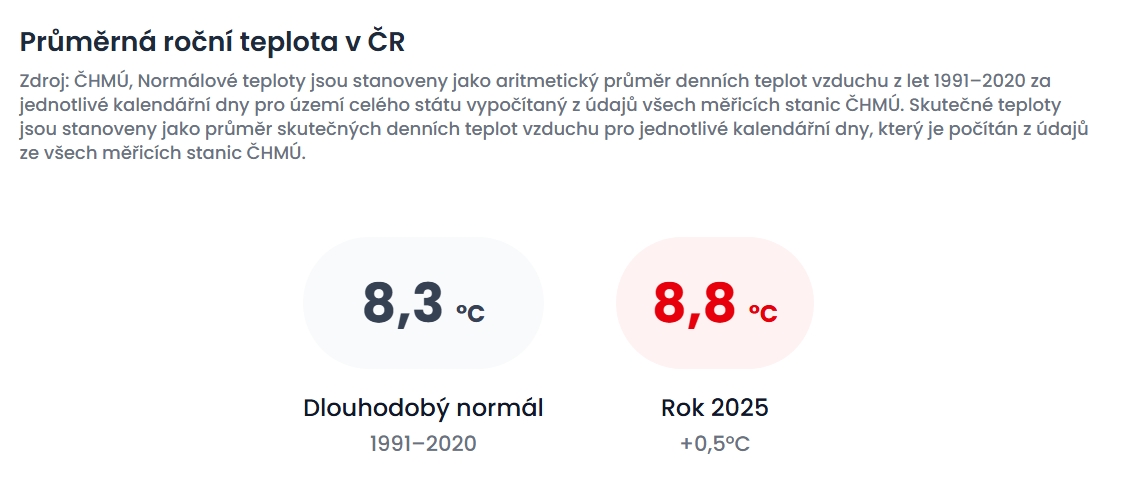
Average annual temperature in the Czech Republic in 2025 and the temperature normal. Source: ČHMÚ, oEnergetice.cz
Households recorded significant consumption growth, while small businesses also saw modest growth. Large consumers and industry recorded, depending on the voltage level, stagnation (medium voltage) to a slight decline (very high voltage).
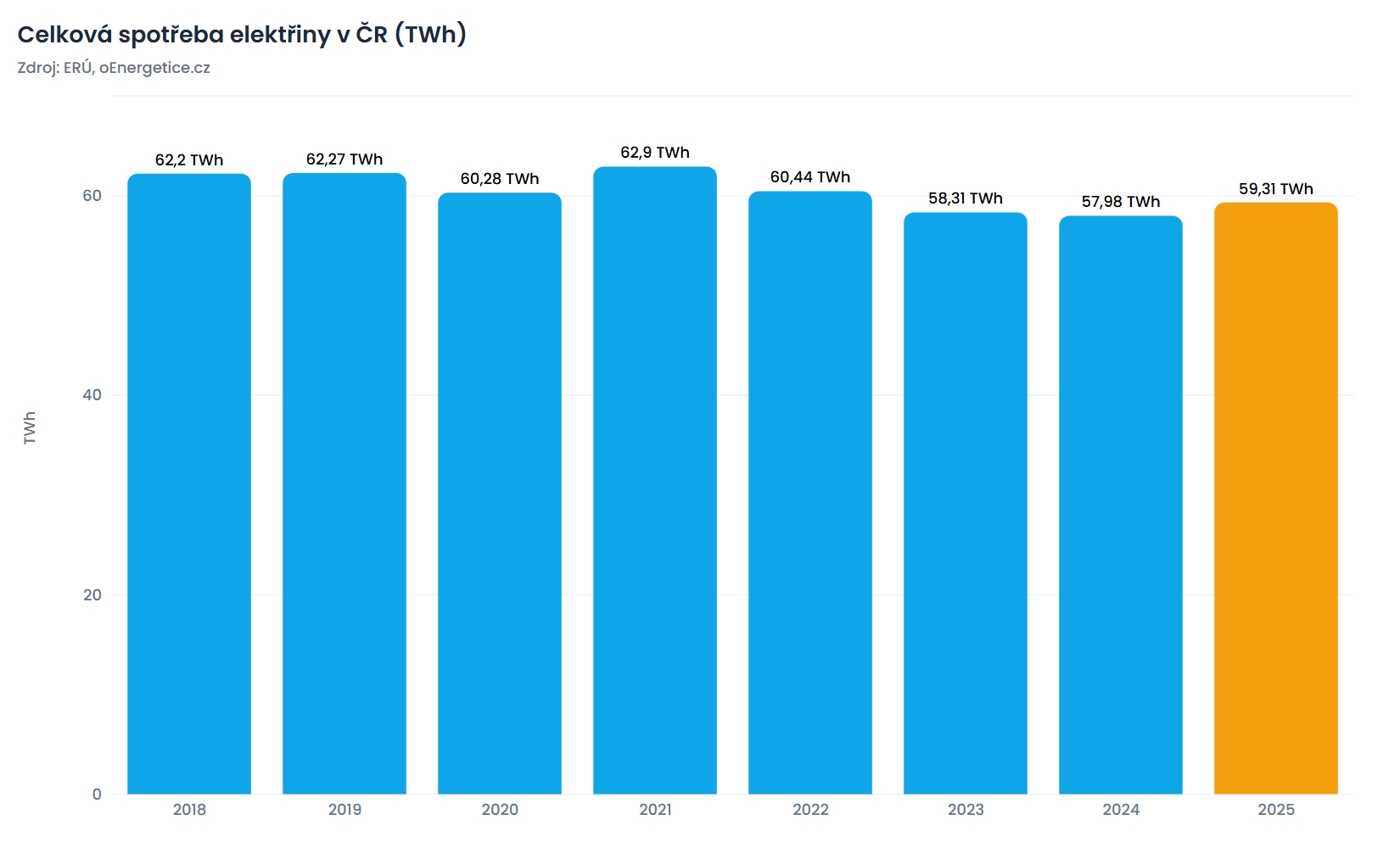
Net electricity consumption in the Czech Republic. Source: ERÚ, oEnergetice.cz
Electricity consumption rose year on year in every month except January and August. February recorded the largest year-on-year increase, with net electricity consumption rising by around 6 %. The main reason was temperature, as last February was significantly colder than the exceptionally warm February 2024.
Seasonal fluctuations in electricity consumption in 2025 were comparable with those in 2024. In 2025, consumption in the winter months was on average 27 % higher than in the summer months, compared with 25 % in 2024.
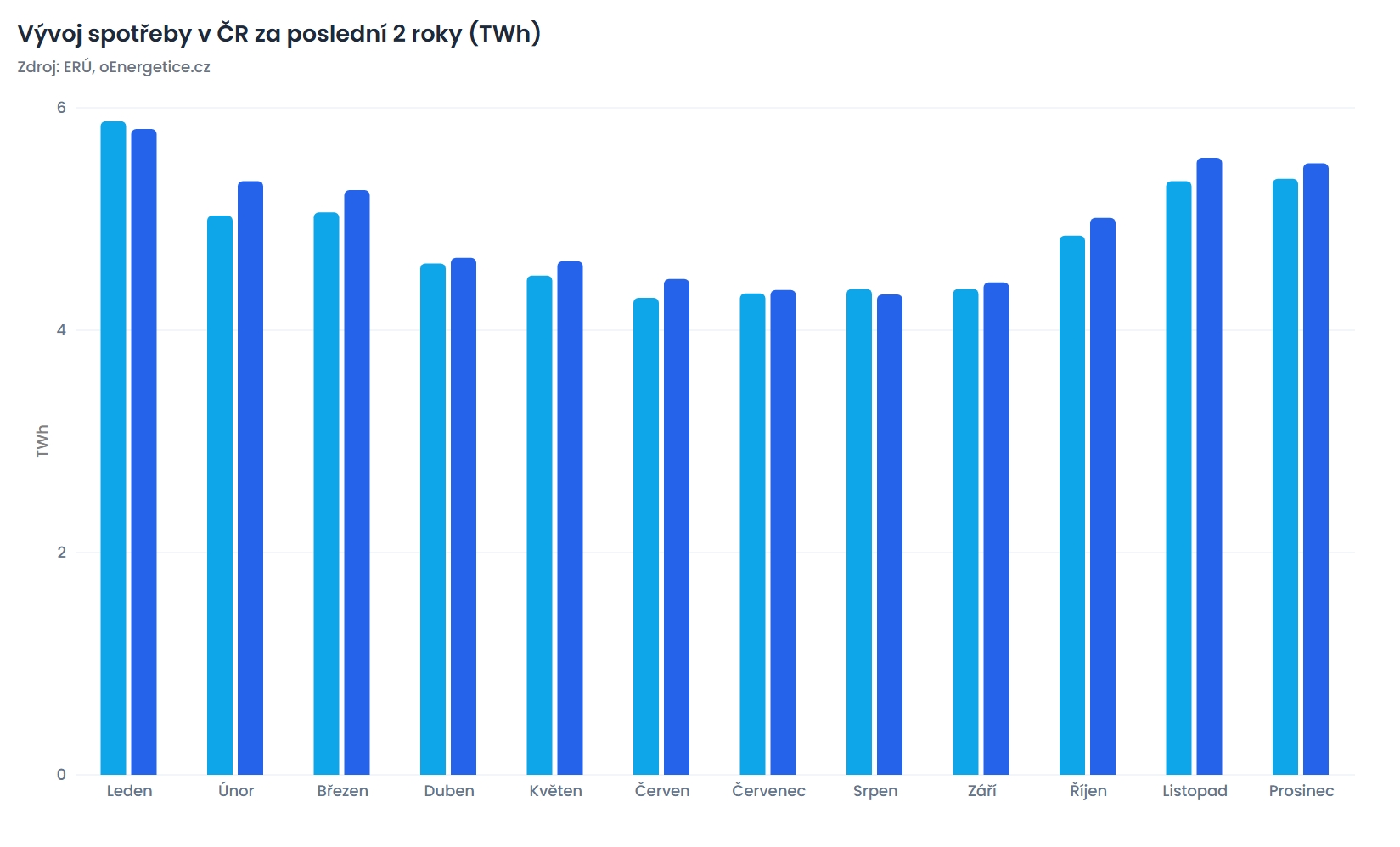
Monthly electricity consumption in the Czech Republic in 2024 and 2025. Source: ERÚ, oEnergetice.cz
Consumption trends in the coming years
ČEPS forecasts future electricity consumption in the Czech Republic under two main scenarios: responsive and progressive. The scenarios reflect different assumptions regarding future consumption growth based on factors such as economic development, heating electrification, electric mobility and the overall energy intensity of the economy.
According to these forecasts, annual net electricity consumption, including losses, will gradually grow in both scenarios, but more significantly in the progressive scenario: 69.5–74.2 TWh is expected in 2030, 75.5–83.0 TWh in 2035, and subsequently 81.5–92.1 TWh by 2040. All the figures indicate a shift towards higher demand over time as a result of the development of new electricity loads and technological changes.
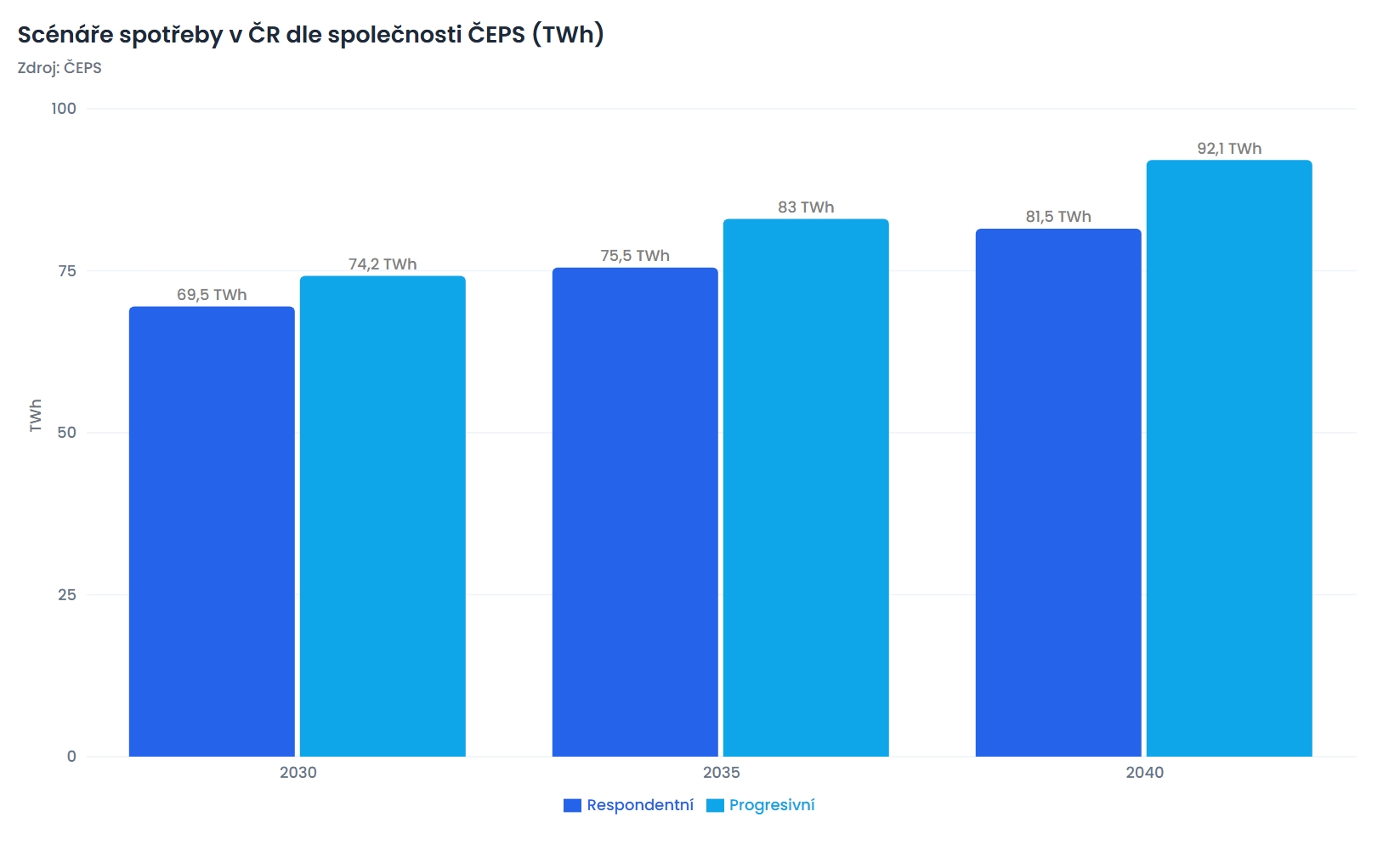
Electricity consumption trends according to ČEPS. Source: MAF 2023, ČEPS
Historical consumption trends point to slower electrification of final consumption sectors compared with the average of countries monitored by the IEA. Between 2005 and 2023, the electrification rate in the buildings sector rose slowly from 25 % to 30 %, and from 22 % to 31 % in industry. These sectoral electrification rates remain below the IEA average of approximately 45 % in buildings and 33 % in industry, although cross-country comparisons do not account for differences in the composition of subsectors.
Several barriers need to be removed to accelerate the electrification of final consumption sectors. Electricity prices are up to three times higher than gas prices, favouring the use of fossil fuels over electricity. Other challenges include problems with electricity grid connection capacity, including lengthy permitting procedures for connecting industrial sites to higher-voltage grids, a lack of policies and incentive programmes supporting electrification, and a lack of fully operational large-scale demonstration projects directly applicable to final consumption sectors.
Translation disclaimer
This article is a machine translation of the Czech original and has not yet been fully reviewed. In case of any doubt, please refer to the Czech version.
Sdílejte článek prostřednictvím:
You might also like
24 September 2026, 11:23

24 September 2026, 10:30
24 September 2026, 06:56