20 October 2026, 15:34
Loading...
Les Království reservoir on the Elbe in Czechia
Tomáš Jirka
19 November 2015, 20:11
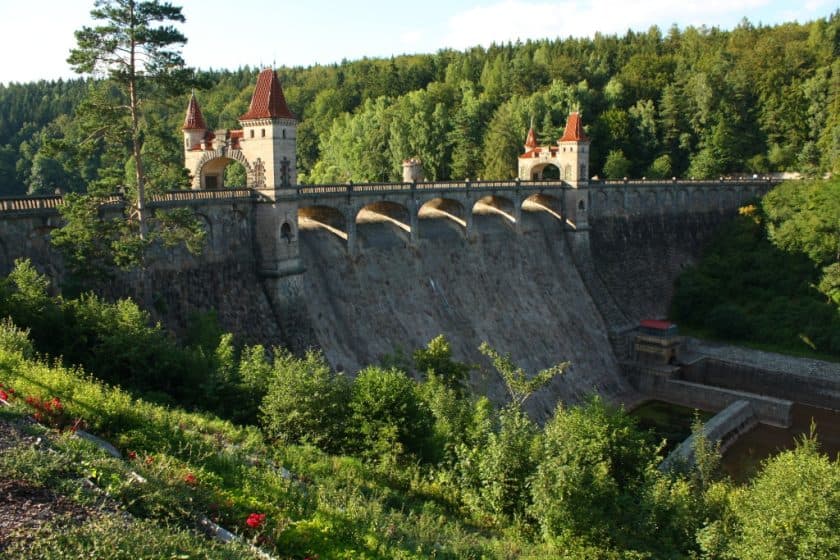
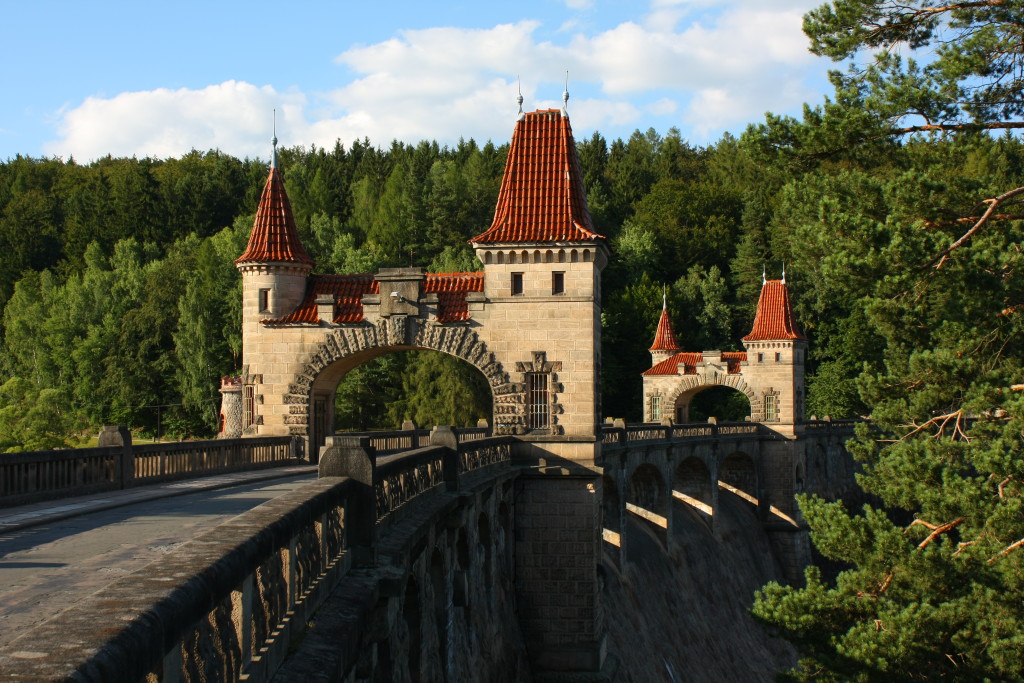
The Les Království reservoir is a valley dam reservoir with a hydroelectric power plant dating from the early 20th century. Thanks to its romantic appearance, it is a popular tourist destination near Zvičina Hill. From a distance, the turrets with red roofs on the dam make it look more like a castle than a dam; all related structures were built in a similarly fairytale style – including the dam keeper’s house, control towers and the later-added anti-seepage walls.
It is located on the Elbe River, 4 km upstream from Dvůr Králové nad Labem, at the isolated settlement of Těšnov (Těšnov Mill) near Bílá Třemešná; these are also the original names that can still be encountered today. A local road runs directly along the dam crest and provides access to the dam, with small car parks on both sides. Tourist information boards are located on the right bank by the dam keeper’s house, while a path runs upstream along the left bank.
Its current name derives from the extensive „Království“ forest complex on its right bank, which is a remnant of a former border forest.
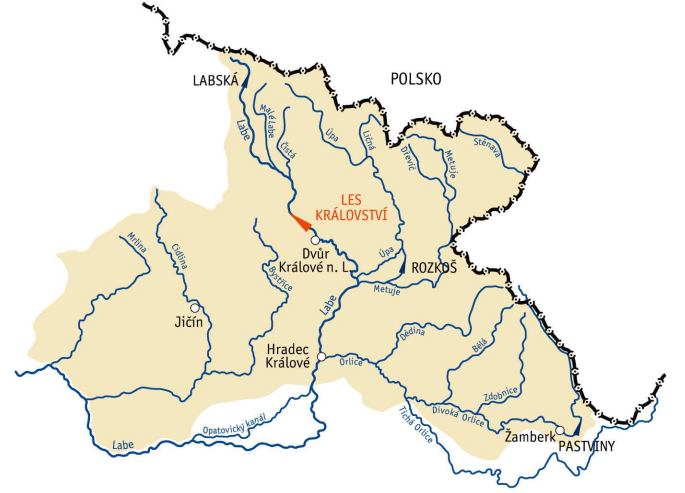
The impetus for construction of the dam came from heavy rainfall lasting 14 days and a cloudburst in the Krkonoše Mountains on the night of 29 to 30 July 1897 (342 mm of precipitation fell in Obří důl during those few days, equivalent to one fifth of the local annual average). The resulting volume of water severely damaged the entire Elbe valley from Vrchlabí to Pardubice and was also linked to one of the greatest disasters in the Krkonoše Mountains, in Obří důl.
It was decided that two dam reservoirs would be built on the Elbe River: Les Království and Labská near Špindlerův Mlýn, which is also a popular tourist destination in the Krkonoše Mountains thanks to its architecture and more attractive location for visitors.
Construction of the Těšnov reservoir
The complete history is covered in the publication Tešnovská přehrada – historie vodního díla na horním toku Labe, Prof. RNDr. Karel Martinek, DrSc. (author’s note)
Preparatory work for the construction was launched in 1902 by the Technical Department for River Regulation in Prague, headed by engineer Josef Plicka, while the country was still part of Austria-Hungary.
Construction took place between 1910 and 1920 (delayed by the First World War), meaning it was completed in the Czechoslovak Republic. The construction work, using local sandstone, was carried out by J. V. Velflík, while the dam’s mechanical equipment was supplied by Fanta and Jireš. Costs rose to 4.7 million Austrian crowns. On completion, it was the largest reservoir in what was then Czechoslovakia.
The run-of-river hydroelectric plant on the right bank below the dam was built between 1920 and 1923 by J. V. Velflík. The technological equipment was supplied by Prague-based Kolben, while the electrical part was supplied by Prague-based Křižík.
Later, in 1929, a sealing wall was built along the left side of the valley which, together with cement grouting, was intended to prevent substantial water seepage into the rocky slope. This 182-metre-long wall was extended by a further 95 metres between 1938 and 1939, preventing water from seeping into the left bank.
Between 1952 and 1959, the dam underwent a major reconstruction, including the concreting over of the right bypass tunnel beneath the dam keeper’s house in front of the gate chamber due to water seepage.
Current purpose of the waterworks
For most of the year, the Les Království reservoir is used to generate clean electricity (it is owned by ČEZ) and for recreation (it is a source of drinking water and is therefore unsuitable for swimming). Naturally, it also serves to protect against the effects of high water and to regulate river flows below the dam.
It is also a popular tourist destination, as there are not many reservoirs of similar architectural design in the Czech Republic. In 2010, the dam became a National Cultural Monument.
Technical parameters of the structure and hydroelectric plant
At maximum fill level, the reservoir is 5080 m long, with a flooded area of 90 hectares and a total volume of 9.15 million cubic metres of water. Its average annual flow is 8.31 m³/s.
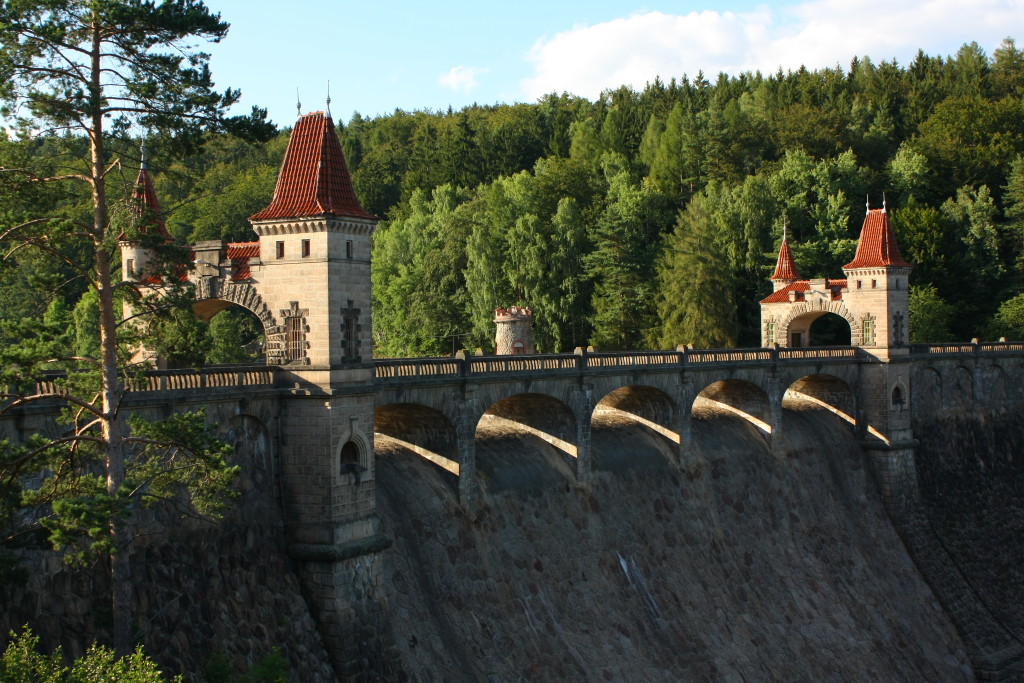
The dam is a gravity arch dam with a radius of 200 metres. Its maximum height is 41.1 metres, its base width is 37 metres, and the 218-metre-long crest is 7.2 metres wide. The depth at the dam is around 28 metres. The crest is located 327 metres above sea level and includes a rail-mounted system for removing deposited sediment.
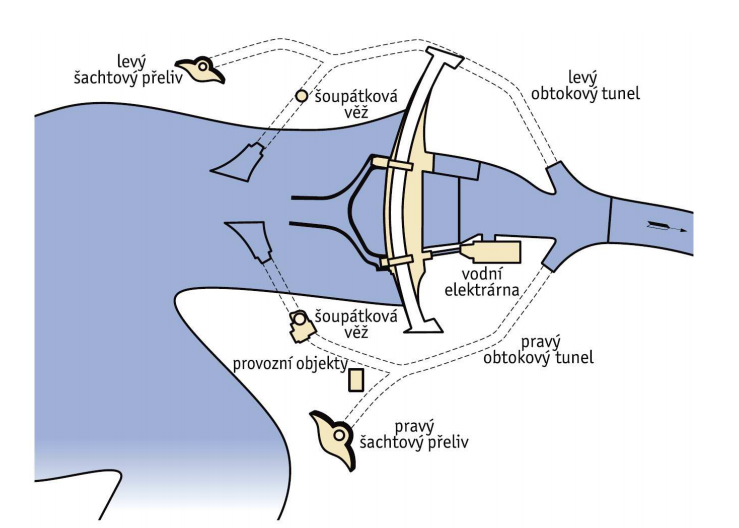
The dam includes a bottom outlet with a diameter of 2 metres and a maximum discharge capacity of 44.3 m³/s, while the structure includes two bypass tunnels: the left one has a diameter of 5.4 metres and the right one 6 metres. Three bottom outlets, each 1 m in diameter, lead into the left bypass tunnel and have sluice-gate closures operated from the gate tower. A single 1.8-metre-diameter outlet is located in the shaft leading to the right tunnel beneath the dam keeper’s house; it is operated by a knife gate, flap gate and segment gate.
If the controllable storage capacity is exceeded, five bays of the emergency spillway are available, with a total capacity of 71.5 m³/s, as well as two shaft spillways, one on each side of the valley: the left-hand one has a capacity of 72.6 m³/s and the right-hand one 111.7 m³/s.
The hydroelectric plant, dating from 1923, had two horizontal Francis turbine-generator sets with twin boiler turbines, with an installed capacity of 1120 kW. Due to turbine reliability problems, the discharge capacity was reduced from 12 to 9 m³/s.
In 2005, the hydroelectric plant underwent a complete overhaul due to obsolete controls, along with its building, which remains on the right bank below the dam. The original equipment is held by the National Technical Museum. The original turbine generators were replaced by two modern turbine-generator sets with horizontal Francis turbines featuring overhung runners, with a total discharge capacity of 12 m³/s and output of 2 x 1 105 kW.
According to data from the ERÚ, this small hydroelectric plant generated 8.3 GWh of „clean“ electricity in 2011.
Sources:
- „Unknown source“ – the photographs in question have been on the author’s HDD for many years and cannot be found online. If any reader recognises them, we would be very grateful to identify their original author.
- Povodí Labe: Les Království dam, available online at: http://www.pla.cz/planet/public/vodnidila/prehrada_leskralovstvi.pdf – complete technical description of the waterworks
- Les Království reservoir on Wikipedia, available online at: https://cs.wikipedia.org/wiki/Vodn%C3%AD_n%C3%A1dr%C5%BE_Les_Kr%C3%A1lovstv%C3%AD
- PROFOTO Dvůr Králové nad Labem photo gallery, available online at: http://www.dvurkralovefoto.cz/fotogalerie/kralovedvorsko/prehrada-les-kralovstvi/
- ČEZ: Les Království dam, available online at: http://www.cez.cz/cs/vyroba-elektriny/obnovitelne-zdroje/voda/les-kralovstvi.html#!&zoom=12
- Les Království dam on Interregion Jičín, available online at: http://www.interregion.cz/turistika/stavby/technika/les_kralovstvi/prehrada_les_kralovstvi.htm – complete photo gallery of the waterworks and its details
- Master’s thesis: Use of selected renewable energy sources in regions of the Czech Republic, Bc. Andrea Kmentová, Brno 2011, available online at: https://is.muni.cz/th/207041/esf_m/Diplomova_prace_finalni_verze.txt
- List of hydroelectric power plants in the Czech Republic on Wikipedia, available online at: https://cs.wikipedia.org/wiki/Seznam_vodn%C3%ADch_elektr%C3%A1ren_v_%C4%8Cesku
Translation disclaimer
This article is a machine translation of the Czech original and has not yet been fully reviewed. In case of any doubt, please refer to the Czech version.
Sdílejte článek prostřednictvím:
Topics:Hydroelectric power plants
You might also like
20 October 2026, 12:55

20 October 2026, 10:49
20 October 2026, 06:13