Twilight of European nuclear power? Koreans disagree, seek partners in Czechia
The past belonged to the Americans and the French; the future belongs to the Chinese, Russians and Koreans. Such a view of the future of nuclear power is certainly not unusual today. Europe is grappling with two cautionary examples of the construction of new-generation nuclear reactors at Flamanville in France and Olkiluoto in Finland, both of which are suffering major delays and cost overruns, while preparations for a number of other projects have stalled. Germany is abandoning nuclear power altogether.
Yet it is the Chinese, Russians and Koreans who, paradoxically, refuse to write off European nuclear power. Korean ambitions in Europe may have received the least attention so far. But the country’s energy company KEPCO is increasingly signalling its interest. In London and other European capitals, including Prague.
And the state-controlled company KEPCO has a significant advantage: if the Russians are barred from somewhere for political reasons and Chinese expansion continues to run into security concerns, none of this applies to the South Koreans.
The British test
Britain recently learned of the current Korean interest. The British press published information according to which KEPCO is in talks to join the NuGen consortium, which plans to build three new reactors at the Moorside power plant in Cumbria, northern England.
The Koreans would thus join Japan’s Toshiba and French company Engie. The reactors for the Moorside plant are to be supplied by a Toshiba subsidiary – the US company Westinghouse, well known in Czechia.
The question is whether the Koreans are trying to emulate the Chinese strategy in Britain: first joining as co-investors, then offering their own reactors. The Koreans would certainly be more appealing to many people in the United Kingdom: while the new British government of Theresa May began to take a cautious approach towards Chinese plans and delayed the project for another (and so far better-known) power plant, Hinkley Point, with French-Chinese investors. It only gave this project the go-ahead after reportedly receiving assurances that the Chinese could not control the entire project themselves.
It began with a victory over the French
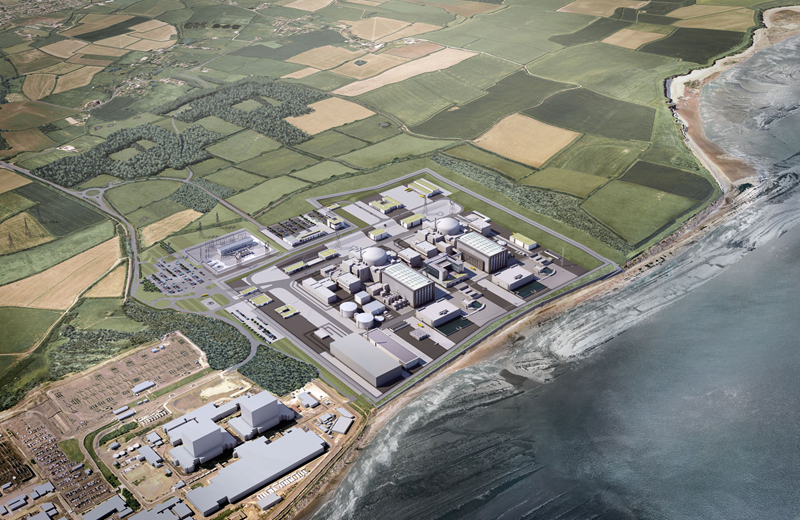
The Koreans now have ambitions to join a project which, if necessary, could perhaps become a kind of alternative to the controversial Hinkley Point, where the same French EPR reactors as at Flamanville and Olkiluoto are eventually to be built.
It may seem symbolic that KEPCO’s entire major push into international markets began seven years ago precisely with a victory over the traditional ruler of European nuclear power – French company Areva. The US-Japanese joint venture GE Hitachi was also among the losers.
This happened in 2009, when the Koreans won the tender for four reactors at the Barakah power plant in the United Arab Emirates. The French, convinced of the perfection of their EPR reactor, took the defeat very badly.
A springboard to the world
Conversely, the Barakah project, where KEPCO also works closely with Americans (who act as subcontractors there), is set to become a Korean springboard for the large-scale export of Korean APR 1400 reactors around the world. The partnership with the Koreans could perhaps be embodied by manager Tom Samson, who was in the management of the nuclear company Emirates Nuclear Energy Corporation and now heads the NuGen consortium in Britain.
South Korea has set a target of becoming the world’s third-largest exporter of nuclear reactors by 2030. It starts from a strong domestic base, as one of the world’s leading operators of nuclear power plants – in addition to 24 existing reactors with a total capacity of almost 22 gigawatts, the Koreans are building another six on home soil. They are also already planning the construction of four more units.
Following in Rosatom’s footsteps?
Korean activities abroad resemble the strategy of concluding preliminary agreements pursued by Russian state corporation Rosatom. KEPCO recently signed a memorandum of understanding with Kenya, covering not only the construction of future power plants but also the exchange of experience – in effect, assistance with developing Kenya’s nuclear programme.
However, it would be a mistake to paint South Korea’s peaceful nuclear programme entirely rosy; this advanced country has also faced critical moments. Three years ago, the country was hit by a major scandal when the nuclear regulator discovered that suppliers of components for its reactors had forged thousands of safety certificates.
The prospect of Dukovany
But let us return to Europe – from the perspective of the old continent, it is important that the Koreans are also targeting it. In its presentations, KEPCO mentions potential opportunities in Czechia, Slovakia, Poland and the aforementioned United Kingdom.
Much suggests that the Koreans attach considerable importance to Czechia in particular. The prospect that KEPCO could play a role in the potential construction of new reactors at Dukovany or Temelín certainly plays a substantial part. The Korean company is one of the companies approached by the Czech government on this matter.
However, Czech-Korean cooperation in nuclear power could potentially have a broader scope. When KEPCO manager Kim ChanHoi visited Prague this spring, he spoke of Czechia’s “advantageous geographical position” in the centre of Europe. The Koreans also signalled that they recognised the long-standing tradition of the Czech nuclear industry.
“Educated and cheap” Czechia
All this invites speculation that if the Koreans won a contract anywhere in Europe, they would not have to manufacture everything in their own country and could seek partners in Czechia as well. All the more so because the Koreans still see Czechia as a country with an “educated yet relatively cheap workforce”. Kim ChanHoi also attracted attention in Prague with his statement about a “surplus of competent specialists in Czechia” following the cancelled completion of Temelín.
Interest in Czechia thus appears to fit into a broader context: the South Koreans have also officially announced their intention to form strategic partnerships with global nuclear companies, intended to help strengthen exports and their ability to meet the diverse requirements of importers.
From the perspective of potential contracts for Czech companies in the construction of nuclear power plants managed by KEPCO – theoretically anywhere in the world – it is important that Czech state insurer EGAP concluded a reciprocal reinsurance agreement in 2015 with its Korean counterpart, agency K-Sure.
Finally, it may also prove beneficial that Prague is a popular city in Korea, so even a trip to the Czech capital for business talks can be a pleasant affair for Koreans.
A breakthrough in Ukraine?
Czech companies may, however, be interested in another piece of news from late this summer – the Koreans concluded a preliminary agreement (memorandum of understanding) with Energoatom, the operator of Ukrainian power plants. The Ukrainian partner in this case should be Korea Hydro & Nuclear Power (KHNP), whose parent company is the aforementioned KEPCO. Under the signed memorandum, the Koreans could win a contract to complete the Khmelnytskyi nuclear power plant. Construction of its third and fourth units – already at an advanced stage – was suspended in 1990.
The traditional supplier for Energoatom is Škoda JS, based in Plzeň. The company saw the potential completion of the Khmelnytskyi plant as an opportunity for Czech firms comparable in scale to that currently offered by the completion of Slovakia’s Mochovce plant. (Two new Russian-type VVER units are being built there.)
At first glance, the Koreans appear to be competitors to Czech companies in the Ukrainian case, but the possibility of partnership could also emerge here.
What next for nuclear power
All in all: for the future of nuclear power in Europe, understood in a broader geographical sense (not only the European Union, which Britain is now leaving), developments on two “fronts” may be crucial under the current circumstances – the Rosatom project at Hanhikivi in Finland (or other Rosatom projects) is important, while the construction of the Hinkley Point plant led by Électricité de France and involving the Chinese in the United Kingdom (or other power plant projects in the United Kingdom) could reveal much.
On the other hand, Europe is certainly not the only part of the world where Korea’s KEPCO intends to establish itself. The Koreans are looking at countries such as Malaysia, Vietnam and Iran. The project in the United Arab Emirates is encouraging their ambitions in the Middle East.
But if Korean interest extends to Europe as well, it shows that there may be more alternatives. This conclusion concerns potential supply. Major battles still lie ahead over how the situation develops on the demand side.
The author works as a consultant and energy project specialist for the HATcom agency.
Translation disclaimer
This article is a machine translation of the Czech original and has not yet been fully reviewed. In case of any doubt, please refer to the Czech version.