10 October 2026, 07:37
Loading...
AI's future in Europe: Artificial intelligence development runs up against water and electricity shortages
Veronika Jurcová
21 August 2025, 11:12
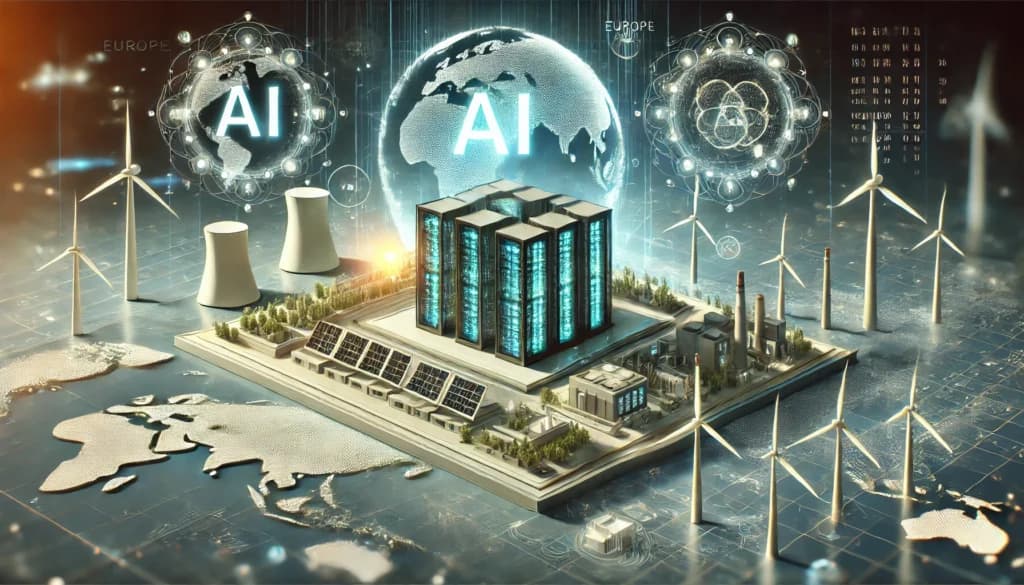
The AI boom is a political priority in Europe, but it is also raising concerns about the availability of key resources — water and electricity. Data centres, essential infrastructure for training and running AI, are becoming a water-thirsty and energy-intensive part of the digital ecosystem, Euractiv reports.
Political ambitions vs. environmental limits
The European Union is seeking to develop artificial intelligence (AI) in the European market and plans to triple data centre capacity by 2032. France, with more than 300 existing centres, aims to become a major magnet for AI investment, a goal backed by President Macron with a plan to simplify permitting procedures. The European Commission wants to build five “AI gigafactories” for the most demanding AI training as part of its AI Continent initiative, with more than 70 applicants already expressing interest in the projects. The forthcoming Cloud and AI Development Act is also intended to simplify data centre permitting and support more efficient operations. These plans, however, are meeting resistance from the public and environmental organisations. French NGO La Quadrature du Net is calling for a moratorium on new data centres until a broader public debate is held on their impacts. Similar initiatives are also emerging in Germany, Ireland and the dry Spanish region of Aragón. Dozens of data centres operate in Czechia, most of them in Prague. Experts estimate that their capacity could roughly double by the end of the decade, although growth is slower than in Western Europe. The state has adopted the National Artificial Intelligence Strategy 2030, but there is not yet a specific policy focused directly on data centres.How much water and electricity do data centres consume?
AI requires massive computing power, and therefore substantial cooling. A 2023 study estimated that 10–50 queries to the GPT-3 model use as much water as one half-litre bottle, excluding the resources needed to train the model. The European Water Association says water consumption by data centres will rise by 52% between 2024 and 2030 — from 62 to 94 million litres per year. Specific consumption data are lacking, and collection is often inconsistent. Still, we know that Google reported consuming 31 billion litres of water in its 2024 environmental report, equivalent to irrigating around 54 golf courses for an entire year. A Microsoft data centre in the Netherlands used up to 75 million litres of drinking water. Electricity consumption by data centres is also rising. According to the International Energy Agency (IEA) report, global electricity consumption by data centres is set to exceed 945 TWh by 2030, more than Japan's current annual consumption. Artificial intelligence, one of the most energy-intensive digital technologies, will account for the largest share of this growth. The sharpest increase is expected in the United States, where data centres could consume more electricity by the end of the decade than all traditional heavy industries combined — from steel and aluminium production to cement and chemicals. China is the second-largest driver of growth. Under baseline scenarios, global electricity consumption by data centres could then reach as much as 1,200 TWh by 2035.Proposed solutions
The vast majority of technology giants say they use air cooling rather than water cooling in dry regions — a method that uses more electricity but is more efficient in terms of water use. They have also pledged to return more water to nature than they consume by 2030, for example through wetland projects. Critics, however, point out that this replenishment water may not end up where it was consumed. Since May 2024, large data centres have also been required to report their water and energy consumption under the Energy Efficiency Directive (EED), but the first data have not yet been published. Critics also warn that mandatory reporting may not be detailed enough to support real decision-making at the local level. As part of its Water Resilience strategy, the Commission plans to improve transparency and introduce water consumption criteria into sustainability assessments. In terms of energy use, one possible solution to high electricity consumption could be direct connections to small modular reactors (SMRs), which could offer a stable and sustainable solution by allowing direct connections outside the main grid. Their wider deployment is still hindered by high costs and complex infrastructure, however, so experts do not expect them to be put into practical use before 2030. In Germany, data centre operators are considering building their own gas-fired power plants because of slow connections to the electricity grid. The European AI market is expected to grow by an average of 26% annually between 2025 and 2031. Although data centres are becoming more efficient, overall demand is likely to outweigh the savings. Europe therefore faces a fundamental dilemma between its ambition to become a leader in the digital revolution and the reality of limited resources and climate targets.Translation disclaimer
This article is a machine translation of the Czech original and has not yet been fully reviewed. In case of any doubt, please refer to the Czech version.
Sdílejte článek prostřednictvím:
You might also like

10 October 2026, 07:02
9 October 2026, 13:47