20 October 2026, 15:34
Loading...
BMW i8 review – What is the point of this futuristic GT?
Tomáš Jirka
18 August 2015, 17:57
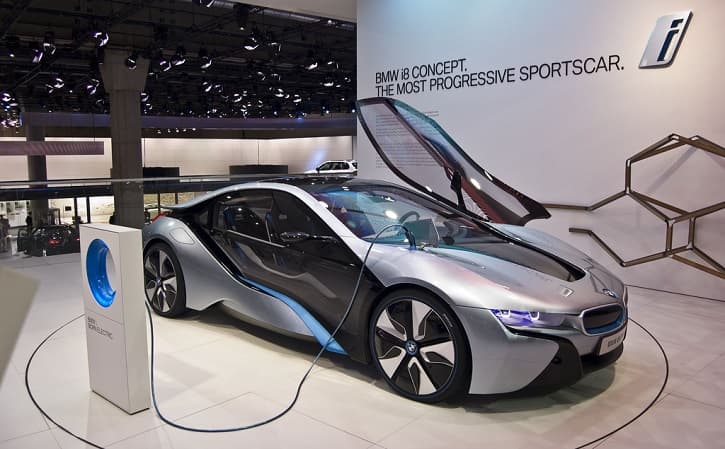
A great deal has been written about the BMW i8 since it came onto the market in 2014 with a price tag exceeding Kč 3 million. Nevertheless, after some time had passed and my childlike excitement had faded (by a considerable margin, it is the most expensive and fastest car I have had the opportunity to drive), I decided to put down my thoughts on its purpose and the technologies used in it. These should also appear in the brand’s mainstream vehicles over the next decade, specifically beginning with the 3 Series in 2022.
To compare it with other vehicles, its positioning and purpose must be mentioned. This is not a hybrid supercar (hypercar) in the vein of the Porsche 918, LaFerrari or McLaren P1, as many reviewers originally suggested due to its hybrid powertrain. Compared with them, it is a slow and poor relative. In terms of both price and performance, it is aimed more at the Porsche 911, Lexus RC or Audi R8; in other words, it is a sports car which, with the help of modern technology, can achieve highly dynamic performance even with an engine that we would at first glance place in a B- or C-segment vehicle.
BMW says the car is a showcase for its technologies, and an interesting comparison could be made between the BMW i8 and the iconic BMW 8 Series of the 1990s, which even today cannot be denied an exceptional design and no shortage of technical curiosities.
The centre of attention in every situation
When buying a vehicle in this price range, customers are usually interested not only in its driving characteristics and equipment, but also in the impression it will make on those around them – its „cool/wow factor“. Given the futuristic but, in my view, still beautiful design of this rather large coupé (470 x 194 x 130 cm, with weight reduced to 1485 kg mainly thanks to its carbon-fibre monocoque), this requirement is met with flying colours. The car is an incredible magnet for onlookers, whether it is moving through a golf club car park or along country roads around Kladno. With its „green label“, it is therefore the ideal image-building vehicle of our time for attracting attention, as its sales and delivery waiting times also demonstrate.
Its design is partly the work of the wind tunnel, as its drag coefficient, Cx, was improved to 0,26 to reduce consumption. This figure is not currently one for the hall of fame, as even an „ordinary“ Peugeot 508 achieves 0,25, the Tesla S 0,24, Mercedes reaches figures as low as 0,22 in its new models thanks to Europe’s newest wind tunnel, and Volkswagen’s XL1, with a very similar price tag, even achieves 0,19. There is therefore considerable room for improvement here, but it is very positive that carmakers have focused in recent years on aerodynamic drag, which plays the leading role in driving resistance at higher speeds. The other issue is downforce for a vehicle capable of reaching high speeds, so ideally active aerodynamic elements would be used in the future; these are already entirely commonplace in this price range today.
Inside, there is no such wildness, and the driver is pampered by the fairly conventional interior of a luxury BMW, with leather wherever you look, navigation… Thanks to the standard Head-up display, the driver does not have to take their eyes off the road at all, which is very convenient and also improves road safety. The only drawback is the 2+2 layout: two comfortable sports seats in the front and two parodies in the rear, where anyone taller than roughly 120 cm simply cannot fit. However, given the small luggage compartments at both the front and rear because of the power units, this storage space ultimately comes in handy; stylish luggage from Louis Vuitton can also be ordered as an option.
Power units, plural
To reduce emissions, carmakers are turning to engine downsizing and turbocharging, or, in exclusive models, to deactivating cylinders in large-displacement units under low load. BMW has taken the former route in cooperation with electric motors, making the i8 a plug-in parallel full hybrid.
The front axle houses a 96 kW asynchronous electric motor with 250 Nm of torque, characterised by lightning-fast throttle response, linear pull and the ability to recuperate braking energy into the batteries, which are housed in the central tunnel for weight distribution purposes (Li-Ion battery capacity is 7,1 kWh, while the standard onboard charger is 3,7 kW/12 A). Only this motor is used in the vehicle’s pure-electric mode.
On the rear axle is a turbocharged 1,5-litre TwinPower Turbo three-cylinder engine producing 170 kW and 320 Nm of torque, which won the 2014 Engine of the Year award in its category. It is connected to the axle via a six-speed automatic transmission, which also has another small electric motor that functions as a starter but can also act as a recuperation generator or assist with propulsion.
Together, these units offer 266 kW and 570 Nm, which according to the manufacturer guarantees acceleration to 100 km/h in 4,4 seconds, to 200 km/h in 14 seconds, and a top speed limited to the standard 250 km/h. However, this leaves very limited storage space in the car, and the reliability of this complex powertrain will be a question in the future, although Toyota’s hybrid vehicles do not suffer from this in any way.
Smooth but frighteningly fast driving, somewhat devoid of emotion
With its specifications, the BMW i8 offers the average mortal a drive from the realm of dreams, but what does it actually feel like to drive?
The vehicle offers three driving modes: pure electric, standard and sport, and this is precisely what is most interesting about it, because by buying one car the owner essentially gets three different vehicles.
In pure-electric mode, it is an excellent „city cruiser“. It cannot be called slow, as even in this mode it has a respectable 96 kW and 250 Nm available for up to 35 km depending on driving dynamics and braking-energy recuperation. Were it not for the bodywork’s poor visibility and the awkward process of getting out, the i8 could be described as the ideal car for the city, since throttle responses are beautifully smooth and gentle, the ride is of course perfectly quiet, and despite the low seating position, surprisingly comfortable.
In terms of space, the BMW i3 is naturally far better suited to the city, mainly thanks to its conventional doors. With the BMW i8, it is entirely possible to park in a car park only to find that, because of its upward-opening doors, you cannot get out, or worse, cannot get in if someone parks too close to your vehicle. This could be resolved in the future by automatic parking, which the BMW 7 Series introduced for 2015 already has.
In standard mode, the internal-combustion engine joins the propulsion system and is so well insulated that it is barely audible either outside or inside. The vehicle turns into a notably fast GT with incredibly flexible acceleration, making even a journey to the French Riviera something to look forward to. Just as it is often said of the competing Porsche 911 that it can be used every day without any problem, the same can unequivocally be said of the i8, apart from getting in and out over those wide sills, which is certainly neither easy nor elegant.
Once sport mode is engaged, it is possible to shift using the paddles behind the steering wheel (given the automatic transmission’s shift speed, I would call this option unnecessary); the interior and digital instrument cluster turn red, and the speakers play a generated V8 engine sound from the BMW M5, which is often criticised by motoring enthusiasts. Yet this was perhaps what I liked most about the vehicle. Although the difference in dynamics between standard and sport mode is no longer particularly pronounced, with the main change being response speed, the rumbling sound gives a much stronger sensation of fast driving and provides the driver with the desired adrenaline during acceleration, while not disturbing those around them.
By coincidence, somewhat later I had the opportunity to drive the same country roads in a 1997 Fiat Barchetta with a „ridiculous“ 96 kW from a naturally aspirated 1,8 16-valve engine, which was the pinnacle of production at the time. Although the BMW grips the road incredibly in any type of corner (both sweeping bends and sudden changes of direction), mainly thanks to its low centre of gravity, and often reaches almost frightening speeds without breaking a sweat, the shaky, creaking and noisy Italian with a partially malfunctioning gearbox offered greater driving enjoyment, which of course may have been due to the absence of a roof.
Fuel consumption was also an interesting comparison for me. The Barchetta unceremoniously demanded 10 litres per 100 kilometres, while the BMW achieved consumption of only just over 7 litres per 100 kilometres, mainly thanks to its genuinely successful recuperation system (it can store up to 60% of the energy in the battery that would otherwise merely heat the brakes), which is an amazing figure for its dynamic performance. Moreover, during non-track driving, the battery is almost impossible to drain, so the more dynamically one drives, the more one saves on fuel in relative terms, although given the vehicle’s price, this is a negligible amount.
In conclusion: „What is the point of the BMW i8?“
After returning the vehicle, I was naturally daydreaming and telling everyone that this was the future. With the benefit of time, however, I no longer think so.
The BMW i8 is not wild enough to be a sports car. It is too perfect and polished to pump adrenaline into the driver on winding roads. Although current hypercars use a similar propulsion system, their fun factor is based more on an absurd excess of power. Add awkward entry and exit to that, and it is clear that it is neither a car for short trips nor for track days. Its focus is as a design-led GT (anyone wanting something more refined will probably choose a Jaguar XK), and it fulfils that role perfectly.
The only question is whether a better propulsion arrangement for this use would be to change it to that of the BMW i3 REX: powering the vehicle with an electric motor, with the option of connecting a small internal-combustion engine as a generator to supply energy to the batteries on long journeys. Running at the constant revs for which it was designed, it would achieve very high efficiency, so the vehicle might perhaps reach its official consumption of 2 litres per 100 km under the NEDC cycle. The vehicle’s usability would not suffer at all, and technologically this could be the real future, because the entire complex gearbox could be omitted, there would be no need to address the engine’s rev range and the torque available within it, and the fuel, cooling and exhaust systems could also be reduced in size.
At present, it is a good demonstration of what BMW is and is not capable of producing, an opportunity to test new technologies (the composite monocoque, hybrid propulsion), and something of a precursor to future vehicles which will probably use slightly different technology for everyday use, while true sports cars will remain with internal-combustion engines, just as their fans want them to.
Translation disclaimer
This article is a machine translation of the Czech original and has not yet been fully reviewed. In case of any doubt, please refer to the Czech version.
Sdílejte článek prostřednictvím:
You might also like
20 October 2026, 12:55
20 October 2026, 10:49
20 October 2026, 06:13