20 October 2026, 15:34
Loading...
Honda unveils technology of new NSX delayed until 2016 (video)
Tomáš Jirka
29 October 2015, 18:00
Acura, Honda’s luxury brand, produced an incredible coupé in the 1990s, with an aluminium body and a mid-mounted V6 engine featuring VTEC (variable valve timing) technology, which gave the relatively light vehicle, with an output of 206 kW, impressive performance. Thanks to its ideally distributed weight and rear-wheel drive, the car delivered a truly sporty experience to its driver, with Ayrton Senna himself also involved in its final tuning.
Over its 15 years of production, the vehicle underwent a slight facelift and the NSX-T model with a removable roof panel, or targa top, was introduced. To the dismay of all lovers of fast cars, however, production ended in 2005 without a successor, and the vehicle is now relatively rare and highly valued.
Second generation Acura NSX
The successor appeared after a rather long wait as a concept at the North American International Auto Show in 2012, took on more realistic form in 2013, and was refined into its final version at the beginning of 2015. Under the original plans, it was due to go on sale before the end of this year, but its launch has now been postponed until spring 2016 because of its powertrain.
Until 27 October, however, the carmaker kept the technology used under wraps. There had initially been speculation about the use of a V8 or V10 engine, following the example of the Audi R8, its main rival. With the Tokyo Motor Show approaching, however, it is clear that the NSX will retain a V6 engine and will be a hybrid. Potential customers need not fear the dullness of a Toyota Prius, though: testing on the Nordschleife of the famous Nürburgring looks and sounds very good.
Powertrain of the new NSX
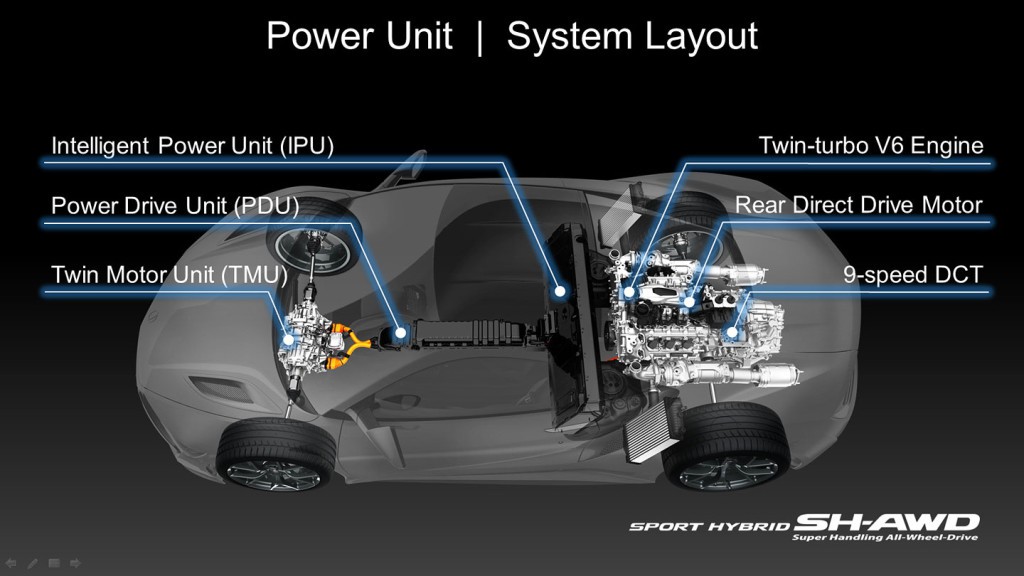
The new NSX will have a 3.5-litre twin-turbo V6 engine positioned ahead of the rear axle. Its output of 373 kW is available from 6,500 rpm up to the 7,500 rpm redline. Torque does not drop below 550 Nm between 2,000 and 6,000 rpm, which sounds like very interesting figures worthy of a fitting successor to the original legend. The engine also features both direct and indirect fuel injection, as well as VTC variable valve timing.
In addition to the combustion engine, the new NSX will also feature electric motors. Next to the V6 will be an electric motor with an output of 35 kW and torque of 148 Nm, tasked with eliminating turbo lag and, together with the V6, driving the rear axle through a nine-speed paddle-shift transmission.
The remaining two electric motors are located on the front axle – the new NSX will therefore be all-wheel drive, with the option of purely electric driving. They have an output of 27 kW and torque of 73 Nm. These electric motors can recharge the batteries located in the centre tunnel and behind the seats (which Honda says give it the lowest centre of gravity in its class), or assist the car with traction and torque vectoring to achieve maximum driving performance. Honda states that the vehicle will accelerate from 0 to 100 km/h in just over 3 seconds and exceed 300 km/h, as the total powertrain output is 428 kW – the question is whether Honda is also preparing a more hardcore Type R or plug-in version.
To keep production costs within reasonable limits, the vehicle’s frame and body are made of aluminium with limited use of composite materials. As a result, compared with the BMW i8, in which carbon fibre predominates, the NSX looks like a paperweight – it weighs 1,725 kg, although this is also due to its far larger engine than the i8’s. As the Nissan GT-R shows, however, greater weight need not be a major obstacle.
While driving, the driver can choose from four IDS (Integrated Dynamics System) modes: purely electric or hybrid „Quiet“ mode with limited performance and a muted exhaust, Sport, Sport+, or the track-oriented Track setting with Launch Control.
Potential competition
Design is a matter of opinion, but the good news is that in the sports car segment around 4 million koruna, buyers can choose from the sharply styled Audi R8, Acura NSX and BMW i8, the traditional icons Porsche 911 and BMW M4; it all depends on the customer’s taste and image.
If the aim of the purchase is brutal performance and an aggressive image, however, the GT-R probably has no cheaper rival. For image, the Mercedes-AMG GT or Jaguar F-Type V8 are also interesting choices, while road tests may shed light on the NSX’s merits (apart from the brand’s prestige in North America).
Translation disclaimer
This article is a machine translation of the Czech original and has not yet been fully reviewed. In case of any doubt, please refer to the Czech version.
Sdílejte článek prostřednictvím:
You might also like
20 October 2026, 12:55
20 October 2026, 10:49
20 October 2026, 06:13