20 October 2026, 15:34
Loading...
Hybrid systems for car propulsion
Tomáš Jirka
27 October 2015, 17:35
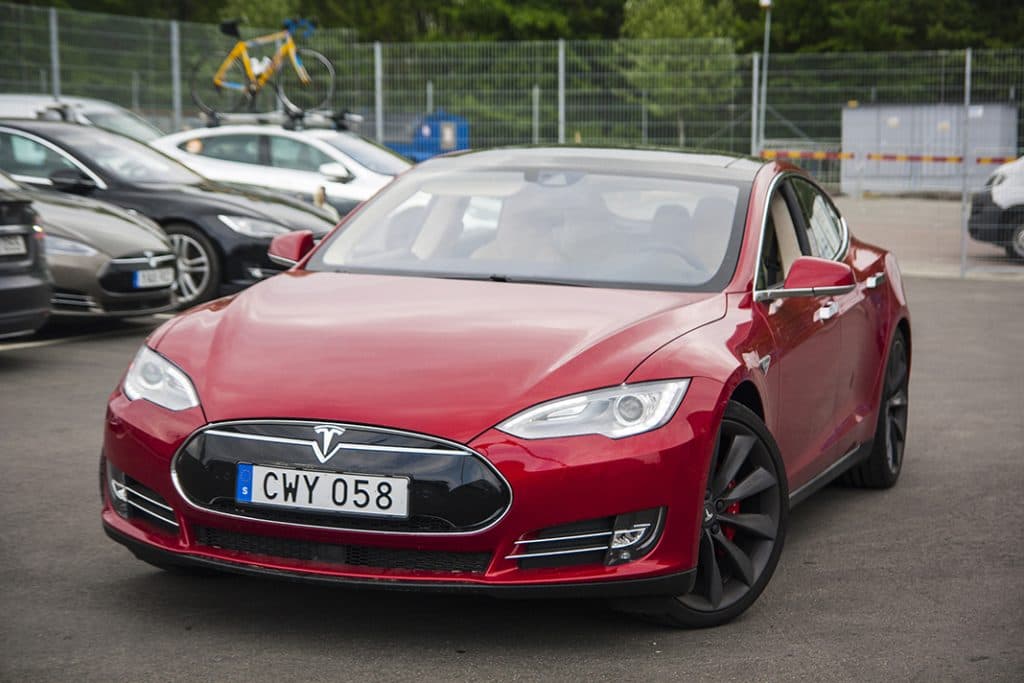
Hybrid propulsion in passenger cars today primarily means the most common combination of a conventional internal combustion engine with an electric motor and battery. However, there are various configurations of this arrangement, as well as other options for storing energy for subsequent use.
The internal combustion engine has a huge advantage in the energy density stored in its fuel, which can be replenished very quickly and is widely available. However, the energy it expends cannot be recuperated, which is why variously advantageous and successful combinations of an internal combustion engine with another drive system have emerged. Their aim is to reduce vehicle consumption, particularly in stop-and-go (urban) traffic, where substantial energy is used to set the vehicle in motion and is then dissipated as heat and brake wear during deceleration – it is beneficial to recuperate this energy and use it for subsequent acceleration.
Outside the passenger car segment, hybrid powertrains can be found in public transport, in trolleybuses or trams that can be powered from overhead lines as well as by a battery or backup diesel generator, in diesel-electric locomotives, and in heavy machinery such as dump trucks in quarries.
History of hybrid cars
Beginnings in the 20th century
Hybrid cars are not a new development, as might seem at first glance. At the dawn of motoring, electric motors led the way because internal combustion engines were difficult to control and start, but they had one major problem: battery capacity.
The first hybrid was a car called the Mixte, developed in 1898 by Ferdinand Porsche in cooperation with the Lohner factory. It was driven by electric motors, but its energy source was an internal combustion engine that turned a dynamo and charged the batteries. The car became a major sensation at the 1900 World Exposition in Paris.
Over time, as oil became cheaper, internal combustion engines overwhelmed all alternatives in passenger cars for a long period, until the end of the 20th century, when carmakers began taking an interest in other approaches again.
One interesting example is the Audi Duo of the late 1980s, which was based on the 100 Avant model. Its rear wheels were driven by a 13 hp electric motor, while the front wheels were independently driven by a 2.3-litre five-cylinder engine. Due to its heavy Ni-Cd batteries, the vehicle consumed more fuel than a conventional car, and neither of its next two generations (the third generation was already based on the Audi A4 B4) proved successful.
The Toyota Prius revolution at the turn of the millennium
In 1997, Toyota launched its hybrid Prius model, partly at the request of the Japanese government. Honda also responded with the Insight model, which did not achieve such spectacular success but remains in the carmaker's line-up to this day (it is now a four-seat liftback; the first generation was an aerodynamic two-seat hatchback, whose spiritual successor is now the CR-Z).
The first generation Prius was initially available only in Japan. Given its success, it was introduced to other global markets in 2000.
In 2003, the second generation arrived on the market. Toyota also focused on aerodynamics (the drag coefficient reached an excellent 0.26 at the time), creating the now very familiar silhouette of this lower-medium-class liftback. One million units had been sold by 2008, and Toyota began offering its hybrid system, called HSD (Hybrid Synergy Drive), in many of its models, including those of its luxury Lexus division (where it is called Lexus Hybrid Drive).
In 2009, the third generation came to market, immediately winning the Car of the Year title in Japan. In 2011, it also gained MPV and hatchback body styles, followed in 2014 by the much-anticipated plug-in hybrid version.
By 2015, when the fourth generation reached the market, more than 5.2 million models from the Prius family had been sold worldwide, accounting for more than 60% of Toyota's total hybrid sales. The Prius became a global symbol of hybrid cars.
Widespread adoption of hybrids and supercars
Today, almost all global carmakers offer hybrid versions of their models, with the main aim of reducing local emissions in cities, where low-emission zones are appearing in urban centres.
The main idea is that a vehicle can run purely on electricity in the city – it does not reach high speeds and distances travelled are short. It brakes frequently, allowing energy expended in this way to be recovered into the battery. This can result in relatively low electricity consumption for moving the vehicle, as some of the energy used for acceleration can be used again. Moreover, acceleration would otherwise cause further losses – in the clutch or torque converter, and through inefficient engine operating modes.
Outside the city, where traffic is much smoother and regenerative braking would not produce significant energy savings, the internal combustion engine operates. Its gearbox can be designed specifically for this purpose (with long gear ratios), but the electric motor can also assist in inefficient operating modes of the internal combustion engine, so that, for example, there is no need to close the throttle valve.
Another option is to use electric drive for short trips, as the average weekly mileage in Europe is just under 400 km. It is therefore possible to make most journeys using electric drive (combined with a battery capacity sufficient for, for example, 100 km of driving) and start the internal combustion engine only for the occasional longer journey, ideally with it operating solely as a generator in a series hybrid.
A special category in recent years has been hybrid supercars. Their goal is not the lowest possible fuel consumption, but an advantageous combination of the responsiveness and range of an internal combustion engine with the high, instantly available torque of an electric motor. These include the “holy trinity” (the McLaren P1, LaFerrari and Porsche 918), the forthcoming Koenigsegg Regera and, with a little generosity, the BMW i8 we tested.
Classification of hybrids by configuration
Series hybrid
A series hybrid car powertrain resembles a purely electric vehicle in many ways. Its axle (or axles, or each wheel separately if the vehicle is fitted with in-wheel electric motors) is driven solely by an electric motor, which has a better torque curve and speed range than an internal combustion engine, meaning no gearbox is needed.
In this case, the internal combustion engine serves only as a generator that recharges the batteries. This makes it possible to size it for operation at constant speeds, where it can run at high efficiency, or to use technical solutions that would not be suitable for normal use – for example, Audi's 2010 A1 e-tron concept used a Wankel rotary engine; its internal combustion engine and generator weighed around 70 kg, a relatively low figure compared with a sufficiently large battery (range of 350 km).
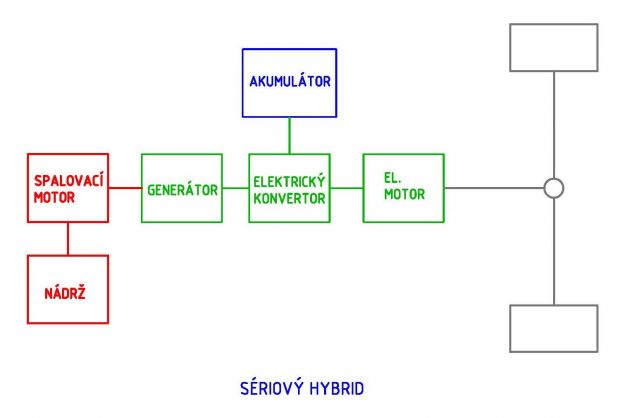
Because this internal combustion engine can be designed without requiring high responsiveness, it can be relatively small and simple, with enough output to cover, for example, driving at a steady motorway speed – on long journeys where battery capacity is no longer sufficient. In this case, however, the overall energy conversion is somewhat less advantageous, as neither the generator nor battery charging achieves 100% efficiency.
These vehicles are often referred to as REVs – electric vehicles with a range extender – such as the BMW i3 REX and other forthcoming BMW cars. They are often cited as a near-future solution because they combine the advantages of electric drive and an energy storage system with the ability to refuel quickly, as in vehicles with internal combustion engines, while the combustion engine does not add as much weight as large-capacity batteries.
Series hybrids available on the market include: BMW i3 REX, Chevrolet Volt / Opel Ampera, Fisker Karma.
Parallel hybrid
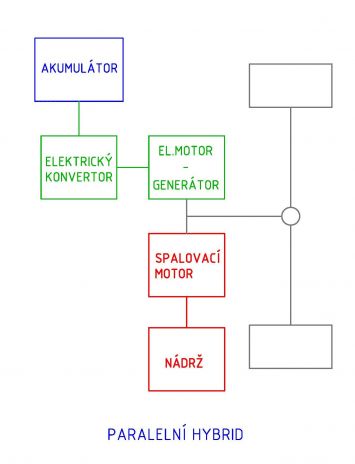
Most hybrids sold today are parallel hybrids. Electronics determine which engine runs when and how, while total output is the sum of their current outputs. The two engines do not always have to run simultaneously – this group is then referred to as series-parallel hybrids, where each engine can operate independently in certain modes, with both directly driving the axle to which they are mechanically connected.
An interesting feature of these vehicles is the ability to drive each axle with a different type of powertrain, thus providing all-wheel drive without a mechanical connection between the axles. Naturally, however, this does not deliver either sporty or off-road driving characteristics. An example is the PSA Group's Hybrid4 models.
Classification of hybrids (HEVs) by output
Micro-hybrid
Micro-hybrid cars are now entirely commonplace – they are simply an enhanced Stop&Start system that switches off the engine at low speed before the car comes to a complete stop, often combined with a capacitor that subsequently assists with restarting the internal combustion engine. Their main purpose was to meet the NEDC standard during type approval, but they do not bring major improvements in terms of vehicle fuel consumption. The term was first used by the French PSA Group for its e-HDi diesel models, and Mazda also uses it today.
Mild (assisted) hybrid
Mild hybrids have an electric motor capable of operating both as a motor and as a generator, but it has low output and cannot propel the car independently for an extended period.
It is usually located between the engine and the gearbox, and its purpose is to assist the internal combustion engine during acceleration or overtaking, or when the combustion engine would not be operating in its ideal range.
An example of this system is Honda's IMA (Integrated Motor Assist).
Full and plug-in (PHEV) hybrids
Full hybrid cars are already capable of purely electric operation, with batteries sized for several tens of kilometres in order to cover the most common urban journeys. They can therefore be operated using either the electric motor or the internal combustion engine, depending on current needs and the advantages of each solution. Toyota uses this type of propulsion in its HSD system, and it was a competitive advantage of the Prius from the very beginning – it could drive purely on electricity.
An important category of plug-in hybrid vehicles subsequently developed from these. They can be connected to a power socket and their battery can be charged by means other than just the internal combustion engine or regenerative braking. These vehicles can then operate purely on electricity for longer periods, with their usefulness depending on how the vehicle is used. In electric mode, the maximum speed is usually limited, and the internal combustion engine starts immediately when high power is required.
Plug-in hybrid variants currently make the most sense, which is why carmakers are focusing on them. Plug-in hybrid versions available on the market include the Toyota Prius Plug-in Hybrid, Mitsubishi Outlander PHEV, Volkswagen Golf and Passat GTE, Audi A3 and Q7 e-tron, Volvo V60 and XC90 Plug-in, and BMW i8; certain BMW (Mini), Mercedes, Cadillac, Hyundai and Kia models, as well as the Škoda Superb III, are also planned.
Diesel hybrids
The category of diesel hybrids emerged relatively recently. It developed later because most hybrid cars targeted the US or Japanese markets, where they were popular and diesel engines had minimal appeal.
As emissions standards have tightened and perceptions of conventional cars have changed in Europe, the range of these cars has also expanded here. It is therefore possible to buy the diesel Citroën DS5 Hybrid4, Peugeot 3008 Hybrid4, Peugeot 508 Hybrid4 and RXH, Volvo V60, and futuristic Volkswagen XL1. The Audi Q7 e-tron, Kia Optima and Sportspace are also due shortly. One of the most interesting hybrids in this category is the multiple winner of the 24 Hours of Le Mans – the Audi R18 e-tron. Ordinary motorists cannot buy it, but Audi is using it to test near-future technologies.
Non-electric hybrid systems
In addition to widely used electric hybrids, there are also variants using an energy store other than an electrical one, usually a mechanical store.
Volvo KERS – flywheel energy storage
In 2013, Volvo put its KERS (Kinetic Energy Recovery System) into testing. The system was expected to reduce fuel consumption by up to 25%. Production cars could have appeared on the roads around 2020; a similar technology is currently deployed in several trolleybuses in Basel, Switzerland. The current status is unknown: road tests were under way in 2014, but Volvo now appears to be promising electric variants instead.
This is not the same KERS system as in Formula 1, where electrical energy is stored, but rather a system that stores mechanical energy in a flywheel, which can subsequently boost total vehicle propulsion output for a short period. According to the Swedish manufacturer, this flywheel would weigh only 6 kilograms, which is very little for a hybrid system.
Hydraulic hybrids
Due to their size, hydraulic hybrids were developed mainly for vans and trucks that stop frequently, such as UPS and other delivery vehicles. Companies working on them include Parker Hybrids and Lightning Hybrids in the US.
A hydraulic hybrid system works by activating a hydraulic pump when the vehicle brakes. The pump compresses air or nitrogen into a high-pressure tank, from which it can drive a hydraulic motor during acceleration as it transfers to a low-pressure tank. This can reduce fuel consumption by up to 50%, naturally depending on how the vehicle is used.
A major advantage of this system is its unlimited number of cycles, longer brake pad replacement intervals, reduced clutch wear, and the ability to retrofit it to vehicles using any type of fuel in a relatively short time.
In 2013, the PSA Group presented a similar vehicle concept using HybridAir technology at Geneva (short-term compressed-air propulsion, in which a hydraulic pump pressurises air in a tank and it is subsequently injected into the piston combustion chambers instead of conventional fuel during acceleration), saying that the first vehicles could enter service around 2016.
On 23 January 2015, development of this technology was suspended for financial reasons. This system can save up to 45% of fuel in urban operation – fuel savings similar to those of electric powertrains, but at lower cost, which would have made it possible to deploy the technology in the B and C segments as well.
Sources: baracudaj.blog.auto.cz
JIRKA, Tomáš. Alternative fuels for car propulsion. Czech Technical University in Prague 2015, Bachelor's thesis
NOVÁK, M. Hybrid powertrains for passenger vehicles. Brno University of Technology 2011: Bachelor's thesis
HRABAL, Martin. Hybrid powertrains for passenger cars. Mendel University in Brno 2011. Bachelor's thesis
Source of the lead image: Jbcarpages.com
Translation disclaimer
This article is a machine translation of the Czech original and has not yet been fully reviewed. In case of any doubt, please refer to the Czech version.
Sdílejte článek prostřednictvím:
You might also like


20 October 2026, 12:55
20 October 2026, 10:49

20 October 2026, 06:13