20 October 2026, 15:34
Loading...
Interesting hybrid and electric concepts at the 2016 Geneva Motor Show
Tomáš Jirka
23 March 2016, 17:12

The recently held Geneva Motor Show is well known for the participation of low-volume manufacturers and the display of future concepts, even though it is among the oldest motor shows (the first edition was held as early as 1905).
Although probably none of the following vehicles will enter production this year, they are certainly worth noting at the Palexpo exhibition centre, whether for their design or, in many cases, the technology used. You can read a separate article about the first model presented, the DS E-Tense; we present the others below in alphabetical order.
It should be added that none of the vehicles belongs to the grey mainstream output of conventional carmakers.
Arash: the bizarre AF8 and AF10 concept
The story of Arash Motor Company began back in 1999, albeit without much success, and essentially the only reason it was talked about was founder Arash Farboud's constant complaints that Ferrari would not sell him an Enzo. Arash therefore decided to build his own supercar, but as things did not work out, he sold the production rights to Farbio Sports Cars of Leeds, which began manufacturing the car as the F400 and updated it into the G60 model in 2010, which continues its own life.
Arash Farboud did not forget about his supercar, however, and reappeared in 2008 with plans to produce it using GM's 7.0 V8 engine, originally used in the Corvette. But until last year, there was no further news.
In 2014, Arash introduced the somewhat oddly shaped AF8 model, with a base price equivalent to around CZK 6 million and the aforementioned mid-mounted engine, producing 550 hp and 645 Nm of torque. Thanks to extensive use of carbon fibre, the vehicle weighs just 1,200 kg, allowing it to accelerate to 100 km/h in 3.5 seconds and exceed 320 km/h, which are certainly respectable figures. The updated AF8 Cassini model was on display in Geneva.
However, the carmaker itself does not consider this breathtaking, so it brought the AF10 concept, bearing the tagline „Spaceship technology“, to Geneva. Its turbocharged V8 alone produces a huge 913 hp and 1,200 Nm, working with either a six-speed manual or paddle-shift automatic transmission. It is hard to say whether anyone asked, „Isn't that a bit too little, Anton Pavlovich?“, but the carmaker decided to add another 4 electric motors (each delivering 220 kW and 270 Nm at a maximum 13,000 rpm), giving the AF10 a total output of an impressive 2,110 hp and 2,280 Nm of torque.
It accelerates to 100 km/h in 2.8 seconds, which is no longer an entirely unusual figure. This may be due to the use of a 32kWh battery, which certainly will not be the lightest (there is no information on the hybrid system layout), or an effort to provide a luxurious interior and hydraulic suspension. This allows the ride height to be set up to 15 cm, which does little to help the low weight, though the promised Race version, complete with a roll cage, could address that.
The resulting price, equivalent to almost CZK 40 million for a car with such performance and an all-carbon monocoque, is no great surprise, but the question is whether potential customers will trust this carmaker.
Italdesign: GTZero shooting brake
One of the most famous Italian coachbuilders of the 20th century is going through difficult times, partly because of falling demand for its design work and the creation of unique sports cars that were so popular in the last century, but also because GiorgettoGiugiaro, who founded the studio in the 1960s, has left.
He was replaced by another Italian from Lamborghini, FilippoPerini, thanks to former Volkswagen Group chief designer Walter da Silva. Perini spent 10 years at Lamborghini and before that was at Alfa Romeo.
This is also why part of the audience is dissatisfied, as the GTZero does not bear the classic hallmarks of Italdesign. However, it certainly cannot be said that this bright orange shooting brake looks dull or ugly. Its front end may evoke Lamborghini styling for some, but the vehicle rather offers references to older models from the Italian studio: the Alfa Romeo Scighera, Daewoo Bucrane, Bizzarrini Manta and Ferrari GG50.
The shootingbrake category itself is relatively rare; currently only the Ferrari FF can be bought, although it was more popular in the past and many British manufacturers and Volvo produced shooting brakes. This particular car is made entirely of carbon fibre, and its upward-opening gullwing-style doors (the gullwing from Mercedes and McLaren F1) are probably among the largest of their type.
A non-running mock-up was displayed in Geneva, but the plan is to install two electric motors at the front and one at the rear, along with four-wheel steering. The electric motors should provide 360 kW, with a calculated range of around 500 km, though battery capacity was not stated. Based on Tesla's experience, they would need capacity of more than 100 kWh, most likely located once again in the floor and „central tunnel“.
An interesting feature of the 2+2 interior is the number of buttons: just 2, one being the handbrake and the other the start button. Everything else is controlled using touchscreens on a huge display reminiscent of Tesla interiors. Interestingly, even selecting forward or reverse is controlled via this screen.
Production is highly uncertain, but following the example of the Ferrari FF, it appears that wealthy, active people are once again keen to buy a shooting-brake-bodied vehicle, provided they do not yet need rear seats and child seats, and provided they do not have a chauffeur and enjoy driving. Moreover, Italdesign's prestige is by no means small, so its price could easily exceed normal figures.
Morgan: EV3 three-wheeler
Morgan is one of the most conservative British manufacturers, still adhering to design from the first half of the twentieth century and building cars precisely for true gentlemen.
Nevertheless, its 3-Wheeler received an electric version in Geneva, which is even 25 kg lighter than the conventional V-twin version that impressed, for example, Richard Hammond of TopGear. It is not the fastest (offering 82 hp at a weight of 525 kg), but it certainly offers plenty of style and fun, partly because the driver protrudes substantially from it, as in racing cars of the 1930s, and also because they are essentially sitting on the tarmac in a three-wheeler with one driven wheel and two narrow front wheels that strikingly resemble bicycle wheels.
The electric motor produces 40 kW, allowing the EV3 to reach 100 km/h in 9 seconds and a top speed of 145 km/h, which the driver and any passenger will enjoy to the full thanks to the absence of a windscreen. The batteries should be enough for 240 km, but potential customers will learn the exact figures only after completion of the final testing phase of the car, which is expected to reach the market in autumn 2016.
For around CZK 900,000, buyers can get incredible style and a hint of old times, with three halogen headlights and a very elegant cockpit with two gauges that, behind the enormous steering wheel, display only range and speed, while between them is an unusual lever for selecting forward or reverse that resembles old school ammeters ????
Pininfarina: semi-roadgoing H2Speed racer
Another Italian design studio arrived in Geneva with a concept halfway between a racing special and a supercar. The H2Speed, which, as its name suggests, is powered by fuel cells and reportedly may not remain merely a concept if customer interest is sufficient.
Its shapes recall the 1969 Sigma Grand Prix racing concept and prototypes for Le Mans and other endurance races; in other words, aerodynamics took centre stage.
Compared with the similarly focused Arash, it is significantly lighter – weighing 1,420 kg, despite being a 4.7-metre-long and 2-metre-wide car just 1,087 mm high. This may be due to the absence of a clutch, gearbox and differentials, but also the absence of a large, heavy battery and the use of a carbon chassis. Even so, its weight distribution is fairly atypical for racing specials – 41:59.
To reduce weight, 19- and 20-inch OZ Racing Ultraleggera HLT Central Lock wheels were designed specifically for the H2Speed.
Propulsion comes from two permanent-magnet synchronous electric motors (maximum speed: 13,000 rpm) with combined output of 370 kW, which can propel the white supercar to 100 km/h in 3.4 seconds and to a top speed of more than 300 km/h. Naturally, it also features torque vectoring, carbon-ceramic brakes and brake-energy recuperation.
Another interesting figure is its standing-start 400 m time: 11 seconds, meaning it is the fastest fuel-cell-powered vehicle on the planet, although against the Toyota Mirai, Honda Clarity and Hyundai Tucson FC, this is not a particularly difficult contest.
The energy source is an 8kWh battery and hydrogen fuel cells manufactured by Swiss company GreenGT, capable of delivering up to 210 kW, though without details of total capacity or therefore range. This makes it the only racing special whose exhaust emits only water and air.
Production is not yet certain, and detractors mock the H2Speed because they believe it is not only the first but also the last fuel-cell racing vehicle. The near future will show whether customers are interested and whether it will actually be produced.
Rimac: production One and the even more powerful Concept_S
Croatia's Rimac is already an established brand, and its cars certainly cannot be denied a certain degree of interest, whether you prefer Lamborghini or Ferrari design. Even more interesting are the driving figures of these supercars, for which the term „electric Veyron“ has caught on, although Mat Rimac works with Christian von Koenigsegg rather than the Volkswagen Group.
The Rimac One, of which only 8 units will be made at a price of $1 million, was recently unveiled in production form, and the first unit will be handed over to its customer at the Geneva Motor Show.
Thanks to four electric motors with combined output of 800 kW and 1,600 Nm of torque, it can accelerate from 0 to 100 km/h in 2.6 seconds, to 200 km/h in 6.2 seconds and to 300 km/h in 14.2 seconds. Each electric motor drives one wheel, which is also the reason for Rimac All Wheel Torque Vectoring – comprehensive torque vectoring. Its top speed is 355 km/h, while the vehicle has retained a relatively conservative and elegant appearance.
Carbon-ceramic brakes and a permanent 4G connection, as used by Tesla, are standard. The battery, located between and behind the seats, has a capacity of 82 kWh, which also accounts for the high weight of 1,850 kg, but the car still has almost 600 hp per tonne, on a par with the banned Group B rally specials! The standard onboard charger is 22kW, while the Combo connector for charging from DC stations has a maximum of 120 kW, although the most powerful current stations offer only 50 kW. However, 100kW units are being prepared, so Rimac is apparently thinking further ahead, and we can hope that this technology will find its way into more ordinary vehicles as well.
Rimac also brought another version of this supercar: the even faster Rimac Concept_S, with output of 1,018 kW and maximum torque of 1,800 Nm, comfortably surpassing many a bus. Its high output allows the car to accelerate from 0 to 100 km/h in 2.5 seconds, to 200 km/h in 5.6 seconds and to 300 km/h in 13.1 seconds; the speedometer „needle“ stops only at 365 km/h.
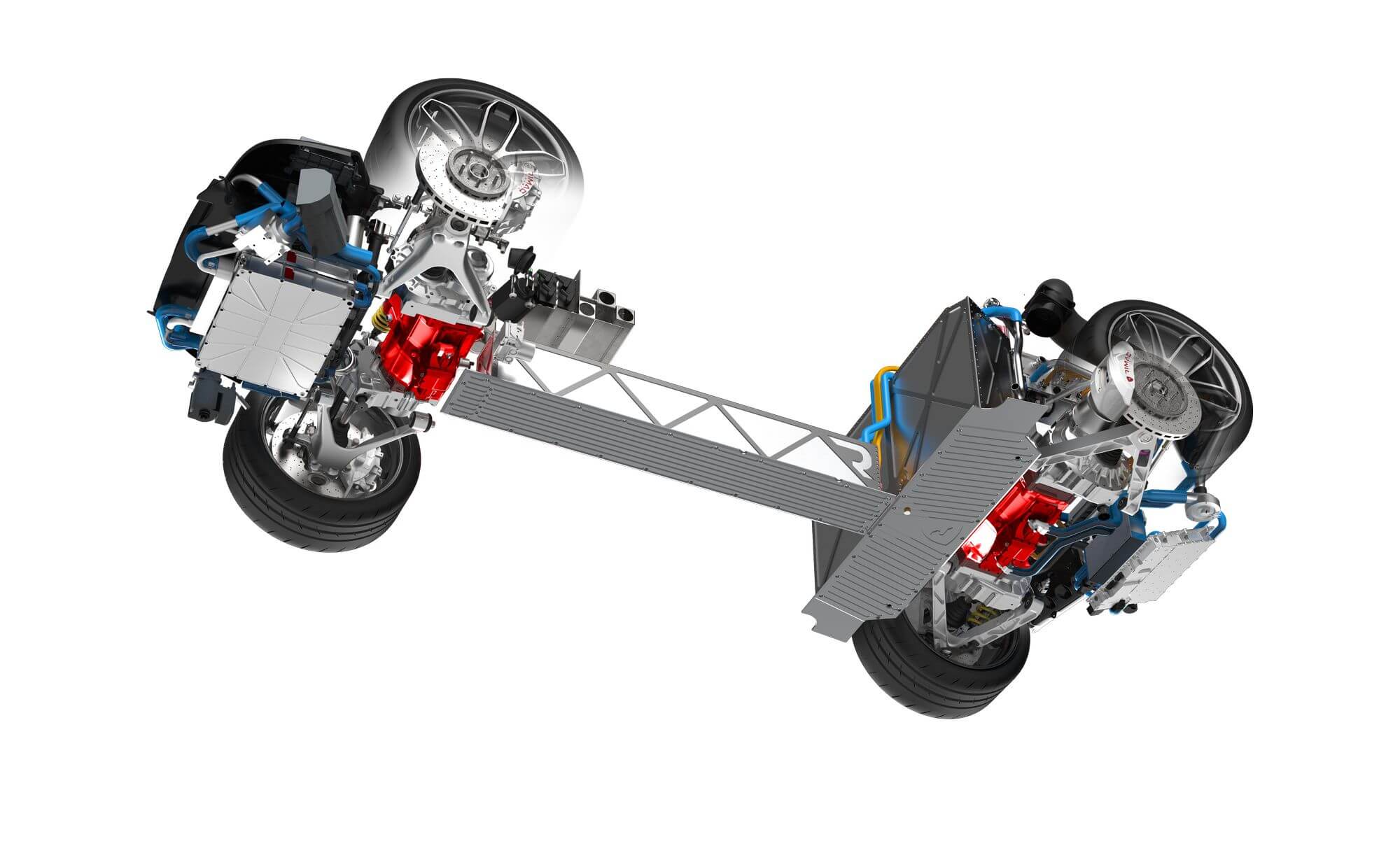
Thanks to experience from hillclimb races at PikesPeak, the car's aerodynamics have been significantly improved while its weight has been reduced by 50 kg. This is partly due to the absence of sound insulation, as it is no longer a super-luxury GT but rather a racing machine, also capable of recording driving telemetry and sending the data directly to mechanics in the pits.
The only question remaining is whether it will actually be produced and whether its price might exceed EUR 1 million?
Techrules: turbine-powered AT96 and GT96 TREV
A Chinese „carmaker“ that nobody had heard of until now presented no fewer than two concepts in Geneva. Both supercars are powered by electric motors, but their interest lies elsewhere: their range extender is a turbine, and their claimed range is as much as 2,000 km!
The difference between the AT and GT is that A denotes aviation petrol, while G denotes natural gas, both of which are burned in the (micro)turbine of the TREV (Turbine-Recharging Electric Vehicle) powertrain. It is therefore a series hybrid, like a BMW i3 REX on steroids, but with even more incredible consumption, as the manufacturer claims 0.18 litres per 100 km, almost giving the impression of a misplaced decimal point. Techrules adds, however, that this is a figure from the test cycle in plug-in hybrid mode and that reality will differ, though it will still be interesting: it claims 4.8 litres per 100 km if the batteries are charged by the TREV system, though this certainly does not represent driving at full power.
Given that testing began in February at Britain's Silverstone, hopefully more realistic figures will be known soon. Techrules plans to begin selling the vehicles within a few years and to build a more conventional, smaller variant somewhat later.
The idea of using a turbine to power a car is not new; the last such car was the Jaguar C-X75, but no automobile has yet chosen this type of propulsion for environmental reasons, and none has reached the market with it. The main reasons were the engine's noise and complexity, as well as the fact that its speed is very difficult to regulate, which is not necessary here. Its high efficiency, which naturally attracts designers, can therefore be fully exploited without the problem of regulating speed, as the turbine is not directly connected to the wheels.
The TREV system is a perfect combination of micro turbine and electric vehicle technologies. It is highly efficient, produces very low emissions and provides an optimal charging solution for electric vehicles.
William Jin, founder and CEO of Techrules
Rather unexpectedly, Techrules even has 6 electric motors: there are two on each rear wheel for a better power-to-packaging-volume ratio. Their combined output is 770 kW and maximum torque an astonishing 8,640 Nm, giving the 1,380 kg car (Techrules would like to get production dry weight down to around 1 tonne) appropriate performance: 0-100 km/h in under 2.5 seconds and a top speed above 350 km/h.
The energy source is a 20kWh battery, which can be charged by a turbine with maximum output of 30 kW and which is certainly not technically uninteresting. Thanks to magnetic bearings, it can reach up to 96,000 rpm without being damaged by shocks from the road, while also achieving high efficiency.
According to the carmaker, another advantage is that no additional new infrastructure needs to be built, unlike for hydrogen-powered vehicles or EVs, as well as the possibility of using a range of other fuels.
Although it is a supercar with a likely price tag in the tens of millions of Czech crowns, its hybrid technology is certainly interesting and could kick-start an interesting evolution of production plug-in hybrids with high efficiency from their auxiliary generator.
Translation disclaimer
This article is a machine translation of the Czech original and has not yet been fully reviewed. In case of any doubt, please refer to the Czech version.
Sdílejte článek prostřednictvím:
You might also like


20 October 2026, 12:55
20 October 2026, 10:49
20 October 2026, 06:13